Across an increasingly wide range of industries, small groups of “superstar” companies are successfully adopting new technologies and either passing the productivity gains on to customers – as lower prices – or pocketing them – as higher profits – rather than returning the full gains to their workforce as higher wages.
At the same time, the productivity “laggards” are losing market share and are unable to pay higher wages.
That’s the explanation of low wages growth advanced by a new paper written by leading independent economist Geoff Weir during a six-month unpaid research fellowship at the Reserve Bank.
This is called “monopsony”. It’s a market condition in which there is only one buyer. It is probably contributing to wage pressures in the Western world, especially the US where such firms are dominant.
But the larger question is not about such “superstar” companies. It is why do broader labour forces have no pricing power? These firms are not so powerful that they can, on their own, determine wage outcomes for the wider market. That’s especially so in Australia where firms such as Amazon have virtually no footprint.
Advertisement
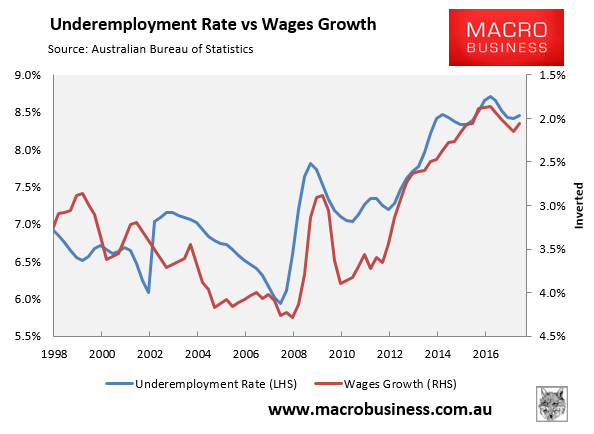
The issue is far more basic. The Australian labour market is simply too loose. If it were tight then there’d be wage rises capitalising on the productivity gains. While it is loose then that won’t happen. It’s called “economics”:
Why is the labour market loose? A few reasons:
Advertisement
the post-mining boom economy is still too uncompetitive to deliver external sector gains;
the private sector is increasingly deleveraging opening a hole in aggregate demand;
public sector dissaving is not large enough to fill it.
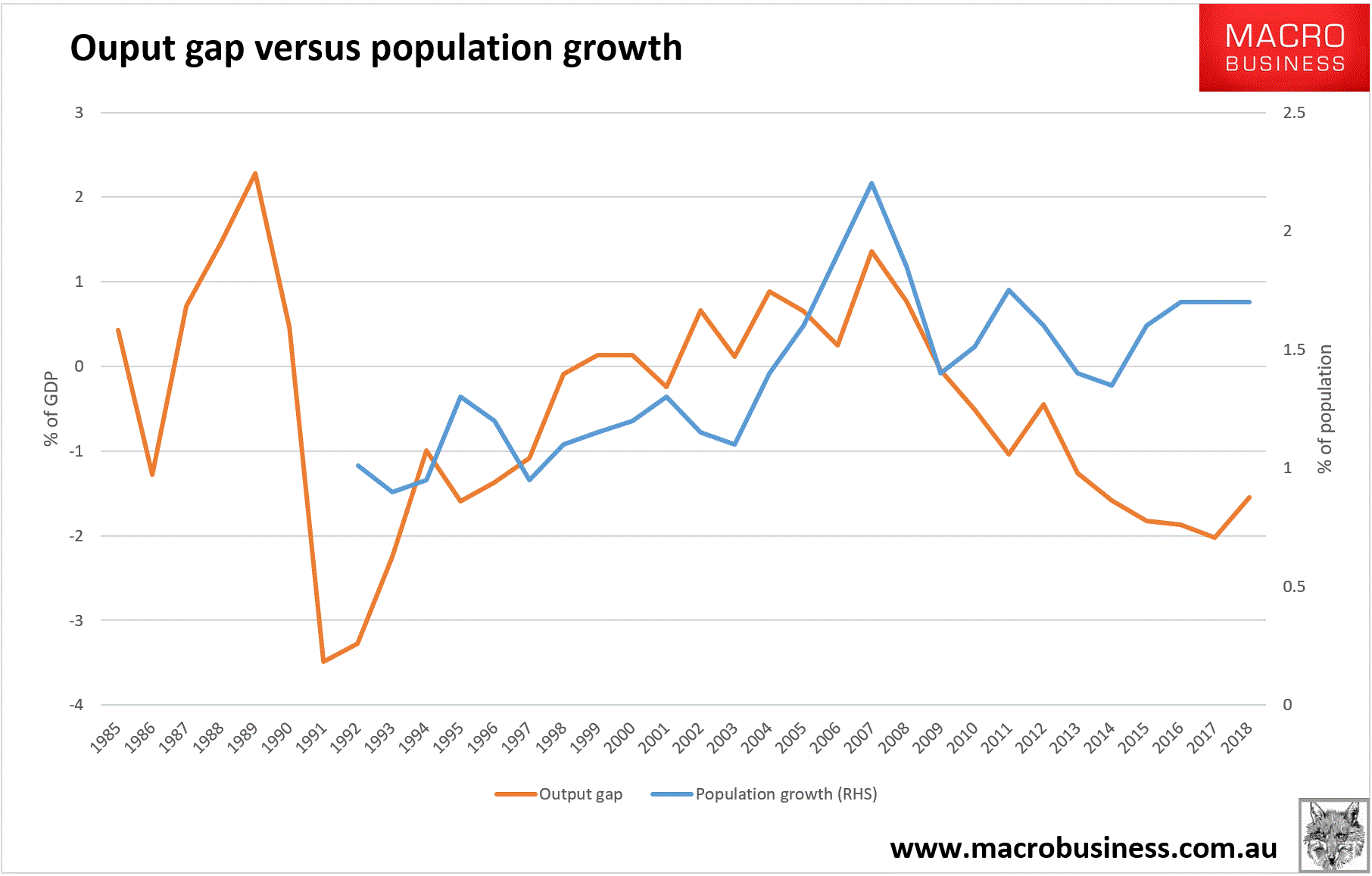
And into this mix of excess capacity we are pouring 240k migrants per annum, a roughly 2% supply shock every single year which has savaged industrial relations:
For years we have seen Dominos, Caltex, 7-Eleven, Woolworths and many other fast food franchises busted for rorting migrant labour.
The issue culminated in 2016 when the Senate Education and Employment References Committee released a scathing report entitled A National Disgrace: The Exploitation of Temporary Work Visa Holders, which documented systemic abuses of Australia’s temporary visa system for foreign workers.
Mid last year, ABC’s 7.30 Report ran a disturbing expose on the modern day slavery occurring across Australia.
Meanwhile, Fair Work Ombudsman (FWO), Natalie James, told Fairfax in August last year that people on visas continue to be exploited at an alarming rate, particularly those with limited English-language skills. It was also revealed that foreign workers are involved in more than three-quarters of legal cases initiated by the FWO against unscrupulous employers.
Then The ABC reported that Australia’s horticulture industry is at the centre of yet another migrant slave scandal, according to an Australian Parliamentary Inquiry into the issue.
The same Parliamentary Inquiry was told by an undercover Malaysian journalist that foreign workers in Victoria were “brainwashed” and trapped in debt to keep them on farms.
A recent UNSW Sydney and UTS survey painted the most damning picture of all, reporting that wages theft is endemic among international students, backpackers and other temporary migrants.
A few months ago, Fair Work warned that most of Western Sydney had become a virtual special economic zone in which two-thirds of businesses were underpaying workers, with the worst offenders being high-migrant areas.
Dr Bob Birrell from the Australian Population Research Institutelatest report, based on 2016 Census data, revealed that most recently arrived skilled migrants (i.e. arrived between 2011 and 2016) cannot find professional jobs, with only 24% of skilled migrants from Non-English-Speaking-Countries (who comprise 84% of the total skilled migrant intake) employed as professionals as of 2016, compared with 50% of skilled migrants from Main English-Speaking-Countries and 58% of the same aged Australian-born graduates. These results accord with a recent survey from the Bankwest Curtin Economics Centre, which found that 53% of skilled migrants in Western Australia said they are working in lower skilled jobs than before they arrived, with underemployment also rife.
The Australian Bureau of Statistics (ABS) latest Characteristics of Recent Migrants report, revealed that migrants have generally worse labour market outcomes than the Australian born population, with recent migrants and temporary residents having an unemployment rate of 7.4% versus 5.4% for the Australian born population, and lower labour force participation (69.8%) than the Australian born population (70.2%).
ABC Radio recently highlighted the absurdity of Australia’s ‘skilled’ migration program in which skilled migrants have grown increasingly frustrated at not being able to gain work in Australia despite leaving their homelands to fill so-called ‘skills shortages’. As a result, they are now demanding that taxpayers provide government-sponsored internships to help skilled migrants gain local experience, and a chance to work in their chosen field.
In early 2018 the senate launched the”The operation and effectiveness of the Franchising Code of Conduct” owing in part to systematic abuse of migrant labour.
Then there is new research from the University of Sydney documenting the complete corruption of the temporary visas system, and arguing that Australia running a “de-facto low-skilled immigration policy” (also discussed here at the ABC).
In late June the government released new laws to combat modern slavery which, bizarrely, imposed zero punishment for enslaving coolies.
Over the past few weeks we’ve witnessed widespread visa rorting across cafes and restaurants, including among high end establishments like the Rockpool Group.
Alan Fels, head of the Migrant Workers Taskforce, revealed that international students are systematically exploited particularly by bosses of the same ethnicity.
There is no mystery to weak wages:
Advertisement
If Jess Irvine gave two hoots about it she’d stop making it worse by constantly arguing for more mass immigration. Even her primary source is slowly waking up. A recent speech speech on inflation by RBA Assistant Governor Guy Debelle contained the short but important admission that immigration is holding down wages [my emphasis]:
The Bank’s forecast is that, as the labour market continues to tighten, wages growth should gradually pick up, and along with that we would expect market services inflation to also increase. However, as we have noted on a number of occasions, there is considerable uncertainty about the extent of unutilised capacity in the labour market and how quickly a reduction in spare capacity would translate into higher wage and price inflation. It is possible that the unemployment rate could fall faster than expected and wages growth could pick up more strongly as a result. Alternatively, it is possible that the flow of new workers into the labour force could continue to be stronger than usual, so that unemployment declines more slowly than we expect and wage pressures could take longer to emerge.
Clearly, the primary driver of “the flow of new workers into the labour force”, which has caused unemployment to “decline more slowly” and caused “wage pressures… [to] take longer to emerge” is immigration.
Advertisement
When you add 200,000-plus migrants to the economy every year, most with work rights, then it represents a positive rolling labour supply shock which must be absorbed.
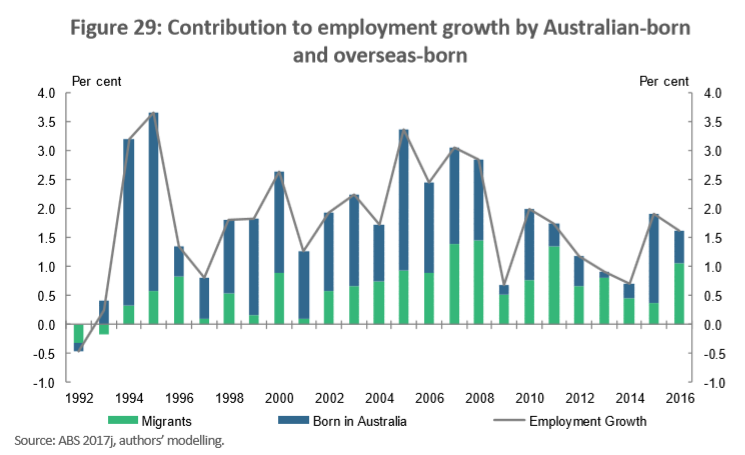
Treasury’s propaganda report admitted that most new jobs created in Australia have gone to migrants:
Recent migrants accounted for two-thirds (64.5 per cent) of the approximately 850,000 net jobs created in the past five years. For full-time employment, the impact is even more pronounced, with recent migrants accounting for 72.4 per cent of new jobs created.
Advertisement
Various Productivity Commission modelling has also shown that immigration lowers the wages of incumbent workers (see here). These results were confirmed recently by modelling from Victoria University (see here). Several notable Australian economists have noted similar.
International analysis from the Bank of England and Cambridge University also shows that immigration reduces wages growth (see here).
Again, the economics is simple: continually increasing labour supply via immigration necessarily reduces workers’ bargaining power and ergo wages growth. Knowing this, over history Australian policymakers have used immigration to compliment booms in the economy by alleviating skill shortages and capping wages. The current crop tried instead to turn the flood of people into the boom with entirely predictable results.
Advertisement
This debate is over. Jess Irvine and the RBA lost it. Community support for mass immigration has collapsed. Time to change the script.
David Llewellyn-Smith is Chief Strategist at the MB Fund and MB Super. David is the founding publisher and editor of MacroBusiness and was the founding publisher and global economy editor of The Diplomat, the Asia Pacific's leading geo-politics and economics portal.
He is also a former gold trader and economic commentator at The Sydney Morning Herald, The Age, the ABC and Business Spectator. He is the co-author of The Great Crash of 2008 with Ross Garnaut and was the editor of the second Garnaut Climate Change Review.