
In the wake of today’s poor dwelling approvals figures, which registered sharp declines in both detached house and unit approvals, the Housing Industry Association (HIA) has yet again called for action on housing supply:
“Towards the end of 2015, the residential building industry was hit by a number of unfavourable developments. The major banks increased their mortgage interest rates, credit conditions were tightened for domestic investors and the $5,000 foreign investor fee came into force. This has made it more difficult to deliver new housing supply and today’s figures seem to bear this out,” Shane Garrett pointed out.
“The HIA’s Housing Australia’s Future report warned last week of the major challenges in meeting Australia’s housing needs over the coming decades. It is therefore vital that policy settings and credit conditions become more focused on the consistent delivery of the required volume of new housing supply over the long term. We’re just not seeing this at the moment,” concluded Shane Garrett.
This comes on the back of the HIA’s lobbying against Labor’s proposed changes to negative gearing and the capital gains tax (CGT) discount:
“[The] announcement by the Opposition that it intends to halve the capital gains discount on investment properties will, in our view, not achieve these objectives”.
“… restricting access to negative gearing for residential property would reduce investment in housing, erode housing affordability and put upward pressure on rents”…
“Now is a pivotal time for investment in new housing, which has implications for affordability and the broader economy, with starts expected to decline over the year ahead. Any changes to taxation with respect to housing must be aimed at boosting housing supply, and reducing the overall tax burden on the sector.”
While I obviously agree with the HIA’s position on the need for more affordable and flexible land/housing supply, its latest rant does yet again highlight the ridiculousness of its staunch opposition to Labor’s property tax reforms.
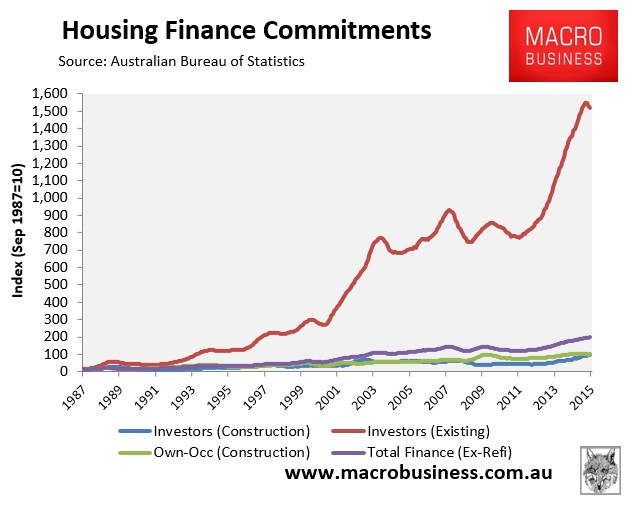
As shown in the next chart, investment in existing dwellings has literally exploded since negative gearing was reinstated in 1987, followed by the halving of CGT in 1999. By contrast, investment in new dwelling construction – which is the supply that the HIA bemoans is far too low – has been poor (see next chart).
In fact, investment in new construction has been so poor that it has actually grown at a slower rate than owner-occupied construction lending since negative gearing was reinstated in 1987 (see next chart).
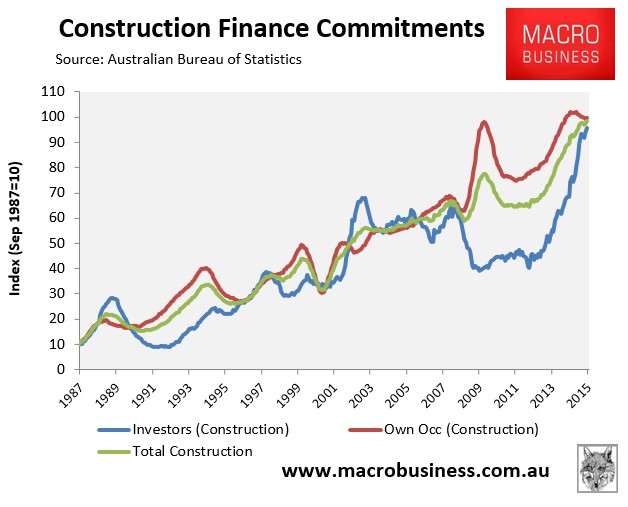
As shown above, every other form of finance has grown stronger since negative gearing was reinstated in 1987 than investor finance in new construction. Accordingly, negative gearing as it is currently structured has not worked to boost housing supply (possibly the opposite), and instead has merely substituted homes for sale into homes for let. In turn, negative gearing has not improved rental availability or affordability, and has merely boosted demand and put upward pressure on existing home prices.
By all measures, negative gearing and the CGT discount have been epic failures in achieving the HIA’s goal of boosting new construction, despite their large cost to the Budget.
So why, then, has the HIA run such a furious campaign against reforms to property tax concessions (e.g. see here, here, here, here, here, here, here and here), which continues today?
Here we have Labor proposing to restrict negative gearing to new homes, thus channeling investment into the exact thing that the HIA is lobbying for – new supply – and boosting jobs for its construction members. And still, the HIA remains staunchly opposed.
I can only speculate once more that the HIA cares more about protecting the value of its developer member land banks, rather than actually boosting dwelling construction. Otherwise, why would it go to such great lengths to oppose Labor’s ‘negative gearing for new homes’ policy?
unconventionaleconomist@hotmail.com
