The Albanese Government’s proposed $10 billion Housing Australia Future Fund (HAFF) aims to finance the construction of 30,000 social and affordable homes over five years.
In announcing the HAFF, Housing Minister Julie Collins declared the fund a “turning point” in Australian housing affordability.
“Housing problems are widespread and visible … the dream of a secure home has become harder”, Collins said.
“For too long these terrible stories have been ignored by the Australian government. Today is a turning point”.
“This fund will be the end of the housing one-offs from the Australian government”, she said.
Master Builders Australia CEO Denita Wawn has told a Senate committee that affordable housing is one of Australia’s biggest challenges, and has urged the Opposition and crossbenchers to support the HAFF.
She has also called for the size of the fund to be increased to $20 billion.
“Finding solutions to the issue of affordable housing is imperative as it poses one of the country’s biggest challenges, and we must work together to address it”, Wawn said.
“Master Builders forecasts new housing over the next five years will fall short of the 200,000 homes needed annually until 2026-27”.
“To meet the additional 800,000 dwellings needed by 2035, the size of the fund’s capital investment should be expanded from $10 billion to $20 billion”, she said.
Let’s cut the bull. Australia’s turbo-charged immigration is the primary driver of Australia’s chronic shortage of social housing.
The federal government dramatically lifted Australia’s immigration intake in the early 2000s.
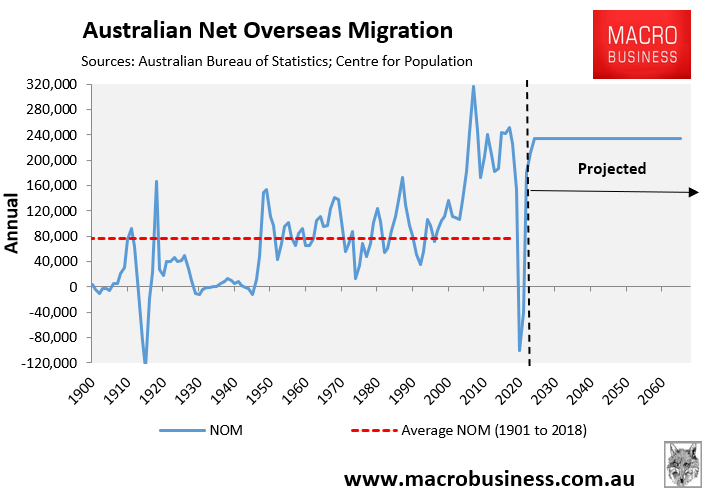
Australia’s net overseas migration jumped from an average of 90,500 between 1991 and 2004 to an average of 219,000 between 2005 and 2019 – representing an annual average increase in immigration of 140%:
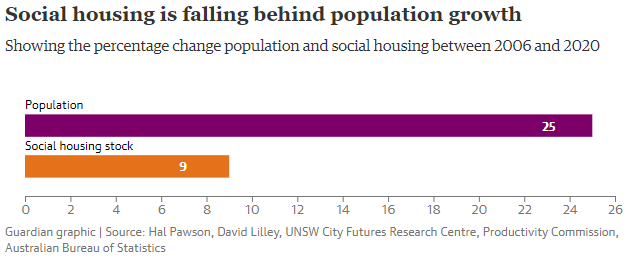
According to the UNSW City Futures Research Centre, Australia’s social housing stock grew by only 9% in the 14 years to 2020 against extreme immigration-driven population growth of 25%:
KPMG estimating that Australia’s population ballooned by 420,000 in 2022 alone, which will easily be exceeded this year as immigration soars to all-time highs.
The fact remains that so long as the federal government runs a ‘Big Australia’ immigration policy, the nation will forever suffer from housing (rental) shortages.
The Intergenerational Report projected that Australia’s population will grow by 13.1 million people (50 per cent) in only 40 years on the back of net overseas migration of 235,000 a year – i.e. 20,000 a year higher than what occurred between 2005 and 2020!
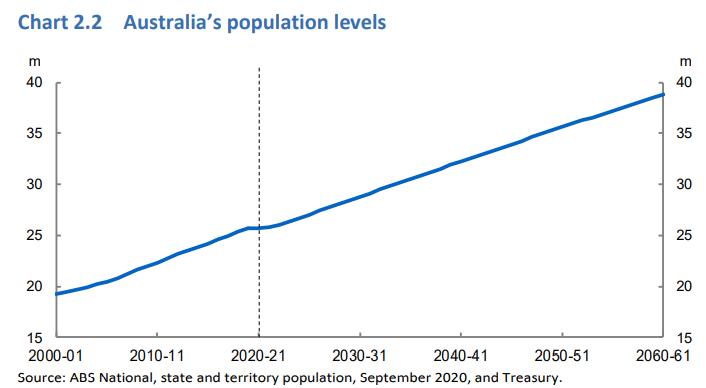
That population increase is the equivalent of adding a combined Sydney, Melbourne and Brisbane to Australia’s current population in only 40 years!
The entire social housing (and rental) shortage is self-inflicted by extreme levels of immigration.
Yet moderating immigration back to long-run historical levels of around 100,000 people a year is never, ever even considered.
Ultimately, high population growth (immigration) is a direct policy choice, and one that most Australians do not support.
If policy makers genuinely want to fix Australia’s housing crisis, they must start by moderating population growth so that demand better matches supply.
Otherwise, the housing crisis will remain a permanent feature of Australia.