At the end of November 2021, the Morrison Government announced that it was aiming to import at least 200,000 migrant workers into Australia by July:
“We are working on a figure of 200,000, it may well be more than that but we will be actively looking to bring as many people into Australia as soon as we possibly can“ – Karen Andrews, 22 November 2021.
On Thursday, Minister for Immigration, Citizenship, Migrant Services and Multicultural Affairs, Alex Hawke MP, announced that 56,000 International Students have arrived in Australia since the international border was opened in November, with 28,000 Working Holiday Maker visas also “approved in the last few months”:
“Australia is open for business. We are welcoming back increasing numbers of International Students, Backpackers, and Skilled migrants,” Minister Hawke said.
“Visa application rates have surged in the last week, since the Government’s announcement of a special Visa Application Charge (VAC) refund window for people who travel and arrive in Australia over the coming weeks,” he said.
“We are building back healthy pipelines of Working Holiday Makers, and we are processing these visas very quickly. The Government is seeing a surge in demand from backpackers and we are ready to welcome them to our shores,” he said…
“There are more jobs now available in Australia than before the COVID-19-Pandemic, and there are still many more places available to Backpackers and Students that we are ready to fill, so come on down,” Minister Hawke said.
Thus, the Morrison Government’s 200,000 migrant worker target looks well on track.
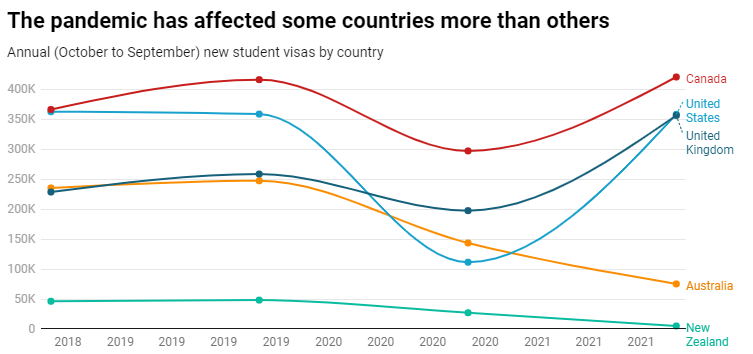
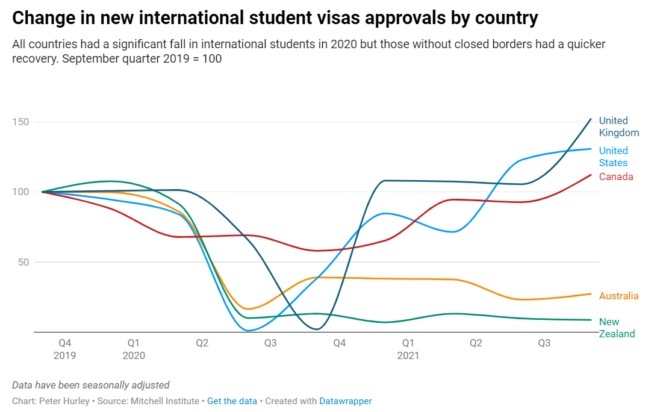
The rebound in student numbers comes after Australia lost market share to Canada, the United Kingdom and the United States over the pandemic:
This prompted the Morrison Government to throw a bunch of incentives at international students and other temporary migrants, including:
- granting a two year Temporary Graduate visa to Vocational Education and Training (VET) sector graduates;
- extending the temporary graduate visa from two to three years for masters by coursework graduates;
- uncapping the number of hours international students can work, thus turning them into defacto work visas; and
- waving visa application fees for backpackers and international students.
The Morrison Government has also tried to encourage thousands of farm workers to come to Australia via its new Agricultural Visa, however no Asian nation signed on as yet.
As explained last week, the primary reason why Australia’s unemployment and underemployment rates have hit a 14-year low is because the international border has been closed to migrants.
Thus, importing 200,000 migrant workers by July will increase labour supply, lift the unemployment rate, reduce labour market tightness, and put downward pressure on wages (other things equal). It is the equivalent of ‘Work Choices 2.0’ – great for the property, business and edu-migration lobbies, but bad for Australian workers. This is especially so given 65% of temporary visa holders have experienced wage theft, according to the Migrant Workers Centre.
Recent opinion polls showed that the overwhelming majority of Australians do not want to return to pre-COVID levels of immigration.
In addition to suppressing wage growth, Australians recognise that the mass immigration program of 2005 to 2020 was managed appallingly and crush loaded everything in sight, resulting in widespread infrastructure bottlenecks across Australia’s major cities and reduced liveability, especially in the major cities.
Sadly, in the unrepresentative democracy of Australia, our politicians, policy makers and media bend the knee to vested interests rather than representing the wishes of the Australian people.
And with it, they will likely lock in another decade of anaemic wage growth, worsening housing affordability, and declining living standards.