
Domainfax: Shut-up, #SardineSydney is good for you
Earlier this week, a Herald poll revealed that 63% of voters supported restricting migrant numbers while 50% opposed more development in Sydney to accommodate population growth.
Predictably, The SMH Editorial has hit back, telling Sydneysiders to suck it:
Sydneysiders love to travel to the world’s great cities of New York, London, Paris and Tokyo. Yet it appears we do not want Sydney to join their ranks. Sydney’s population is still only a fraction of those cities…
The Herald is open to a debate about a gradual cut or reprofiling of the immigration program but a dramatic shift is risky. It could damage house prices and the economy. So the likelihood is that migration will continue to boost Sydney’s population for decades to come.
The fact that cities such as New York or London not to mention the mega-cities of Asia can function well with much bigger populations should make Sydneysiders ask why we cannot do the same. While there are annoyances, there are also benefits in living in big cities. The modern, connected economy requires cities with a dynamism and critical mass.
The key to getting the best of both worlds is better planning and better transport…
The argument that “cities such as New York or London not to mention the mega-cities of Asia can function well with much bigger populations” is banal. There are also many struggling cities that are much larger than any in Australia, including Mexico City, Buenos Aires, Moscow, Sao Paulo, Rio de Janeiro, Manila, Jakarta, Istanbul, Bangkok, Lagos, and Tehran. So what’s the point? Is bigger necessarily better?
Here’s the Mercer Quality of Living Index rankings, which look at which cities provide the best quality of life:
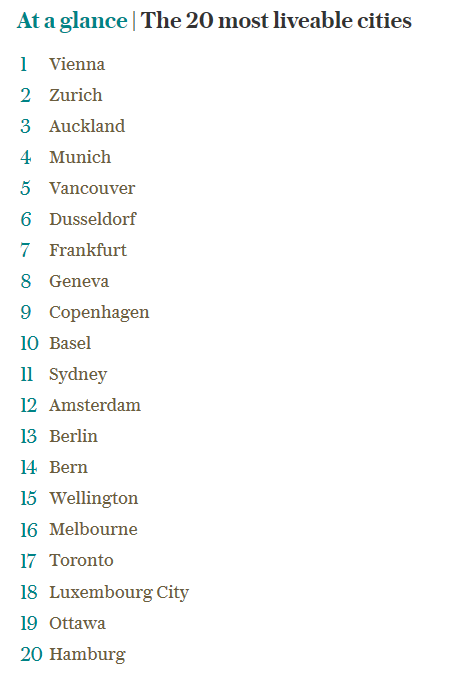
And here’s the urban/metropolitan populations of these top 10 cities:
- Vienna: 2.6 million
- Zurich: 1.8 million
- Auckland: 1.7 million
- Munich: 6 million
- Vancouver: 2.5 million
- Dusseldorf: 1.2 million
- Frankfurt: 2.3 million
- Geneva: 1 million
- Copenhagen: 2 million
- Basel: 550,000
As you can see, only one of these cities (Munich) has a bigger population than Sydney (5.1 million). Speaks volumes, doesn’t it?
As to the claim that lowering immigration would crash the economy: the world has 7.4 billion people. Australia doesn’t need to import them to sell to them. There’s a thing called “exporting”, which allows Australia to reap the benefits from a global economy without incurring the costs.
This brings me to the claim that Sydney just needs “better planning and better transport”, like it is so easy.
The reality is that in already built-out cities like Sydney, the cost of retrofitting new infrastructure to accommodate greater population densities is prohibitively expensive because of the need for land buy-backs, tunnelling, as well as disruptions to existing infrastructure. These are basic dis-economies of scale.
But don’t just take my word for it.
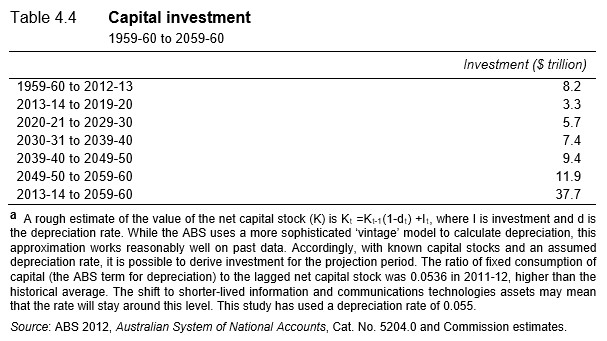
In November 2013, the PC released its final report on An Ageing Australia: Preparing for the Future, which projected that Australia’s population would swell to 38 million people by 2060 (let alone 40 million as projected currently) and warned that total private and public investment requirements over the 50 year period are estimated to be 5 times the cumulative investment made over the last half century:
The PC’s 2016 Migrant Intake into Australia report explicitly noted that infrastructure will have to increase to accommodate a bigger population, and that this infrastructure will necessarily be expensive:
A larger population inevitably requires more investment in infrastructure, and who pays for this will depend on how this investment is funded (by users or by taxpayers). Physical constraints in major cities make the costs of expanding infrastructure more expensive, so even if a user-pays model is adopted, a higher population is very likely to impose a higher cost of living for people already residing in these major cities.
…governments have not demonstrated a high degree of competence in infrastructure planning and investment. Funding will inevitably be borne by the Australian community either through user-pays fees or general taxation…
Whereas, the PC’s recent Shifting the Dial: 5 year productivity review explicitly noted that infrastructure costs will inevitably balloon due to our cities’ rapidly growing populations:
Growing populations will place pressure on already strained transport systems… Yet available choices for new investments are constrained by the increasingly limited availability of unutilised land. Costs of new transport structures have risen accordingly, with new developments (for example WestConnex) requiring land reclamation, costly compensation arrangements, or otherwise more expensive alternatives (such as tunnels).
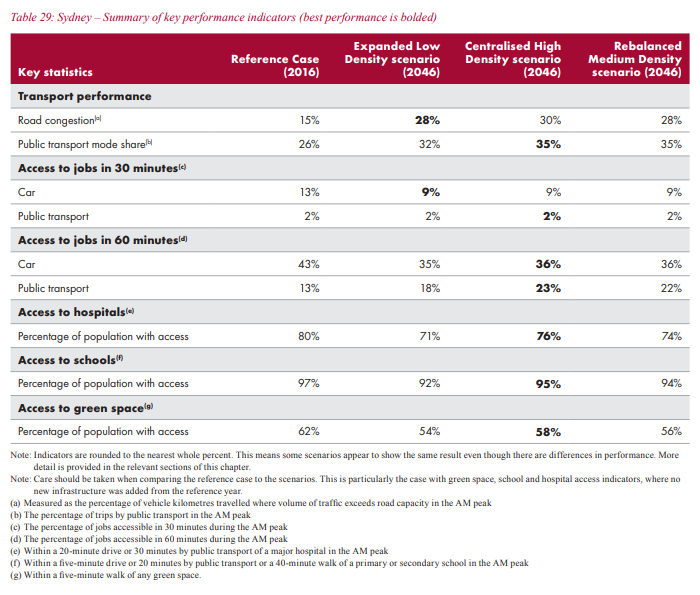
If you are still not convinced, consider Infrastructure Australia’s recent report, which found that Sydney’s living standards will be unambiguously crushed as its population surges 7.4 million people by 2046, with worsening congestion and reduced access to jobs, hospitals, schools and green space. And this crush-loading will occur irrespective of how Sydney builds-out to accommodate population growth:
Why would The SMH editor wish to bestow lower living standards on Sydneysiders?
The answer is simple: Fairfax’s newspaper division is now little more than the marketing arm for Domain, which profits from an increasing population. Follow the money.
