“Smoke and mirrors”. That’s the best way to describe the Coalition’s fake 21,000 cut to the permanent migrant intake. From The ABC:
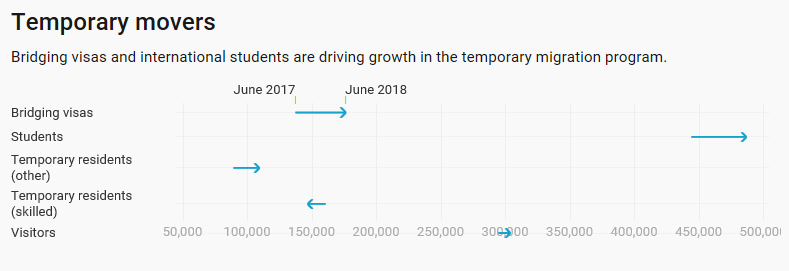
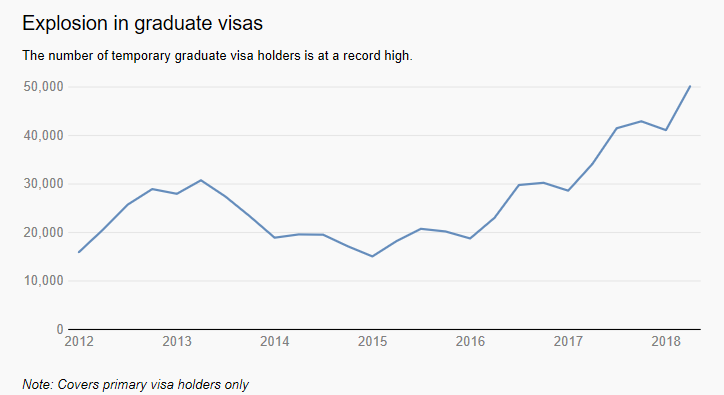
International students, graduates and people on bridging visas are continuing to fuel Australia’s immigration boom.
The number of temporary visa holders in Australia in June increased by 107,000 in the past year — a rise of 5 per cent according to statistics released on Friday afternoon.
These new visa holders easily eclipse the Government’s 20,000 cut to permanent visas over the same period.
The number of bridging visas — now at 176,000, having grown by almost 40,000 in the past year — was described by Abul Rizvi, a senior official in the immigration department during the 2000s, as “unheard of”.
“Bridging visas were introduced as a means of dealing with a situation of keeping a person legal while we processed their visa — it was a stopgap measure and that’s how it should be viewed,” he told the ABC.
“If bridging visas are increasing in number, what it says is that the immigration department is not able to process the visas quickly enough.”
10,000 extra Chinese nationals, 7,000 more people from India and another 4,000 Malaysians were in Australia on bridging visas in June compared with a year ago.
“When I was running the program, a figure of 30,000 was regarded as problematic,” Mr Rizvi said. “200,000 is just a frightening number”…
Mr Rizvi said the rise in bridging visas meant that some migrants were taking advantage of delays to enjoy more time in Australia.
“It reflects a decline in integrity and a decline in efficiency in administration,” he said.
Migration agent Jonathan Granger from Granger Australia described the bridging visa increase as a “blow-out”.
He said the rise was due to two main factors — the increasing numbers of visa refusals going to appeals and an increase in visa processing times.
“It’s almost like they’ve decided not to put resources there and just leave it”…
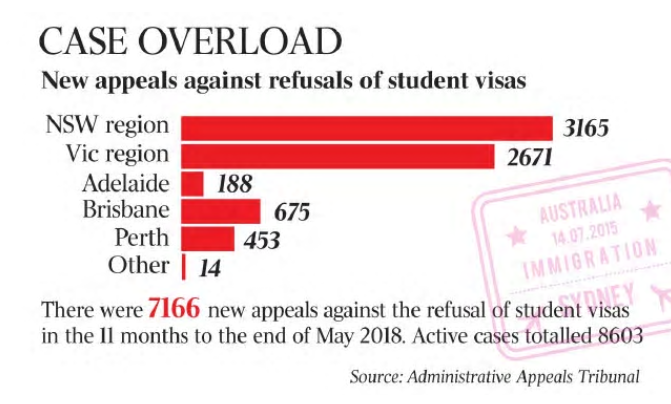
As I reported last week, foreign students have been ‘gaming’ Australian immigration system by appealing their decisions en masse to the Administrative Appeals Tribunal (AAT) to extend their stay:
Advertisement
The Australian can reveal that the median time for the AAT to finalise a decision on the refusal of a student visa is 428 days. Foreign students are able to seek judicial review of any unfavourable decision in the Federal Circuit Court.
The AAT yesterday acknowledged it was increasingly unable to keep pace with its growing workload, telling The Australian the number of “members available to review decisions has not kept pace with this trend”.
The process of legal appeals can take several years to exhaust, prompting concern among some government MPs that the AAT backlog is contributing to overcrowding in capital cities as the national population last night ticked over 25 million.
Victorian Liberal MP Jason Wood, the chair of the joint standing committee on migration, said the backlog of cases at the AAT was “outrageous” and argued that the appeals process was “working in favour of the visa holder and not necessarily the Australian taxpayer”. He said foreign students could game the system to extend their stay by several years — an outcome which he said would deny Australian citizens more part time jobs.
The reality is that Australia’s education system has become an integral part of the immigration industry and Australia’s population ponzi – effectively a way for foreigners to buy backdoor permanent residency to Australia.
Dr Jenny Stewart, Honorary Professor of Public Policy at the University of New South Wales, drew the direct link between permanent residency and foreign student demand in her excellent article Hooked on Students:
Advertisement
If you work in a university, you cannot help but be aware of the extent to which universities are dependent upon income from international undergraduate students. Many of us working in the sector realised that it was not for any intellectual brilliance on our part that the students came, but because for many, coming to Australia as a student was a significant step on the path to becoming an Australian resident…
What do these undergraduate students do once they have completed their qualification? Many, understandably, wish to remain in Australia…
With appropriate advice and support and the necessary persistence, it would seem to be possible for just about any international student who is a graduate of an Australian university to become, eventually, a permanent resident…
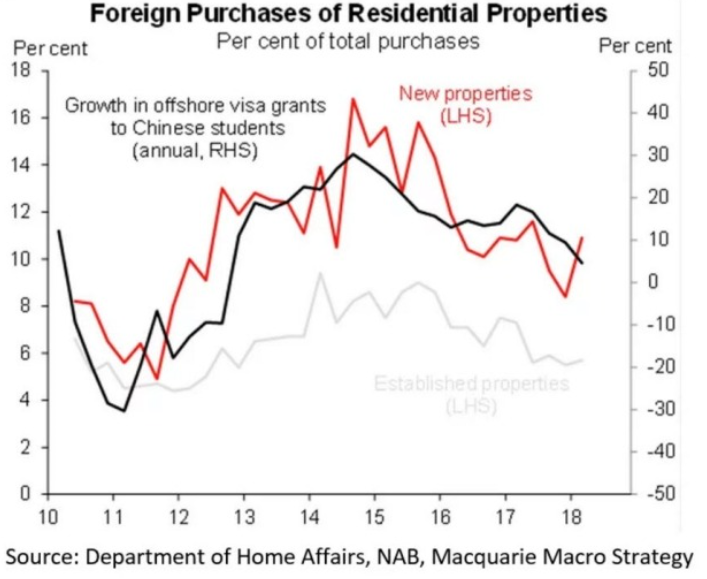
In addition to creating competition for jobs at the entry level of the market, the boom in international students, particularly from China, is also having a deleterious impact on housing affordability, thus dealing a double-blow to Australia’s youth:
Advertisement
Clearly, Australia needs to switch the education sector from residency to pedagogical exports.
Many migrants come to Australia on temporary visas with the hope of transitioning to a ‘skilled’ permanent visa. Therefore, if Australia was to remove the carrot of permanent residency by slashing the ‘skilled’ intake, as well as tightening the appeals process, it would also stem the numbers of temporary migrants in Australia, since the two areas are intrinsically linked.
The economy will adjust quickly with lower house prices and a lower Australian dollar. Thus, the international students will still come in droves for the value offered in Australian degree but without being so detrimental to wages, house prices and crush-loaded public services.
Advertisement
The flow of temporary migrants would also be stemmed by raising the appallingly low pay floor on ‘skilled’ temporary workers from $53,900 (non-indexed) to, say, the full-time average salary of $84,682 (which includes unskilled workers).
By maintaining such a low pay floor for temporary ‘skilled’ foreign workers, the government has ensured the system has been overused and abused by employers, thereby undermining the pay and working conditions of local workers. This needs to stop.
Leith van Onselen is Chief Economist at the MB Fund and MB Super. He is also a co-founder of MacroBusiness.
Leith has previously worked at the Australian Treasury, Victorian Treasury and Goldman Sachs.