
From Bloomie today onto some long term MB reasoning:
One of the strangest things about this project is something that partisans on either side of the debate are often unwilling to admit: Despite Adani’s promise to start mining by 2020, Carmichael stands very little chance of ever being built.
A comparison with one of Australia’s biggest coal operations shows why. BHP Billiton Ltd.’s Mt Arthur and its associated pits typically deliver a Carmichael-sized 20 million metric tons a year from the Hunter Valley north of Sydney to Newcastle, the world’s biggest coal export harbor. Its coal is a better product, with a heating value of 6,450 kilocalories per kilogram and 17 percent ash content compared to the 4,950 kcal/kg and 26 percent ash that the Institute for Energy Economics & Financial Analysis, a think-tank that’s opposed the project, calculates for Carmichael.
Despite that, Mt Arthur is struggling. In BHP’s 2016 fiscal year ended last June, the unit lost $22 million in underlying Ebit. Chief Executive Officer Andrew Mackenzie was quoted by Australian Mining magazine last March saying that it’s “touch and go” whether operations might have to be suspended.
With Newcastle coal surging to its highest level in four-and-a-half years in November, Ebit did rebound to hit a three-year high of $110 million in the half year through December. But a $4 billion mine borrowing money at the 5.8 percent that Adani gets on its Australian dollar bonds would need that sort of result in every single half year just to pay its interest bill — and that’s before you factor in a $2.5 billion rail line. A $16.5 billion project would require about $950 million of Ebit a year.
…Using taxpayer money to develop uneconomic projects will “materially increase the risk to existing coal operations,” Glencore Plc’s coal chief Peter Freyberg warned in 2015, in a thinly veiled swipe. If Canberra tries to push more tonnage into coal’s glut, it will ultimately damage the industry it aims to help.
Government funds would be better spent addressing some of the looming problems with Australia’s domestic energy supply. We’ll address that issue next Monday.
Exactly right. The break even for Adani is somewhere around $100. We’ve been above that mark for just three months in six years:
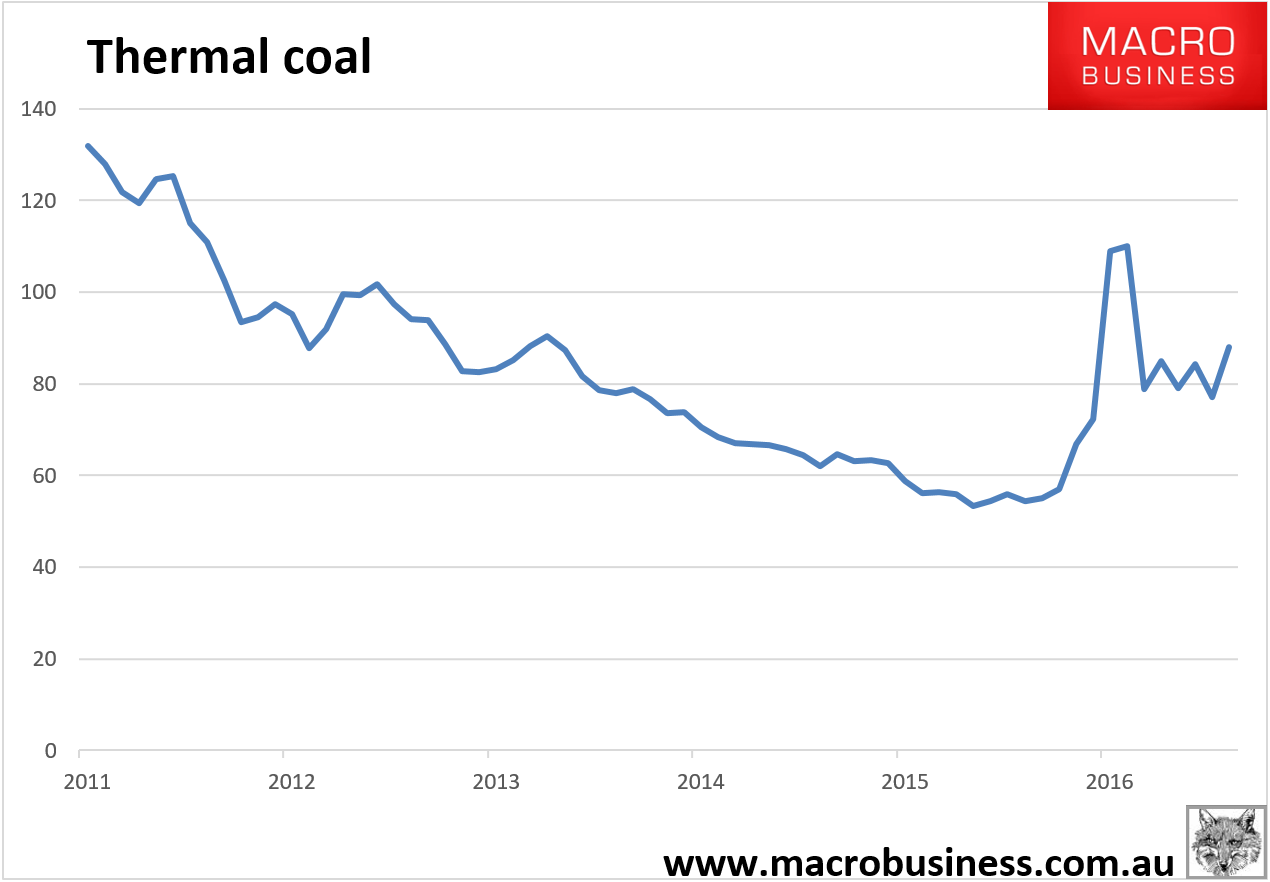
And all reasonable forecasts for the future are around $70 and falling.
It’s lunacy to subsidise such a white elephant when it will only close more efficient mines further south.
The FT has the punchline:
Adani Enterprises, which wants to build one of the world’s biggest coal mines in Australia, plans to invest A$2bn-A$3bn in solar power plants in the country over five years as it further diversifies its business beyond India.
Jennifer Purdie, chief executive of Adani Australia Renewables, said the company had secured agreements to build two solar farms, each with capacity of 100-200 megawatts in Queensland and South Australia. She said Adani was seeking new sites to expand its projects to a combined capacity of 1,500MW by 2022.
“If we can achieve our 1,500MW target, A$2bn-A$3bn is the order of what we would have to invest to do it,” said Ms Purdie.
“It’s not tokenism, it’s a serious investment.”
Give Australia a carbon price and unleash investment, not a bloody dead and buried coal mine and power plant.
