
The astonishing Budget hypocrisy of Peter Costello
Is there a bigger hypocrite on Budget-related matters than former Treasurer, Peter Costello?
Over the weekend, he delivered yet another sermon on how he fixed the Budget and lamented the position that it is in today. From The Australian:
One of the things I am proud of in my time in government is that we bequeathed no debt to future generations. And we cleared the debts of all the governments that went before it. Never had the financial position of the federal government been stronger. It was an important time to be strong, given the gyrations in the international financial system in 2008.
I doubt we will ever be in a debt-free position again…
As is well known, in 1996 we decided to balance the budget over a two-year time frame by cutting expenditure.
We did not decide to increase revenue to match spending. We decided to cut spending to match revenue. Over the next two years expenditure was cut to 23.9 per cent of gross domestic product, a reduction of 1.7 per cent of GDP, and the budget was balanced…
Sustained budget surpluses allowed us to pay off all that debt in net terms and reduce the cost of debt servicing. By 2006 it was zero. That’s a saving of 1.7 per cent of GDP compared with where we started.
All fine when taken on face value. But once one scrapes below the surface, the Costello’s “sound Budget manager” myth evaporates into thin air.
Let’s look at the revenue side of the Budget first.
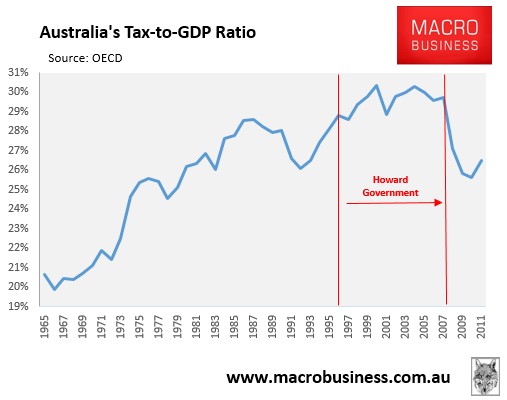
Peter Costello was fortunate to have been Treasurer during a period of benign macroeconomic conditions, both locally and abroad, which produced strong levels of taxation (revenue):
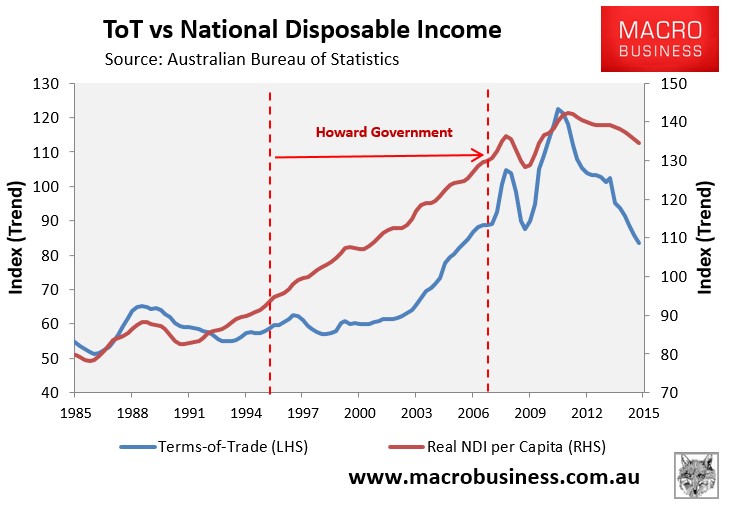
Because he presided over the most lucrative part of the resources boom when commodity prices and the terms-of-trade exploded, providing the key impetus for the rising disposable incomes:
In turn, nominal GDP, which is the dollar value of what’s produced and earned across the economy and is also the measure that drives federal taxation revenue, surged, as it reaped the benefits of growing personal and company taxes, not to mention increased capital gains taxes as asset markets boomed:
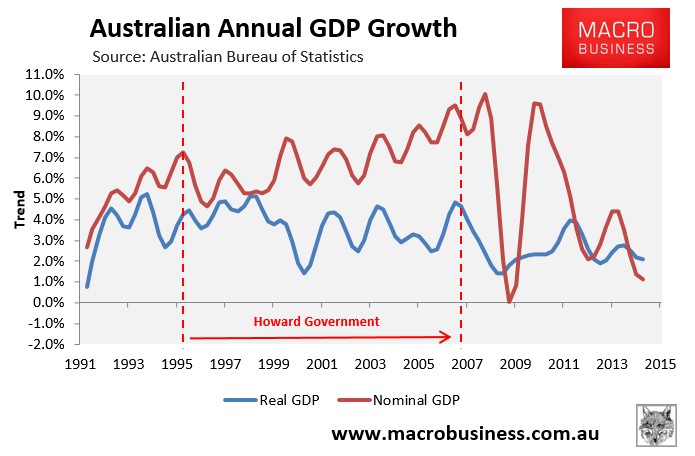
By way of comparison, nominal GDP averaged 6.8% annual growth throughout the Howard Government’s rein, whereas it has averaged just 4.9% annual growth ever since.
Of course, household debt levels also literally exploded during Costello’s 11 years as Treasurer:
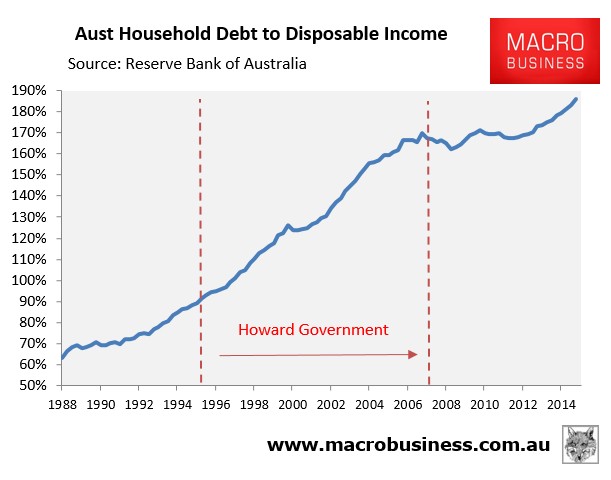
This extra demand (spending) by the household sector meant that the Howard Government was able to run bigger surpluses, without adversely affecting overall demand in the economy:
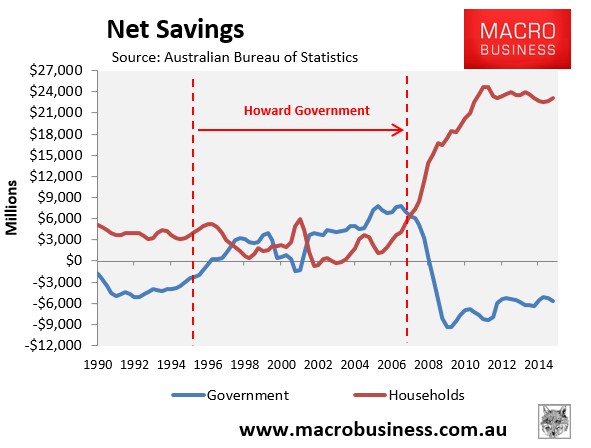
And then there are the raft of tax/revenue measures introduced by Peter Costello that have blown big long-term holes in the Budget that the current political crop must now close. Examples include:
- Freezing fuel excise indexation in 2001 (costing more than $5 billion annually today);
- Greatly loosening the assets test to qualify for the part Aged Pension and the Commonwealth Health Card;
- Implementing generous “transition-to-retirement” superannuation rules, assisting those approaching retirement to avoid paying tax;
- Implementing tax free superannuation for those aged over-60, a move dubbed by Saul Eslake as “one of the worst taxation policy decisions of the past 20 years”;
- Removing the superannuation surcharge on high income earners; and
- Halving the rate of capital gains taxes (CGT) in 1999, which pushed up house prices, overwhelming benefiting the rich, and now costs the Budget some $4 billion in revenue foregone.
I could add others, such as continually lowering income taxes (a good move, in my view) and ballooning middle-class welfare (e.g. baby bonuses – a bad policy in my view). And to be fair, there were some wins, such as implementing the GST.
Thankfully, the current Coalition Government has worked to unwind some of Costello’s Budget mistakes – but there is still much work to be done.
In May last year, the Coalition successfully negotiated with the Greens to re-introduce fuel excise indexation. While the move will not claw back the $5 billion-plus in revenue foregone from Costello’s initial short-sighted decision, it will at least stop the revenue lost from escalating over time.
The Coalition also last year successfully negotiated with the Greens to undo Costello’s reckless 2006 decision to loosen the assets test for the Aged Pension and Commonwealth Health Card.
Overall, Peter Costello has no right to lecture us on fiscal management, given he enjoyed highly favourable global and domestic macroeconomic conditions, and was chief architect of multiple Budget howlers, which we are still paying dearly for today.
And if the Budget deficit has any hope of being eliminated, and the “age of entitlement” addressed, the Coalition must right Costello’s Budget wrongs.
