
The conga line of commentators calling for the capital gains tax (CGT) discount to be unwound just got larger, with Opposition Leader, Bill Shorten, taking direct aim at the concession in Friday’s address to the Social and Economic Outlook conference in Melbourne. From The Guardian:
“We have taxpayers in the top personal income tax bracket account for 2.7% of the total number of taxpayers. But they also account for 55% of the total capital gains income… They accounted for 12% of total income, from reportable fringe benefits. They are able to avail [themselves] of a system where they’re 2.5 times more likely to be able to claim tax concessions than other income earners.
When asked if changes to fringe benefits and capital gains were on the table, the opposition leader said: “In the Turnbullian vibe that we have in this country, we want to look at issues”.
“I know therefore you will give us a lot of room to look at issues without immediately launching a scare campaign on what I’ve said,” he told reporters.
Shorten’s comments follow Deloitte Financial Services’ report last month, which argued that the CGT discount is far “too generous” to high income earners, “undermines the very principles of this nation’s progressive personal income tax system”, and hurts the economy by providing too much stimulus to housing investment.
Analysis released last year by the Australian Treasury also noted that high income earners have been the main beneficiary of CGT concessions, with around half of all net capital gains income reported by those earning above $180,000:
Taxable net capital gains income tends to be received by individuals at the higher end of the income distribution. Around half of total taxable net capital gains income reported for 2011-12 was received by taxpayers whose other taxable income was above $180,000 (the top tax rate threshold). For the 2011-12 year the average statutory rate of tax on taxable net capital gains income was 30.9 per cent, compared to the overall average rate of around 22.2 per cent.
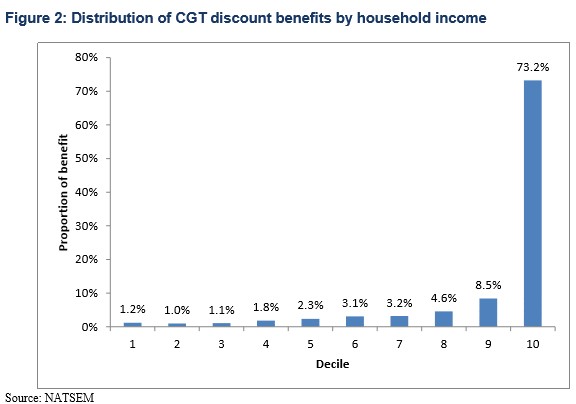
The Australia Institute has also found that nearly three quarters (73.2%) of the CGT discount went to the top 10% of income earners:
Finally, the Parliamentary Budget Office has estimated that cutting the CGT discount to 40% would provide a four-year Budget saving of $2.3 billion, whereas cutting the discount to 25% would save $5.7 billion over four years, and removing it altogether would save the Budget some $10 billion.
CGT reform is a no-brainer, which is why the RBA, the Murray Financial System Inquiry, Audit Commission chair Tony Shepherd, the Australian Treasury, Deloitte, the Australian Greens, and now Bill Shorten have all called for a review of the CGT discount.
With support from nearly all quarters, now is the time for Messers Turnbull and Morrison to unwind the CGT discount, and in the process right Howard’s and Costello’s wrong.
