
In the wake of the this week’s Four Corners report on Chinese investment into Australian real estate, academics Dallas Rogers, Urban Studies Lecturer at the University of Western Sydney, and Shanthi Robertson, Senior Research Fellow at the University of Western Sydney, have written a curious article attacking those that question Australia’s enforcement of foreign investment into Australian real estate as “xenophobic”. From The Conversation:
Super rich investors are only one investor group and foreign real estate investment is less than 5% of Australia’s residential real estate economy…
Halfway through the show the Four Corners piece took a strange turn. The investigation shifted from foreign real estate investment onto corruption claims, spy networks and religious persecution in Mainland China.
There is a danger in rolling the diverse investors groups, property types and investor motivations into a discussion about corruption and money laundering. And there is also a xenophobia in associating “dirty money” specifically with Chinese investment practices, especially practices that are common across Chinese and non-Chinese investors…
After the 2014 Parliamentary Inquiry into Foreign Investment in Residential Real Estate it was clear the Federal government was planning to make an example out of some foreign investor “rule breakers”.
However, as one of the authors suggested at the time, apart from political point scoring, catching the rule breakers will have a marginal impact on the domestic residential housing market.
This move has simply shifted the public debate from a discussion about invading foreign investors to a discussion about foreign rule breakers.
Certainly, the government needs to better regulate the movement of people and capital through Australian real estate and address the money laundering question. The Parliamentary Inquiry showed the government needs to improve its data collection process to achieve this goal.
But blaming foreign investors wholesale and making the global real estate, migration and other industries responsible for managing and enforcing foreign investment and migration seems untenable.
It’s funny how the authors claim with confidence that “foreign real estate investment less than 5% of Australia’s residential real estate economy”, and quote debunked FIRB data to support their claim, but then later on admit that “the government needs to improve its data collection process”.
Blind Freddy knows that the FIRB data is highly spurious, since it only accounts for approvals, not actual sales. Kelly O’Dwyer MP, who chaired the recent parliamentary inquiry into foreign ownership, acknowledged this fact when she released the inquiry’s report (my emphasis):
“I regard the current internal processes at the Treasury and FIRB as a systems failure. Most concerning is that sanctions seem to be virtually non-existent. There have been no prosecutions since 2006 and no divestment orders since 2007. Suggestions by officials, that this is due to complete compliance with the rules is simply not credible. The data on foreign purchases of Australian houses and apartments is inadequate, making policy evaluations very difficult”…
FIRB chairman, Brian Wilson, also noted the inadequacy of the foreign investor data when he appeared before the Australian Securities and Investment Commission’s annual conference in March:
“There are about 11 million residential dwellings in Australia, and about 600,000 property transfers every year. It is inevitable some of those properties will be exchanged contrary to the law, but our ability to first discover and then prosecute these cases is sorely limited”…
“At the moment the FIRB and Treasury can only investigate the cases that come before us. What is needed is central depository of automated data to aid detection”…
Without a registry of who’s buying what, nobody knows for certain just how many homes are being snapped up by foreign nationals.
That said, the only data that is publicly available comes from the NAB quarterly property survey of 300 real estate professionals, which shows that foreign buyers are very active in the housing market, particularly in Victoria (Melbourne) and New South Wales (Sydney):
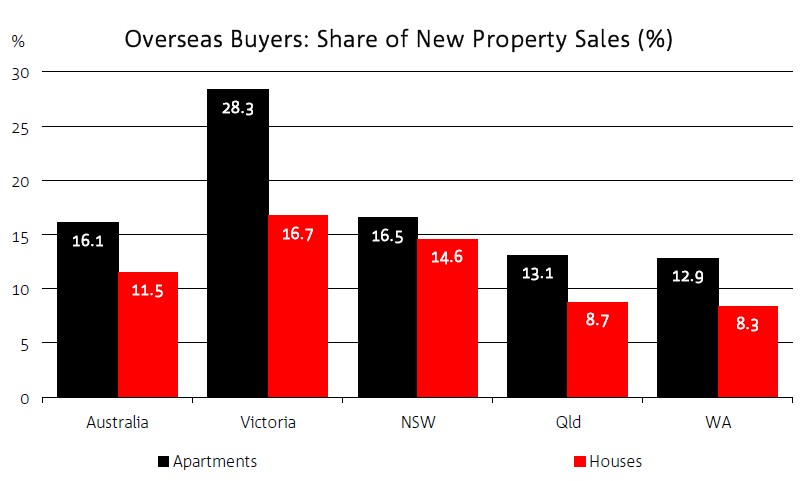
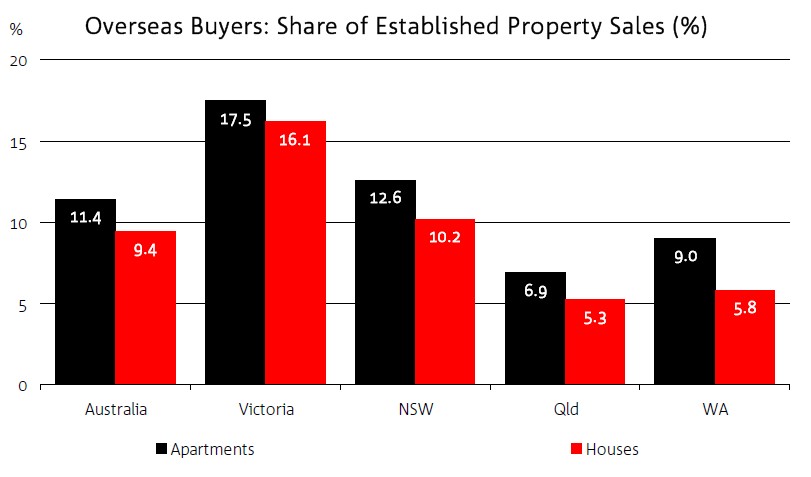
The authors claim that there is “a xenophobia in associating “dirty money” specifically with Chinese investment practices, especially practices that are common across Chinese and non-Chinese investors” is also ridiculous. Have they not read the recent report from the Paris-based Financial Action Task Force (FATF) on money laundering, which warned that Australian residential property is a haven for international money laundering, and targeted the Chinese in particular [my emphasis]:
Australia remains at significant risk of an inflow of illicit funds from persons in foreign countries who find Australia a suitable place to hold and invest funds, including in real estate… Australia is seen as an attractive destination for foreign proceeds, particularly corruption-related proceeds flowing into real estate…
Large amounts are suspected to be laundered out of China into the Australian real estate market. China and other countries within the Asia-Pacific region were also seen as likely sources of corruption proceeds that are laundered in Australia…
Of great concern is that Australia has not brought real estate agents within the AML/CTF [counter-terrorism finance] regime…
Most DNFBPs, including real estate agents and legal professionals, are… not subject to AML/CTF controls or suspicious transaction reporting obligations, even though they are highlighted as being high-risk for ML activities…
There is nothing xenophobic about not wanting Australia to be a dumping ground for illegal and corrupt funds. Nor is it xenophobic to want our regulators to actually enforce Australia’s foreign investment rules that, for very good reason, preclude foreign nationals from purchasing established dwellings, because it pushes-up house prices and erodes housing affordability. To label anyone that raises concerns about Australia’s non-enforcement “xenophobic” is quite frankly pathetic.
In any event, the alleged “xenophobia” would dissipate with hard data and actual enforcement of Australia’s foreign ownership rules, which has been sorely missing, along with implementation of the draft anti-money laundering rules pertaining to real estate, which have been waiting to be implemented since 2006.
While it is certainly wrong to pin the blame for Australia’s sky high housing costs solely on the Chinese, given that multiple factors are at play (e.g. tax concessions, loose capital rules, supply-side constraints, high immigration, etc), it is also highly disingenuous of the authors to cite dodgy data to obscure the very real issue of foreigners buying established housing, whilst also ignoring the important issue of money laundering into Australian real estate, as identified by the global anti-money laundering regulator (FATF).
