Last week I argued that it was wrong for Western Australia to demand a bigger slice of the GST pie, given:
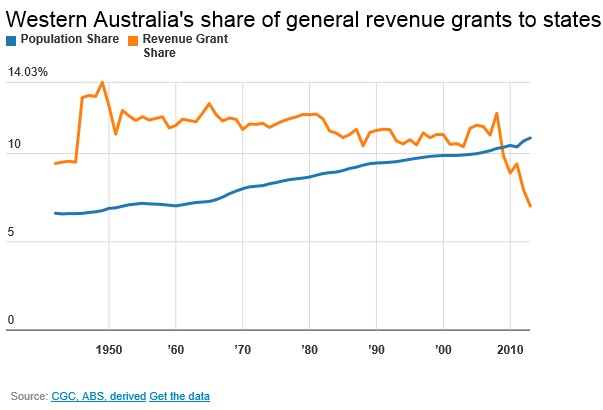
It had been a prime beneficiary of the grants system since Federation and received more than its per capita GST distribution in the years leading-up to the mining boom;
The lagged “horizontal fiscal equalisation” (HFE) system that carves-up GST revenues between the states, which is based on a three-year rolling calculation, greatly benefited Western Australia during the initial phase of the commodity price boom, since GST revenues took longer to be adjusted downwards; and
To replace this lagged system now, just because Western Australia is now on the losing side, would ignore these past gains and also pose significant implementation problems.
Today, The Guardian’s Greg Jericho has posted a well-reasoned article posing similar arguments against changing the grants system to favour Western Australia:
Advertisement
A look at the distribution of the GST since 2001 shows that WA has certainly lost a lot of its share in recent years, but it is worth noting that as short a time ago as 2006-07, WA was actually receiving more GST revenue than it would expect due to its population size…
When determining the distribution of the GST, the commission looks at the capacity a state has to raise revenue and the requirements it has when spending money on services…
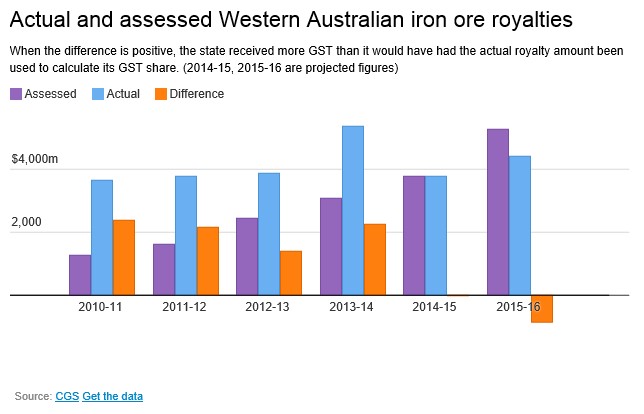
The commission… noted that since 2010-11 WA has benefited from fast-rising iron ore prices, which meant the amount of mining royalties the state earned was actually higher than the amount estimated by the commission when it determined the state’s GST share:
The commission calculated that because it underestimated the amount of mining royalties WA would raise, over the course of the mining boom till 2014-15, the state “received around $7bn additional GST revenue” than it would have had the commission’s estimate been equal to the actual amount of the royalty raised by WA.
So it is pretty damn rich ($7bn worth of richness) to start complaining now that it is being hard done by…
The policy of horizontal fiscal equalisation has [also] massively benefited Western Australia.
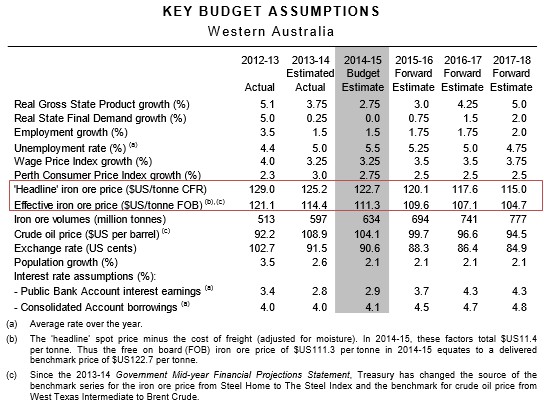
Too right. The key problem for the Western Australian Government is that it stupidly believed that the iron ore price would stay strong forever (see next chart) and pissed away the temporary windfall.
Leith van Onselen is Chief Economist at the MB Fund and MB Super. He is also a co-founder of MacroBusiness.
Leith has previously worked at the Australian Treasury, Victorian Treasury and Goldman Sachs.