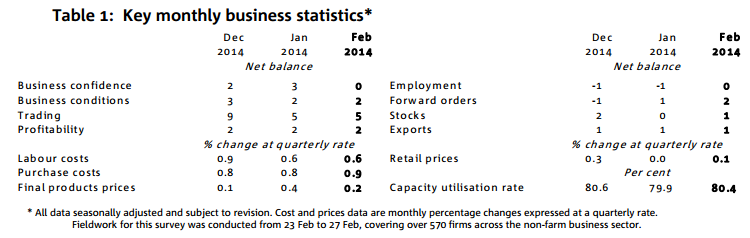
The NAB Business Survey is out for March and is not encouraging:
The RBA’s 25bp cut to interest rates in February did not appear to have the desired effect on firms ‘animal spirits’, with confidence actually deteriorating in the month. The index is now at its lowest level since before the Federal election in 2013 and is well below the long run average. The fall was relatively broad based, suggesting common factors such as political and economic uncertainty, are driving this result. Mining and retail reported the largest decline, while manufacturing and wholesale were the only industries to report a rise in confidence (although both remain soft).
Business conditions were unchanged in February, with each of the components (trading, profit, employment) holding broadly steady – the employment index improved only marginally. This level of conditions is pointing to below trend rates of activity. By industry, manufacturing and construction improved the most, more than unwinding a surprise drop in construction last month to be in positive territory again. In contrast, mining dropped sharply in line with weaker commodity markets and less favourable movements in the AUD. Orders were up (albeit still soft), as is capacity utilisation, which is helping support reasonable levels of non-mining capex (although recent ABS data raises questions over the longer-term outlook). In contrast, the ‘bellwether’ wholesale industry weakened even further.
The full text of this article is available to MacroBusiness subscribers
David Llewellyn-Smith is Chief Strategist at the MB Fund and MB Super. David is the founding publisher and editor of MacroBusiness and was the founding publisher and global economy editor of The Diplomat, the Asia Pacific's leading geo-politics and economics portal.
He is also a former gold trader and economic commentator at The Sydney Morning Herald, The Age, the ABC and Business Spectator. He is the co-author of The Great Crash of 2008 with Ross Garnaut and was the editor of the second Garnaut Climate Change Review.