
From the AFR today, Massey University’s director of the centre for financial services and markets, associate banking professor David Tripe reckons on New Zealand macroprudential that:
“I think the RBA can be a little more sensitive to public opinion; in fact the RBNZ can strike you as singularly insensitive,” he said.
“Every time you intervene you create some market distortions; the question is whether the distortions are worse than the problem you are trying to solve.”
He also said: “If and when the restrictions are eased, there will be a surge of activity by first-time home buyers, which will be likely to push up prices, particularly in Auckland.”
…high LVR loans has created a steep fall in the first-time buyer market. First-home sales have dropped from 24 per cent to 16 per cent of sales in eight months.
…Others agree. “The jury is still out, and it would be hard to measure, given the 100 points rise in the OCR; It has been ‘successful’, but what does success look like?”, said Kirk Hope, executive director of the of New Zealand Bankers Association.
Well, if the banking lobby hates it then that’s a good start.
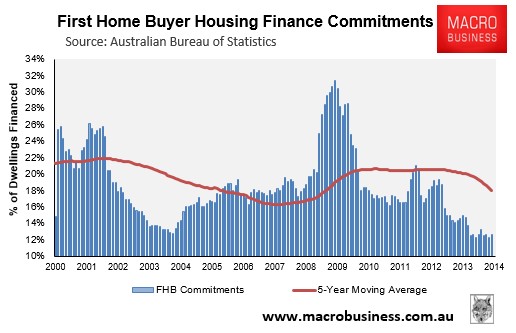
OK, let’s play this out. FHBs have been encumbered by MP. As a result their proportion of loans has fallen to 16%, still miles above where Australia’s FHB’s already sit at 12.6%:
In short:
- Australian FHBs are already priced out. If MP were installed the proportion may fall further but prices would stop rising and it would give them a chance to save an apposite deposit before entering the market. Is that worse off? No.
- As well, the RBNZ is contemplating tweaking MP so that investors are also targeted. It can be constructed any way you like.
- When the restrictions are removed, will FHB demand jump back? Sure. And? Same thing happens with interest rates.
- Should the RBA let popular opinion govern its decisions? Obviously not.
Is MP perfect? No. Is it adding another “distortion”? Perhaps. But this is not a market now. It’s an asset quango that favours the incumbent owners. In the circumstances of an overly high currency, adding temporary rules to prevent it from hollowing out the tradable economy while more permanent fixes can be sought is better than letting it run headlong into a crash and bailout cycle that will only entrench failure of what market principles that remain.
Finally, MP pushes the onus of affordable housing policy back onto fiscal authorities by removing the easy out of rate cuts to improve mortgage affordability. Supply side reform has followed in New Zealand.
