Details have emerged on the Government’s rumoured temporary “Budget debt levy”, which will reportedly kick in at 1% for income above $80,000 and double to 2% for those earning above $180,000 or more.
The Government has also flagged that the income test for family tax benefits will be lowered to $100,000, whereas some social security payments will also be scaled back by an unspecified amount and eligibility rules tightened; although changes to the Aged Pension will not occur until after the next Federal Election.
Today’s AFR Editorial has slammed the Government’s Budget stance, arguing that:
A temporary “deficit levy” to help balance the budget would be a classic example of one policy failure begetting the next. The correct remedy for the first problem – cutting spending to match the resources available – looks politically too hard. So, going against all its instincts, the government is flirting with increasing the penalty on enterprise and wealth creation.
I have some sympathy with the AFR’s stance. As argued yesterday, the temporary Budget debt levy does nothing to fix the crumbling structure of Australia’s taxation system, whereby the tax base is shrinking via falling (or soon to fall) company and indirect taxes, as well as the declining workforce participation as the population ages.
Instead of implementing a temporary levy on higher income earners – which does nothing to address longer-term structural Budget challenges – the Government focus its efforts on reducing superannuation concessions, which are already almost as large as the Aged Pension, are growing much faster, and overwhelmingly benefit higher income earners. The Government should also look at removing the tax-free status of superannuation earnings for people over 60, as well as tighter means testing of the Aged Pension and related programs, so that benefits only flow to those in genuine need.
That said, tax policy is about much more than just revenue. Rather, it should be viewed as a means to boosting the nation’s productivity and living standards.
As shown by the below chart from the Henry Tax Review, the two biggest sources of federal taxation revenue – personal income taxes and company taxes – are inefficient, producing a high “marginal excess burden” (i.e. the loss in consumer welfare relative to the net gain in government revenue):
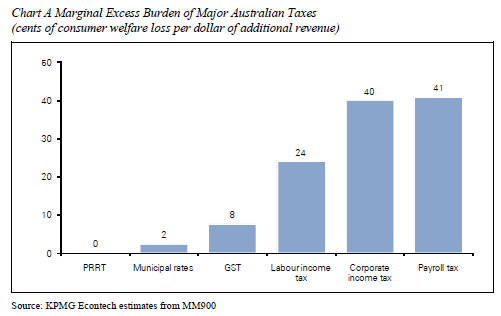
Substantial efficiency/productivity gains could, therefore, be made by shifting Australia’s tax base away from productive enterprise towards both consumption (e.g. GST and fuel excise), as well as taxes on land and resources (e.g. resource rent taxes and a broad-based land tax). The marginal excess burden from GST is just 8%, according to the Henry Tax Review, whereas it is near zero for taxes on land and resources. In any event, they compare very favourably against personal (24%) and company taxes (40%), offering the nation large pay-offs from fundamental tax reform.
If the Government was truly interested in boosting productivity and living standards, as well as seeing Australia through the unwinding of the mining boom and population ageing, it would place genuine tax reform high on its “to do list”, rather than taking temporary actions to plug immediate Budget holes.
unconventionaleconomist@hotmail.com