
I know, we’ve heard it all before, but Roger Bootle, managing director of Capital Economics, believes that Japan’s massive accumulation of debt is nearing a tipping point. From The Telegraph:
…across the Pacific a serious debt problem is still building in Japan, [which is] a slow burner…
As a share of GDP, government debt has been growing since the early 1990s. This is the result of the long-running weakness of economic growth, repeated fiscal stimulus packages and a long period in which the overall price level has stagnated or fallen. Japan has managed to muddle through, but it now looks as though it is close to a tipping point.
The scale of the problem is staggering. Japan’s net government debt is about 140pc of GDP. This is way ahead of the US, which is on 87pc, and not that far below Greece. What’s more, it is easy to see the ratio increasing further. The IMF expects net debt to rise to 148pc of GDP over the next five years. In fact, if the economy performs badly, inflation remains low or borrowing costs rise, debt could easily follow an explosive path, with the ratio quickly rising towards 300pc of GDP…
If Japan followed anything like this path, then some form of default would eventually become inevitable…
Japan suffers from another major obstacle, namely that its debt is overwhelmingly held by Japanese financial institutions, including banks. A default would land the financial sector with massive losses and could cause a catastrophic financial crisis.
The orthodox way to tackle debt is to impose austerity via cuts to government spending or increases in taxes. In fact, Japan will increase its consumption tax in April and quite considerable deficit reduction is promised for the next few years.
But this runs into two problems that are familiar from a European perspective. First, such austerity is not popular and the politicians in Japan may yet baulk at the scale of the tightening to be imposed.
Second, austerity tends to reduce GDP…
Faster economic growth would help but is in practice difficult to achieve… Japan faces a huge demographic hurdle. It simply isn’t making enough Japanese. The size of the workforce is already falling and will continue to do so for decades…
The way out for Japan is to try to engineer a higher rate of inflation, perhaps much higher than the current 2pc target. For any given rate of increase of real GDP this would give a higher rate of growth of nominal GDP, that is to say, expressed in money terms. With debt fixed in money terms this would, other things being equal, bring down the debt to GDP ratio.
Many commentators blame the bursting of Japan’s joint property and share market bubbles in the late-1980s for the economy’s malaise and the build-up of debt. I, however, place the most of the blame on Japan’s ageing population and poor demographics, which has significantly reduced the proportion of workers in the economy, in turn crimping growth, reducing budget revenues and increasing outlays, and placing downward pressure on asset values (and prices more generally):
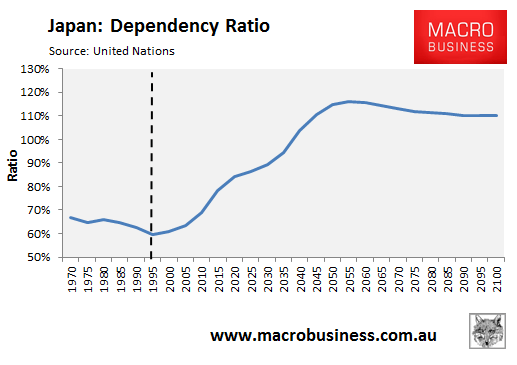
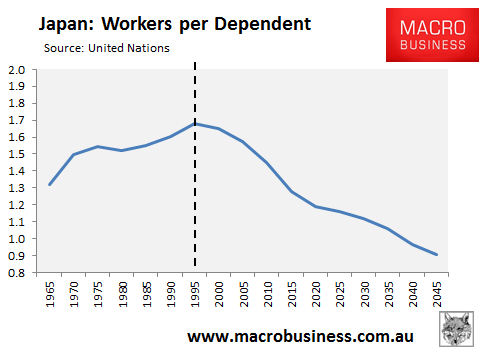
Unfortunately for Japan, the ageing of the population and rising old age dependency still has decades further to play-out, which makes a day of reckoning on its debt all but inevitable in my view: as the proportion of workers declines, Japan’s debt burden will increase, other things equal.
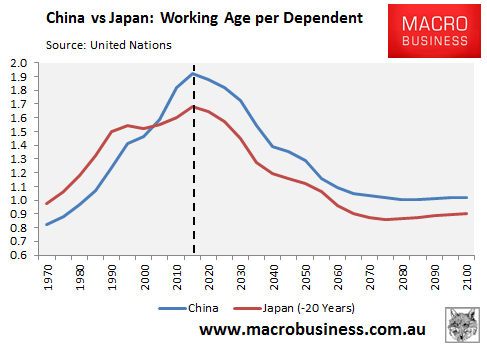
What is also worrying from Australia’s perspective is that its biggest and most important trading partner – China – is facing similar demographic headwinds to Japan, albeit 20-years later, which should ultimately curb growth and thwart its development (see next chart).
The above chart also explains why I am bearish on the Chinese economy over the longer-term.
