
Cross-posted from Kate Mackenzie at FTAlphaville.
At the end of this month, The Oil Drum will be archived after eight years.
A flurry of commentary when this was first announced concluded that it’s shutting down because of the demise of peak oil. Noah Smith, Forbes and Reuters’ John Kemp, among others, have concluded that extraction from new sources, particularly shale gas and oil in the US, have killed the idea of peak oil and, in turn, The Oil Drum. As an explanation for TOD’s impending closure, it sounds neat — but it’s not correct.
Firstly, it’s a bit of a stretch to call TOD a purely peak oil blog. A survey in 2009showed more than a quarter of its readers didn’t believe resources would constrain economic growth. They even had nicknames for the extremes at either end – the ‘doomers’ and the ‘cornucopians’. A post published on the site yesterday titled “What The Oil Drum Meant” talks more about this. John Kingston wrote at Platts that much of the division was between the geologists and the environmentalists; but we’d argue that the key evolution in TOD has been from a strictly geological focus more on the implications of expensive oil, and away from discussions about oil suddenly “running out”, with the attendant survivalist themes.
Secondly, the state of the peak oil debate plays only a small part in its closure. As ‘Heading Out’, one of the founders of TOD, wrote in a polite response to the Forbes column:
No, gentle readers, the closing of TOD is, in my opinion, based on a deliberate but IMHO faulty management decision made in that group a couple of years ago. It was predictable at that time, but it has nothing to do with the coming of Peak Oil, and is not even symptomatic of much of a delay in that arrival.
…Next, onto the inevitable (if somewhat dull) question…
IS PEAK OIL REALLY ‘DEAD’?
We’d argue that no, it’s not, other than in its roughest and simplest form. Sure, you would have a hard time arguing these days that no new sources of oil will be utilised, and that technology will not make previously-inaccessible reserves more economic to extract. But that hasn’t been the premise of peak oil for some time – at least not as it was discussed on The Oil Drum. There, the debate had moved towards a greater focus on “net energy”, and EROEI, or energy returned on energy invested. The idea that energy underpins the economy is one that some economists scoff at, and still more probably choose to ignore. Does that mean it is wrong?
Let’s see what Econbrowser’s James Hamilton, an economics professor at University of California San Diego with a strong interest in energy economics and markets, says. Hamilton is an expert in econometrics and monetary policy as well as energy economics, and authored a fascinating paper on the link between high oil prices that the US recession of late 2007 – mid-2008. He also wrote the excellent post “How to talk to an economist about peak oil” in 2005, a very polite and clear attempt to bridge the chasm between geologists, engineers and economists on the subject.
Hamilton in April surveyed the state of ‘peak oil’ today, comparing the contrary views expressed by T. Boone Pickens and Daniel Yergin back in 2005. He points out that while oil production indeed rose by 4m b/d between 2005 and 2012, more than half of the increase “has come in the form of natural gas liquids– which can’t be used to make gasoline for your car– and biofuels– which require a significant energy input themselves to produce”.
Meanwhile, tight/shale oil production in the US — the main cause of recent supply optimism — isn’t necessarily disproving the finite nature of oil reserves, either:

He adds:
Texas production in 2012 was still 1.4 mb/d below the state’s peak production in 1970, and I haven’t heard anyone suggest that Texas is ever going to get close again to 1970 levels. Production from any individual tight-formation well in Texas has been observed to fall very rapidly over time, as has also been the experience everywhere else.
Figure 6. Type decline curve for Eagle Ford liquids production. Source:Hughes (2013).
Hamilton looked about a year ago at an IMF paper which compared peak oil forecast models and EIA forecasts, and found that neither had fared particularly well:
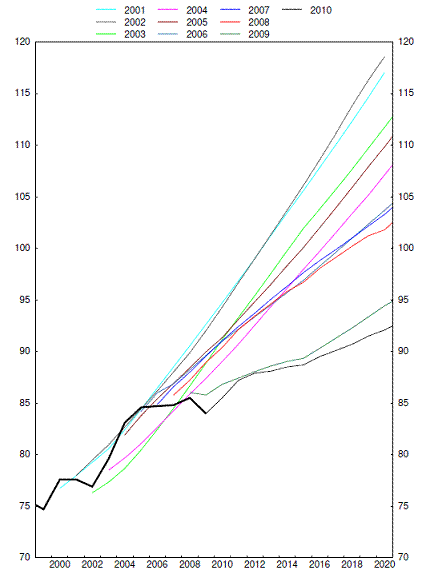
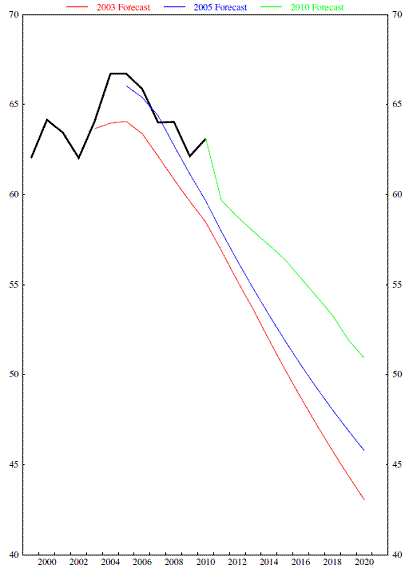
Hamilton concludes:
We like to think that the reason we enjoy our high standards of living is because we have been so clever at figuring out how to use the world’s available resources. But we should not dismiss the possibility that there may also have been a nontrivial contribution of simply having been quite lucky to have found an incredibly valuable raw material that for a century and a half or so was relatively easy to obtain. Optimists may expect the next century and a half to look like the last. Benes and coauthors are suggesting that instead we should perhaps expect the next decade to look like the last.
