
Javier Blas, energy and commodities columnist at Bloomberg, posted the following chart on X (Twitter) showing how the International Energy Agency (IEA) has consistently underestimated global coal demand, which is running around 1 billion tonnes higher (~9%) than the agency had expected only five years ago:
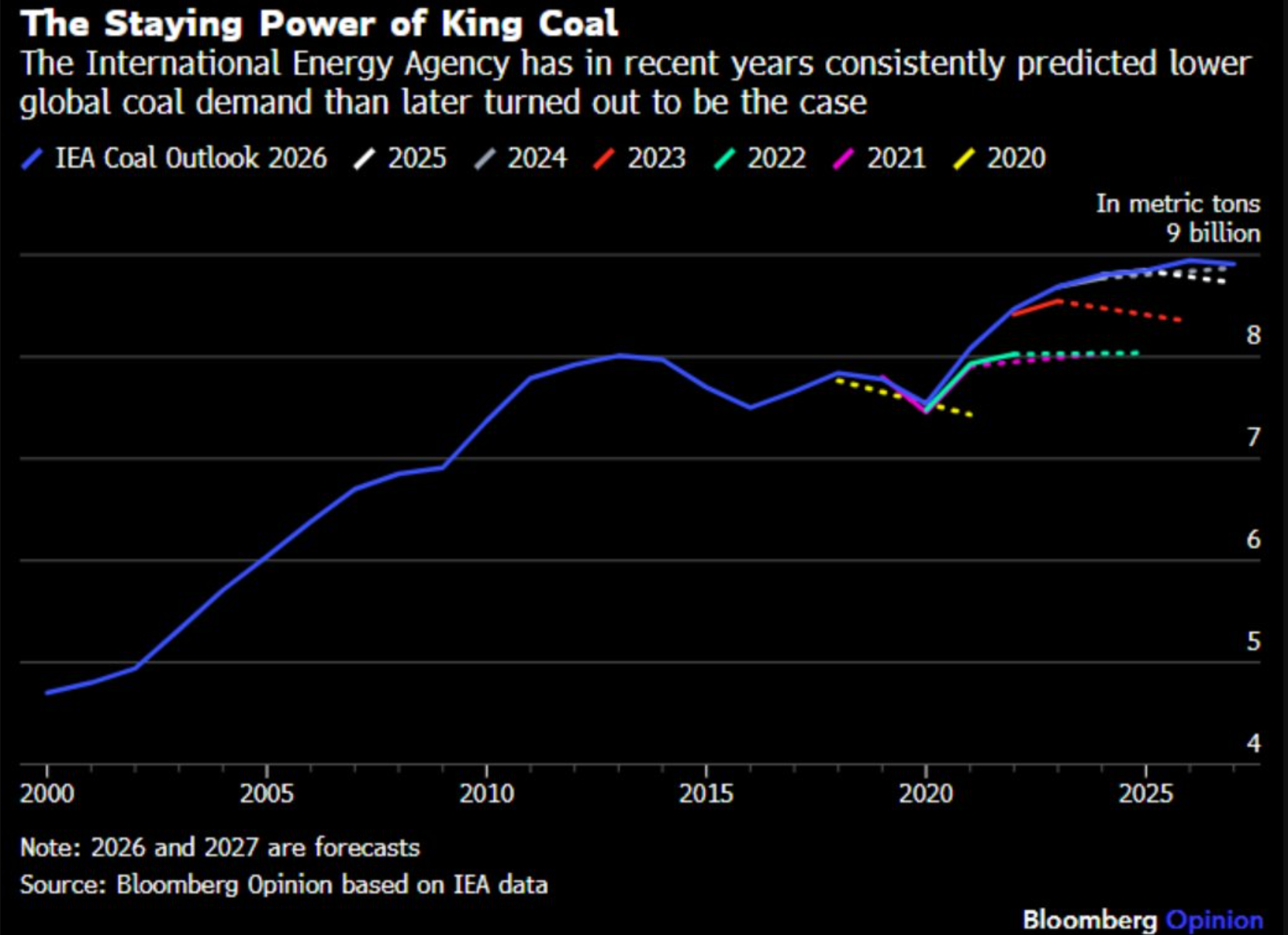
“The forecasting error equals to the anual demand of the EU, Japan and the US — combined”, Blas noted.
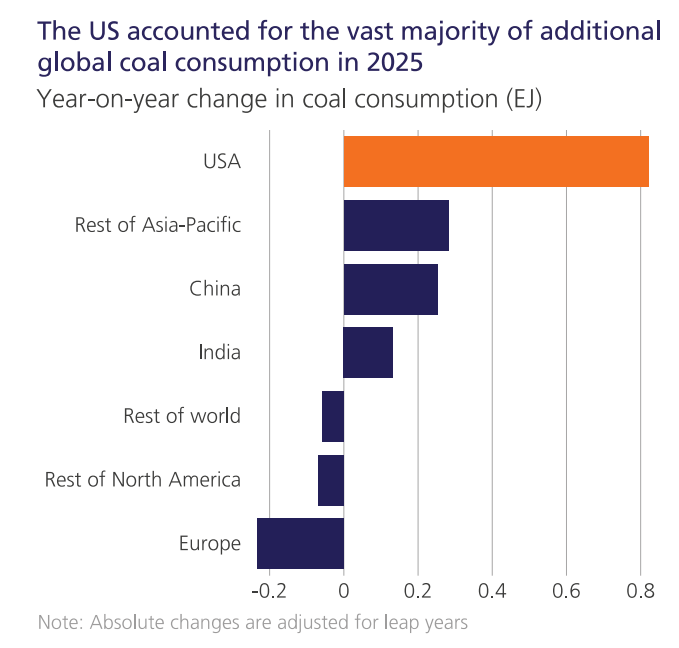
The 2026 Statistical Review of World Energy, considered the gold standard for tracking what powers the world, was released in July and revealed that global coal consumption hit a record high after growing by 0.7% in 2025.
China’s coal consumption only grew by nearly 0.3% in 2025 (adjusted for the leap year), India’s coal consumption increased by 0.6% year-on-year, the United States’ by 10%, and the rest of Asia-Pacific’s by around 1.0%.
Source: The 2026 Statistical Review of World Energy
“The Asia-Pacific region continued to dominate the global coal system, accounting for 80% of global production (144.8EJ) and 83% of global consumption (138.1EJ)”, noted the Statistical Review of World Energy. “China alone represented 52% of global production and 56% of global consumption”.
“The biggest driver increasing global coal demand was the US, whose 2025 coal use expanded by 0.8EJ to 8.73EJ, an increase of 10%”.
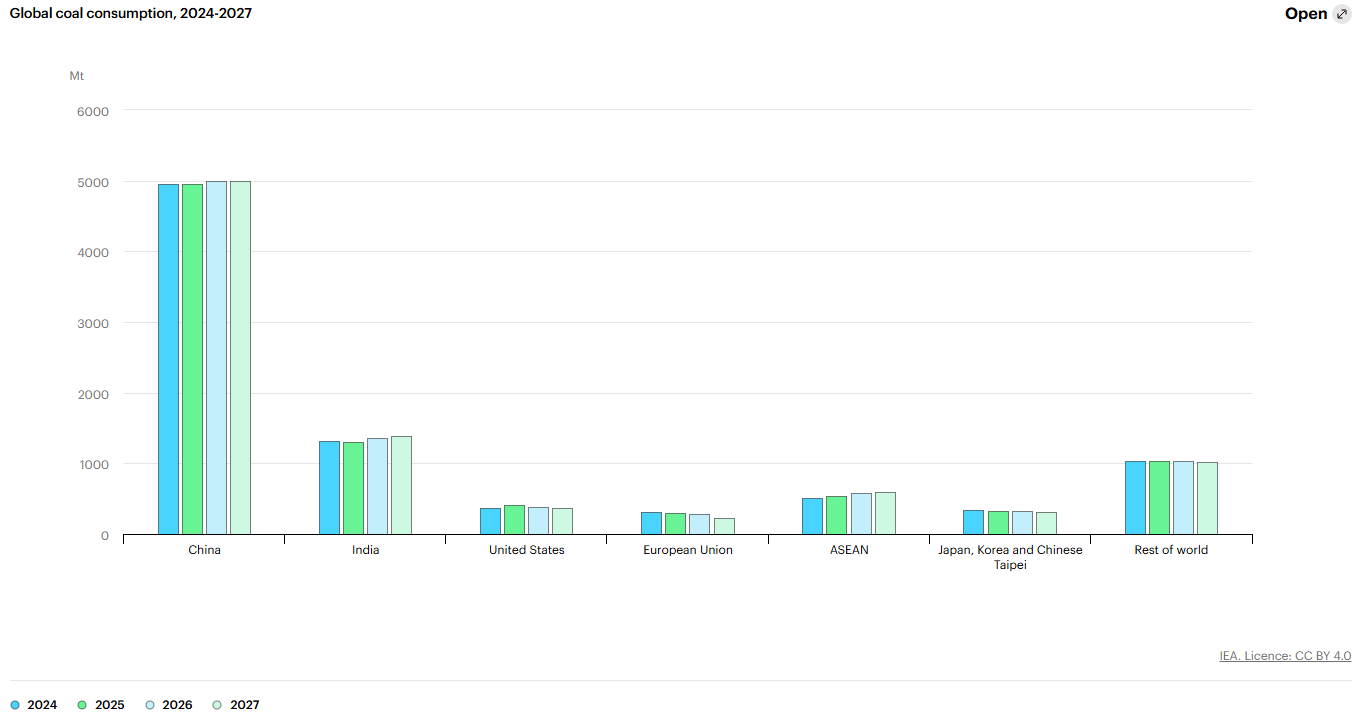
Meanwhile, the IEA’s Coal Mid-Year Update, released last week, revealed that “Global coal demand rose by 0.3% in 2025 to 8.84 billion tonnes (Bt), narrowly surpassing the previous year’s record high”.
“Global coal demand is set to increase by 1.2% in 2026 to reach 8.94 Bt, reversing previous forecasts of a decline. The change mainly reflects the crisis in the Middle East and an unusually strong El Niño weather pattern”, the IEA notes.
“China’s coal demand is expected to increase by 1% in 2026 to 5 Bt, following the upward revision of earlier forecasts”…
“Coal demand in India is expected to return to its historical growth trend in 2026, following last year’s temporary decline. Rising electricity demand will continue to support coal use in the power sector, despite the rapid expansion of renewable capacity”…
“Overall, India’s coal demand is expected to increase by 4.2% to reach 1 353 Mt in 2026”, noted the IEA.
Source: IEA
Other data also point to rising global coal consumption in the years ahead.
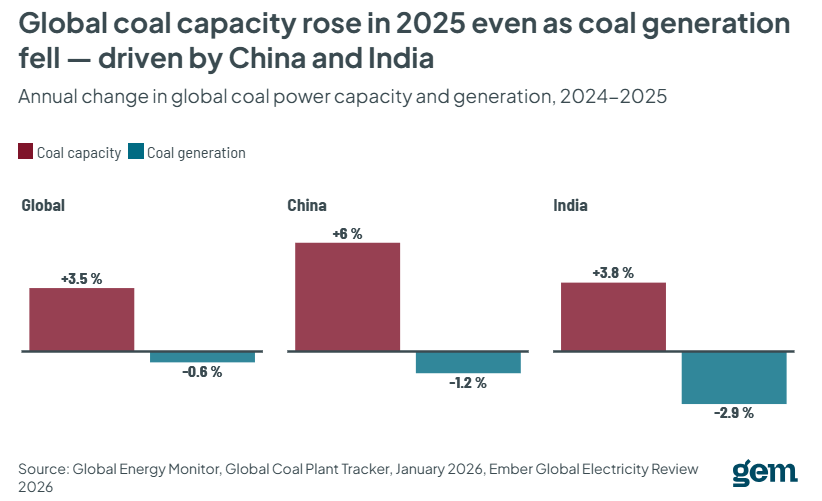
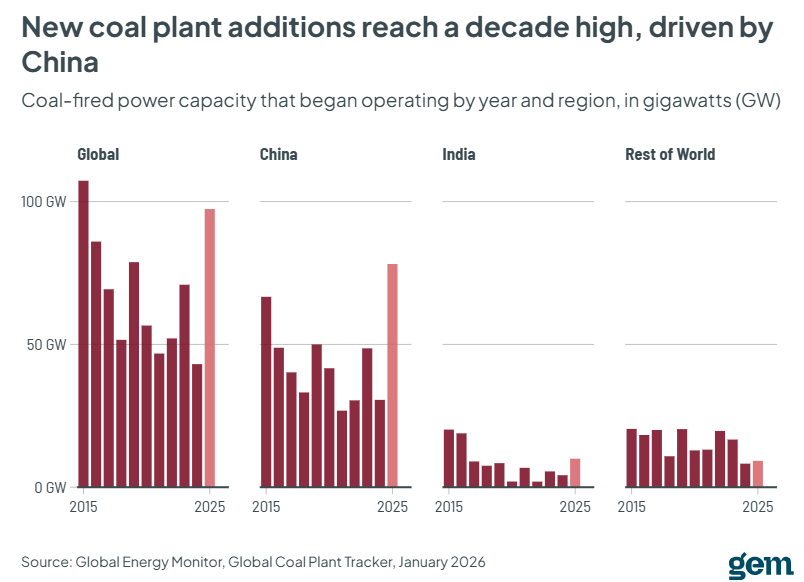
The Global Energy Monitor’s Boom and Bust Coal 2026 report, released in May 2026, noted that “new coal power capacity additions increased by 3.5% to reach one of the highest levels on record, even as coal-fired electricity generation declined by 0.6%”. China and India led the expansions:
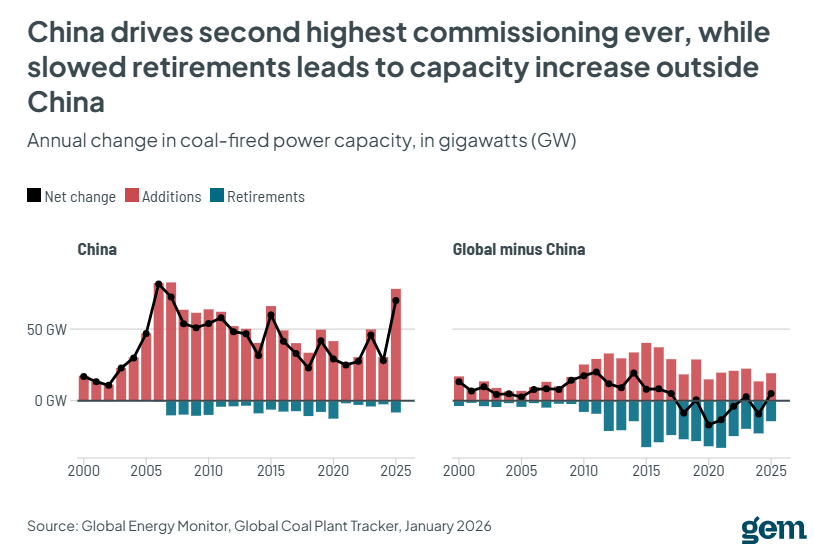
Meanwhile, the commissioning of new coal plants globally hit near-record-high levels in 2025, according to the Global Energy Monitor:
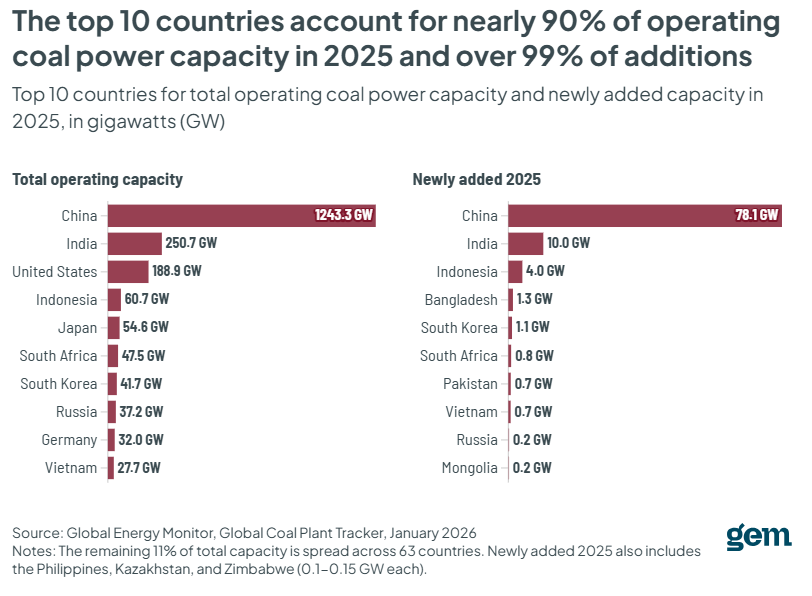
“Global coal plant commissioning in 2025 was heavily concentrated in China, where new coal capacity additions reached a decade high of 78.1 GW. India also saw a rebound in coal commissioning compared to recent years with 10 GW added, although additions remained below mid-2010s levels. Globally, capacity added in 2025 totaled 97.4 GW, the second-highest on record behind only 2015 (107.3 GW)”.
The chart below from the Global Energy Monitor also makes it clear that Australia’s coal consumption is a rounding error on the world stage:
China and India also continue to dominate new coal proposals and construction activity:
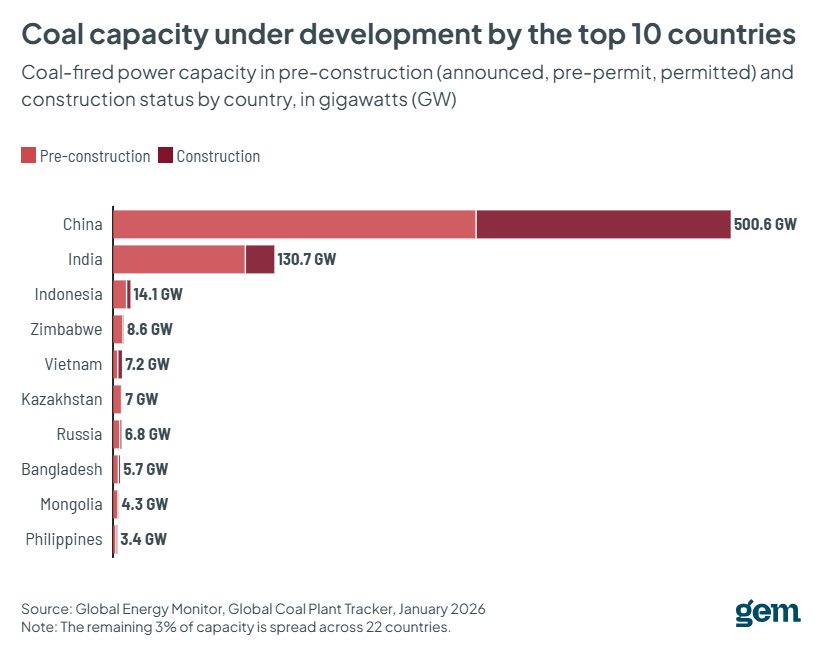
“New proposals and construction activity were once again dominated by China — and to a lesser extent India — helping to drive a 12% expansion in coal power under development globally, from 633 GW in 2024 to 710 GW in 2025”, noted the Global Energy Monitor.
China’s coal demand also appears to have risen so far in 2026. According to Reuters, China increased its thermal power usage by 3.4% year-on-year in the first five months of 2026 to 2.53 trillion kilowatt-hours (kWh), mostly from coal and a small amount from gas.
“Consultancies S&P Global Energy and Wood Mackenzie expect coal-fired power to rebound by 1.5% to 2%, respectively, to 5.4 trillion kWh in 2026 from last year while data analytics firm Kpler expects coal consumed in the power sector to rise some 3% to 2.7 billion tons”, Reuters noted.
Separately, Reuters reported that “China’s new solar installations dropped 66% in the first half of 2026 from a year earlier, as the world’s largest solar market cooled following a rush to connect projects before pricing reforms took effect last year”.
China’s curtailment of wind and solar power also soared 49% to 360 TWh in H1 2026, mainly due to insufficient transmission infrastructure.
India’s coal demand is also forecast to soar.
A recent government report, “Scenarios Towards Viksit Bharat and Net Zero: An Overview (Vol. 1)”, outlined India’s strategic pathways to achieve two major goals by 2047: becoming a developed nation (Viksit Bharat) and reaching net-zero carbon emissions.
The report projects that India’s coal consumption will increase dramatically until 2047, even as the country pursues its net-zero emissions target by 2070 to support economic growth and energy demand:
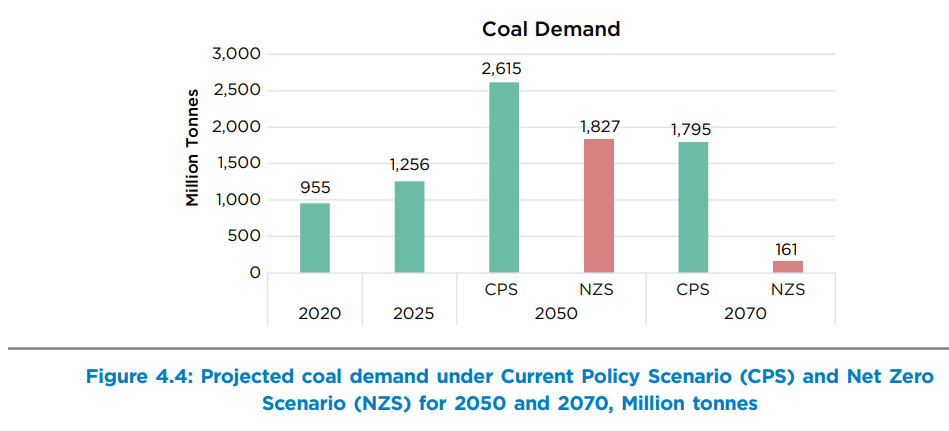
Under the Current Policy Scenario (CPS), long-term demand could more than double to 2.615 billion tons by 2050, up from 1.256 billion tons in 2025.
Even in the net-zero scenario (for India, the net-zero goal is 2070), coal demand will rise to 1.827 billion tons by 2050, up 45% from 1.256 billion tons in 2025.
Coal-to-chemicals and coal-to-liquids sectors are booming:
Coal has also provided an alternative to petroleum, notably through China’s expanding coal-to-chemicals sector, where it can replace oil and gas as a feedstock for products such as plastics and fertilisers.
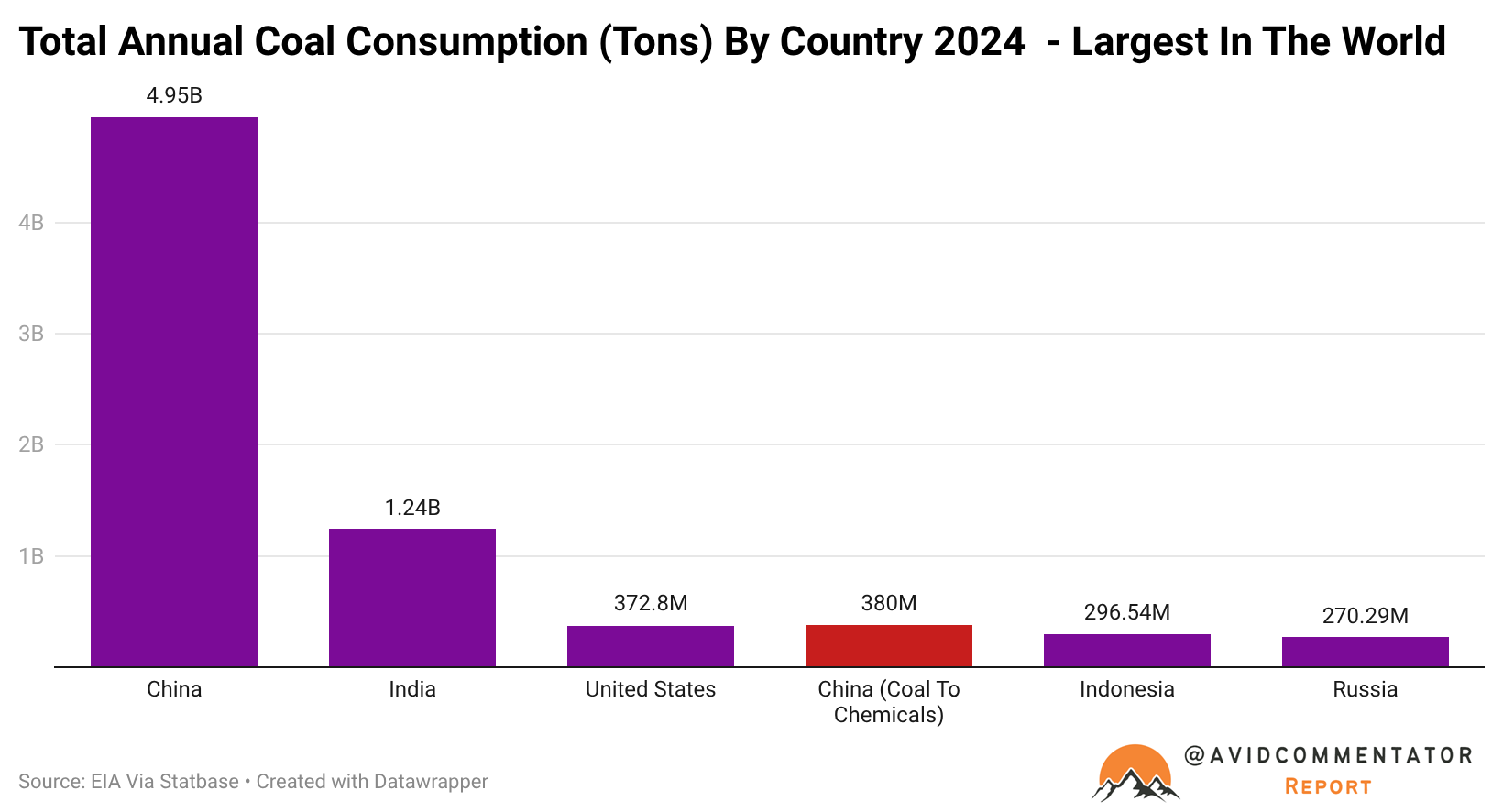
The IEA estimates that China converts around 380 million tonnes of coal per year into fuels and chemicals, which as Tarric Brooker shows below, “would be the third largest consumer of coal globally” where the Chinese coal-to-chemicals industry its own country:
Similarly, India’s Union Cabinet in May announced a nationwide program to gasify 100 million tonnes of coal by 2030.
This is the centrepiece of India’s coal‑to‑chemicals strategy and includes:
- Incentives covering up to 20% of plant and machinery costs.
- Support for 75 million tonnes of coal/lignite gasification under this scheme.
- Long‑term coal linkages extended to 30 years to de‑risk investment.
The government explicitly frames coal gasification as a tool to reduce dependence on imported:
- LNG (over 50% imported)
- Urea (~20% imported)
- Ammonia (~100% imported)
- Methanol (80–90% imported)
The announcement aligns with India’s broader Atmanirbhar Bharat (self‑reliance) agenda and its desire to insulate the economy from global energy volatility.
The Bottom Line:
Coal’s demise has been greatly exaggerated. Instead, global coal consumption will almost certainly rise in the years ahead, alongside carbon emissions. The data presented above is unambiguous.
