
Today, I continue my series on the disaster that is Victorian frontline services for family violence, mental health and child protection.
So far, I have recounted:
- The failure of the Rosy Batty panopticon: MARAM has replaced frontline workers’ judgement with a centralised information-sharing system.
- The failure of AHPRA regulation to hold medical bad actors to account.
- The use of mandatory mental health orders thrown around like lollies to destroy lives.
- How child protection steals children willy-nilly with no accountability.
The next area of coverage is, once again, born of the Andrews Government panic and is, perhaps, the worst deformation of the traditional system of all: the rise and rise of the weaponised social worker.
In 2021, while Dan Andrews had all of Victoria locked up, he undertook a Royal Commission into Victoria’s Mental Health System.
It determined:
- Demand for services had far exceeded available capacity for many years.
- Chronic underfunding had left services unable to meet community needs.
- The system relied too heavily on hospitals and crisis care instead of prevention and community treatment.
- People often faced long waiting lists and fragmented services that were difficult to navigate.
- Many consumers experienced coercive practices such as seclusion and restraint, raising significant human rights concerns.
- Families and carers were frequently excluded from treatment decisions and received inadequate support.
- People living in rural areas, Aboriginal communities, culturally diverse communities and other disadvantaged groups often experienced poorer access and outcomes.
- Suicide prevention efforts were fragmented and lacked coordination.
And replaced it with:
- Establishing a new Mental Health and Wellbeing System focused on recovery and prevention.
- Expanding community-based services so people receive treatment closer to home.
- Creating local mental health and wellbeing services across Victoria.
- Building a dedicated statewide crisis response system that reduces reliance on police and emergency departments.
- Giving people with lived experience of mental illness a central role in designing and delivering services.
- Strengthening specialist services for infants, children, young people and older Victorians.
- Expanding suicide prevention and aftercare programs.
- Creating a stronger mental health workforce through major recruitment and training initiatives.
- Replacing the previous mental health legislation with new laws centred on human rights and patient choice.
- Improving accountability, data collection and system performance monitoring.
Sounds good, eh? The problem is that this adds up to this: replacing doctors and nurses with social workers as the frontline addressing mental health.
That, in turn, means a shift in ethical underpinnings from the four basic tenets of medical care:
- Autonomy – Respect a patient’s right to make informed decisions.
- Beneficence – Act in the patient’s best interests.
- Non-maleficence – “First, do no harm.”
- Justice – Treat people fairly and distribute healthcare resources equitably.
To social, state intervention ethics.
- Respect for persons and human dignity.
- Social justice.
- Professional integrity.
- Human rights.
- Self-determination.
- Advocacy for disadvantaged and vulnerable people.
- Cultural responsiveness.
- Professional accountability.
So far, the suicide rate speaks for itself.
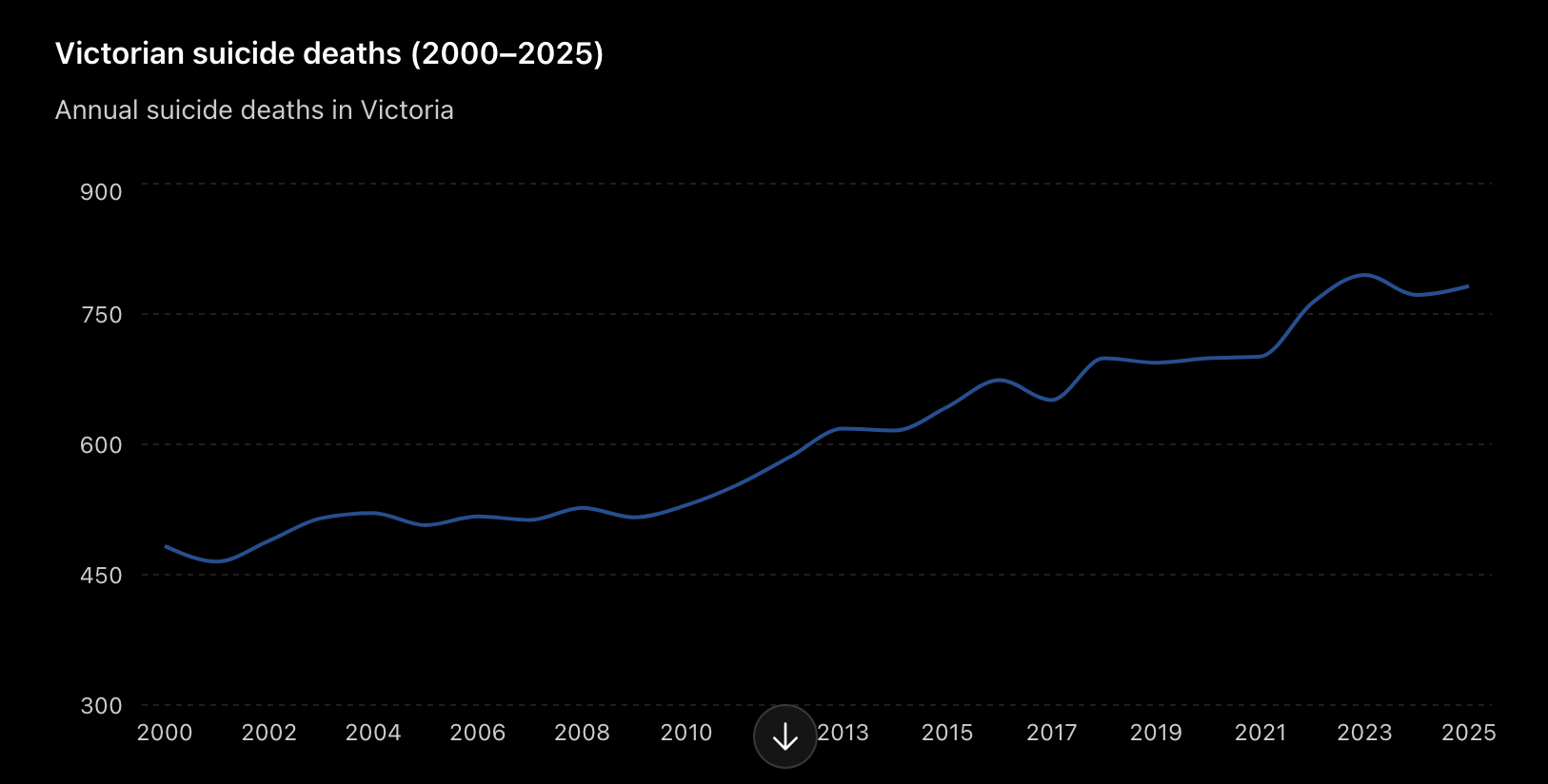
Let me add my observations. During the attack upon my family by the new system of social workers, led by one psychopathic nurse, I spoke with a Centre Against Sexual Assault (CASA) as a secondary victim of sexual assault in early 2025
I was very clear about what I needed. The psycho-nurse had been stalking my wife and children for a decade but with greater intensity in the past 18 months and was causing me ever-greater distress. I asked for one simple thing:” a referral to a victim of crime psychologist”.
That seems a mature and sane thing to do in the circumstances, does it not?
After one brief online consultation with a CASA social worker, I was instead referred to a Crisis Assessment and Treatment Team CATT, the emergency mental health service, to address my “paranoia” and psychosis.
The CATT social workers arrived – one a walking cadaver and the other a daughter of Quasimodo – and I angrily objected, explaining they had no right to be there given my simple request made to CASA for a crime specialist psychologist to call, and CASA had instead very clearly violated my confidentiality and labelled me psychotic.
The two weirdos ignored me, then described me in my medical records as “fat, dirty, dishevelled, drunk”. They took no notice that I was renovating my house and was covered in garden dirt, nor did they notice that I always speak slowly and appear a bit pissed even when stone-cold sober (which is 99.9% of the time).
Later, I discovered that all of these women personally knew the stalker I had named in the initial session, so what I was really witnessing was a nepotistic witch hunt orchestrated by the psycho-nurse.
But the social worker angle was still important. The freak pair felt entitled enough to invade my home. They were aggressive in getting access and didn’t listen at all. They went on to harass my wife about my insanity. Remembering that she was trying to recover from a sexual assault and these social workers were referred from the Centre Against Sexual Assault (CASA).
This was not medical non-maleficence. It was weaponised social justice.
Astonished by their behaviour, my wife and I both rang CASA and complained, and they noted to me that there is NO REGULATORY BODY for social workers, and again noted how aggressive I was. This tactic is the favourite trick of corrupt social workers. Gaslight the shit out of you, then play the victim.
Back to the point, even a failing AHPRA-style debacle would be better than having no regulatory touchpoint at all, because without regulation, these creepy women are loosed upon the community with no control whatsoever.
And guess what happens in these circumstances? They all work from community centres where gossip overtakes scientific enquiry, and they refer to each other with complete disregard for the consequences.
In my case, for the crime of gardening, social workers declared me “fat, substance abusing, dishevelled, paranoid and psychotic.”
MARAM then spread these allegations throughout the system.
And, finally, as the psycho-nurse trap closed, social workers from Child Protection, who were in their early twenties and could not judge between a parent and an elephant, took away my children for three months, annihilating their developmental health, as well as having my 14-year-old son declared insane, which the police refused to serve out of sheer common sense.
They then rang all three of my kids’ schools and declared me a “lunatic”. The schools were so alarmed by the social worker’s behaviour that two of the three broke the law and rang me instead, warning me to stay away lest I be arrested on campus. The witch hunt also, in part, got the third school’s principal sacked.
All of these women worked together in one mental health community centre. It was a fucking lunatic asylum itself.
In short, the push towards undertrained, unregulated social workers (mostly women) taking control of Victorian mental health has created community cauldrons of witch-hunting haters (perhaps not all) and has failed to improve the suicide rate at all.
Though it may have lifted the homicide rate.
