
The Australian Industry Group (AIG) has released an alarming report on the decline in trade apprenticeships.
The latest data on Australia’s apprenticeship system, released by the National Centre for Vocational Education Research (NCVER), show that in the 12 months to September 2025, trade apprenticeship commencements are down almost 10%, while non-trade commencements (traineeships) are down just over 18%.
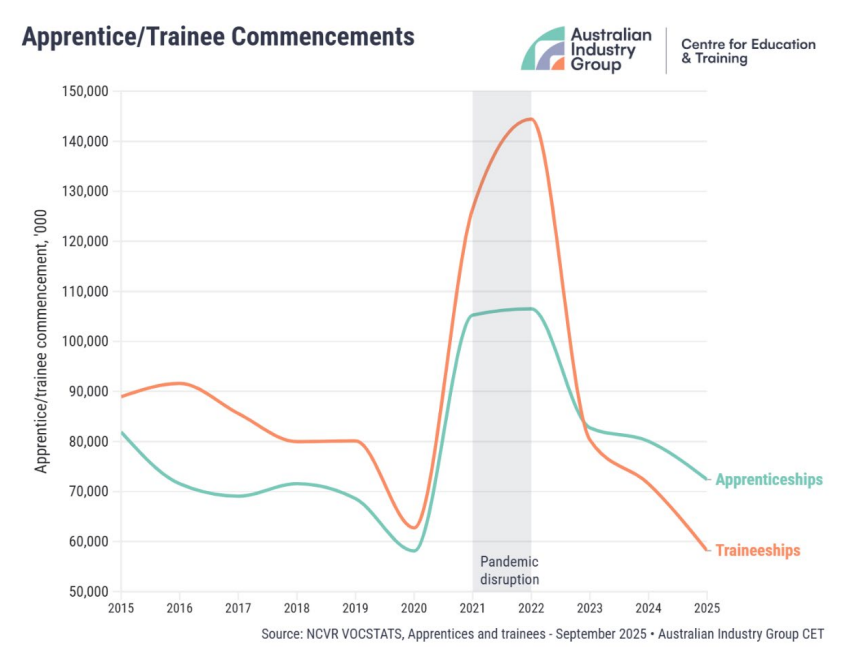
These declines are described as “the canary in the coalmine” for future skills shortages.
“If Australia is serious about increasing housing supply, delivering major infrastructure, managing the energy transition and delivering high-quality services and local manufacturing, we cannot do it without a steady pipeline of skills”, AIG wrote.
“Today’s declining commencements are tomorrow’s severe skill shortages—that risk slowing projects, raising costs, and placing a further brake on productivity”.
Technicians and Trades Workers make up over half of all occupations in persistent shortage, according to Jobs and Skills Australia (JSA).
JSA projects a demand for 195,000 additional trades workers and 236,100 community/personal service workers over the next decade.
Meeting the National Housing Accord target of 1.2 million homes by 2029 requires 116,700 extra construction workers — a 25% increase over business‑as‑usual.
Around half of employers say they would reduce apprentice hiring without incentives. But from 1 January 2026, the federal government reduced incentives for priority occupations outside housing and new energy.
AIG warns this will make apprenticeships less affordable, especially in manufacturing, care, and other sovereign capability sectors.
The AIG report calls for:
- Restoring employer incentives to at least 2025 levels
- Consistent incentives across priority occupations
- A renewed focus on workplace‑based training, not just institutional delivery
- A national effort to rebuild the apprenticeship pipeline
Without this, Australia faces persistent, embedded skills shortages that will slow housing construction, infrastructure delivery, manufacturing capability, and the energy transition.
The Albanese government’s infatuation with university qualifications in making the shortage in the trades worse.
The government’s Australian Universities Accord Final Report set a target of 55% of young Australians having a university degree by 2050.
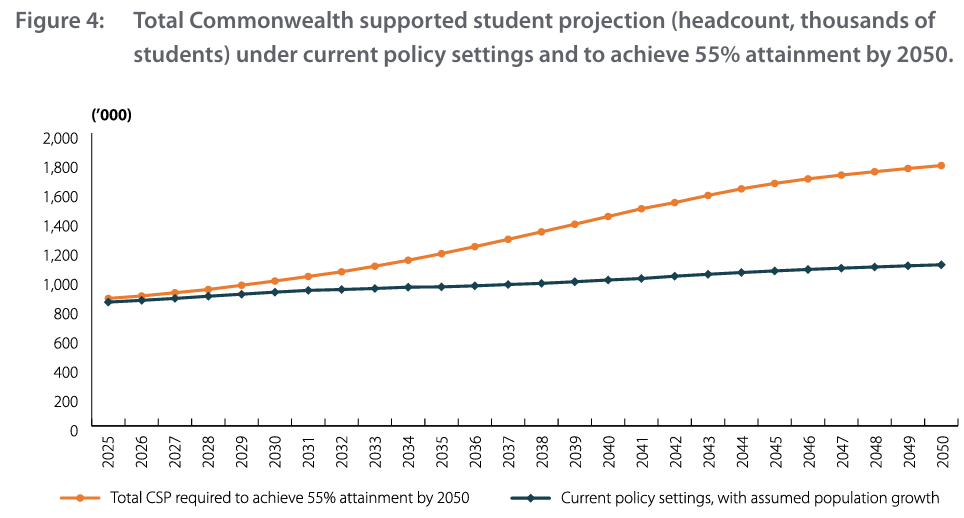
The report states that to meet its 55% university attainment target, “the system will need to more than double the number of Commonwealth-supported students in universities from 860,000 currently to 1.8 million by 2050”.
The federal government would need to divert people away from TAFE and vocational education to meet Labor’s 55% university attainment target. Therefore, it will inevitably make labour shortages in the trades even worse.
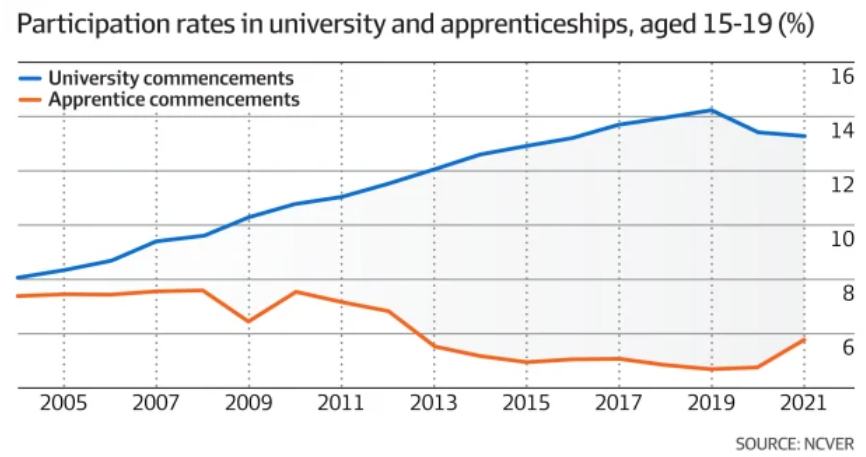
Australia’s immigration policy is also worsening labour shortages.
As reported by the Grattan Institute, “migrants who arrived in Australia less than five years ago account for just 2.8% of the construction workforce, but account for 4.4% of all workers in Australia”.
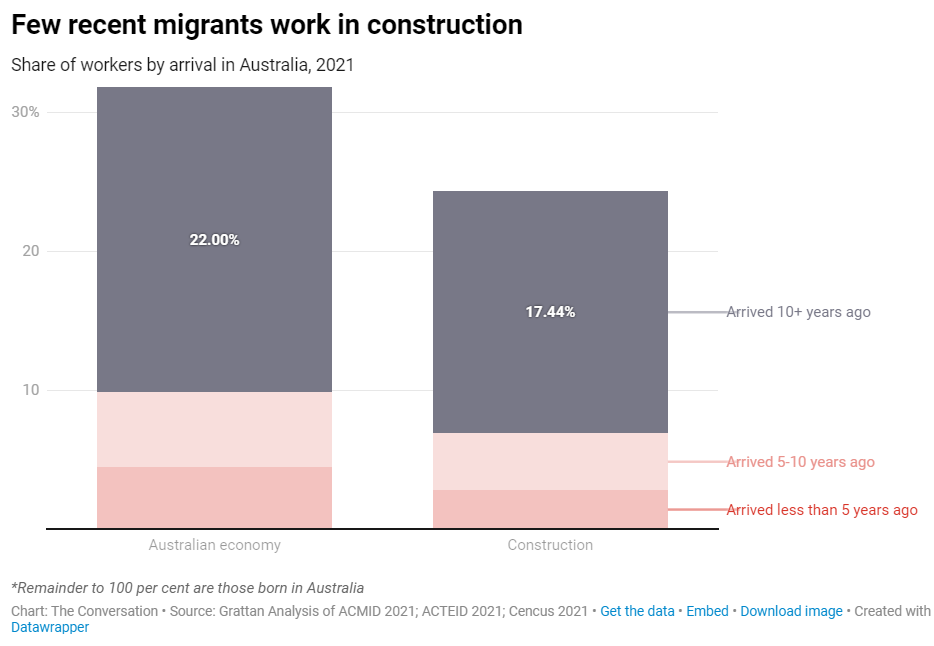
Therefore, migrants have increased the demand for tradies much more than they have increased the supply.
Master Builders Australia also noted in last year’s pre-budget submission how new migrants were shunning the construction industry, exacerbating skills shortages:
The building and construction industry has a proud history of a migrant strong workforce, especially during the 1960s and 70s.
Today, workers who were born overseas make up about 24% of the building and construction workforce.
However, those who arrived within the last five years only represent 2.8%.
Prioritising universities above vocational or trade schools was never in the national interest, socially or economically.
Labor’s Universities Accord will inevitably exacerbate Australia’s skill shortages by starving the trades and flooding the job market with useless university degrees.
