
The ferrous market is doing its usual seasonal thing, but there is not much good news beneath the surface.
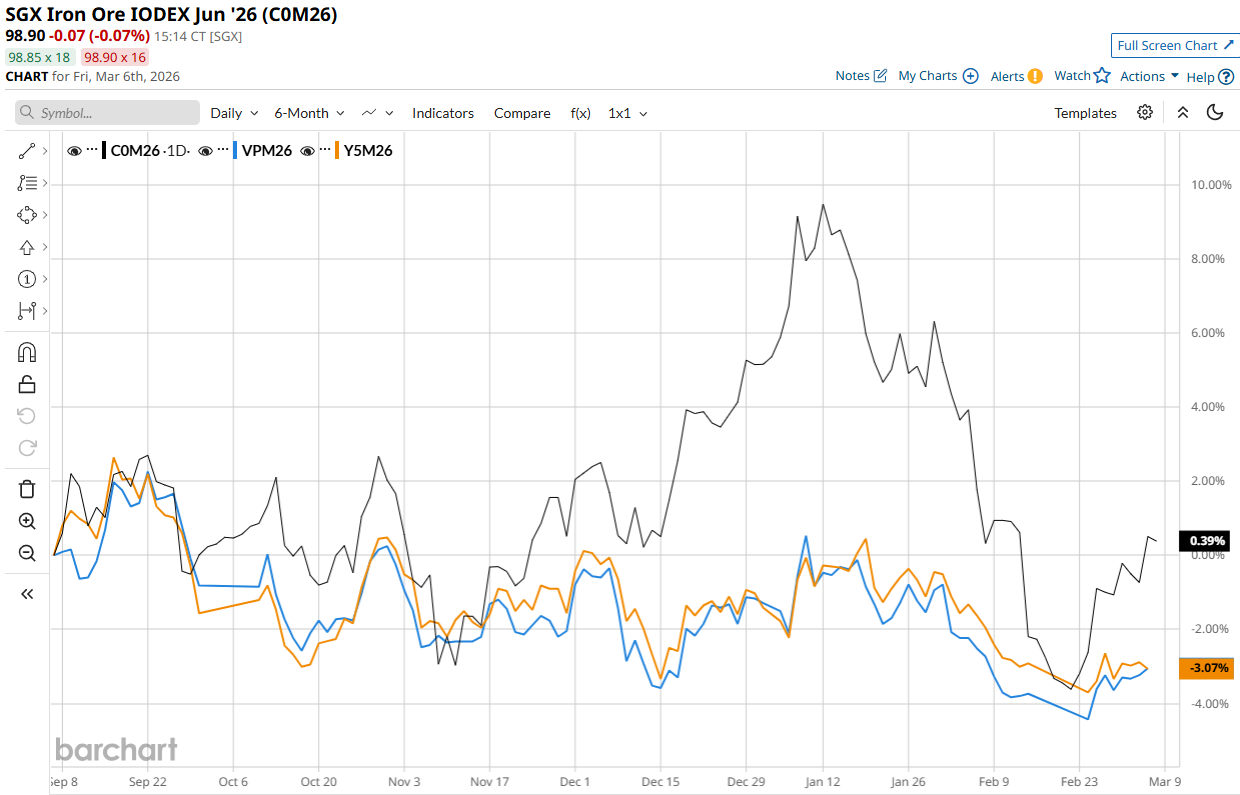
China is imposing stricter regulations on BHP.
China Mineral Resources Group (CMRG) told several traders this week to buy fewer seaborne cargoes of BHP’s flagship products: Mac fines, Newman fines and Newman lumps, according to two people who spoke on condition of anonymity given the sensitivity of the matter.
These products have not yet been subject to the widely reported restrictions introduced in September and November.
Several traders said sales of BHP cargoes were unusually low since last week, a move they attributed to growing concern in the market about a bigger clamp-down from the state-run buyer.
Perversely, this may be supporting prices in the short term. But it won’t in the long run when BHP buckles. It has so far been protected by the debasement trade into copper, which refers to the strategy of investing in copper as a hedge against currency devaluation, but that is now coming apart thanks to oil and DXY.
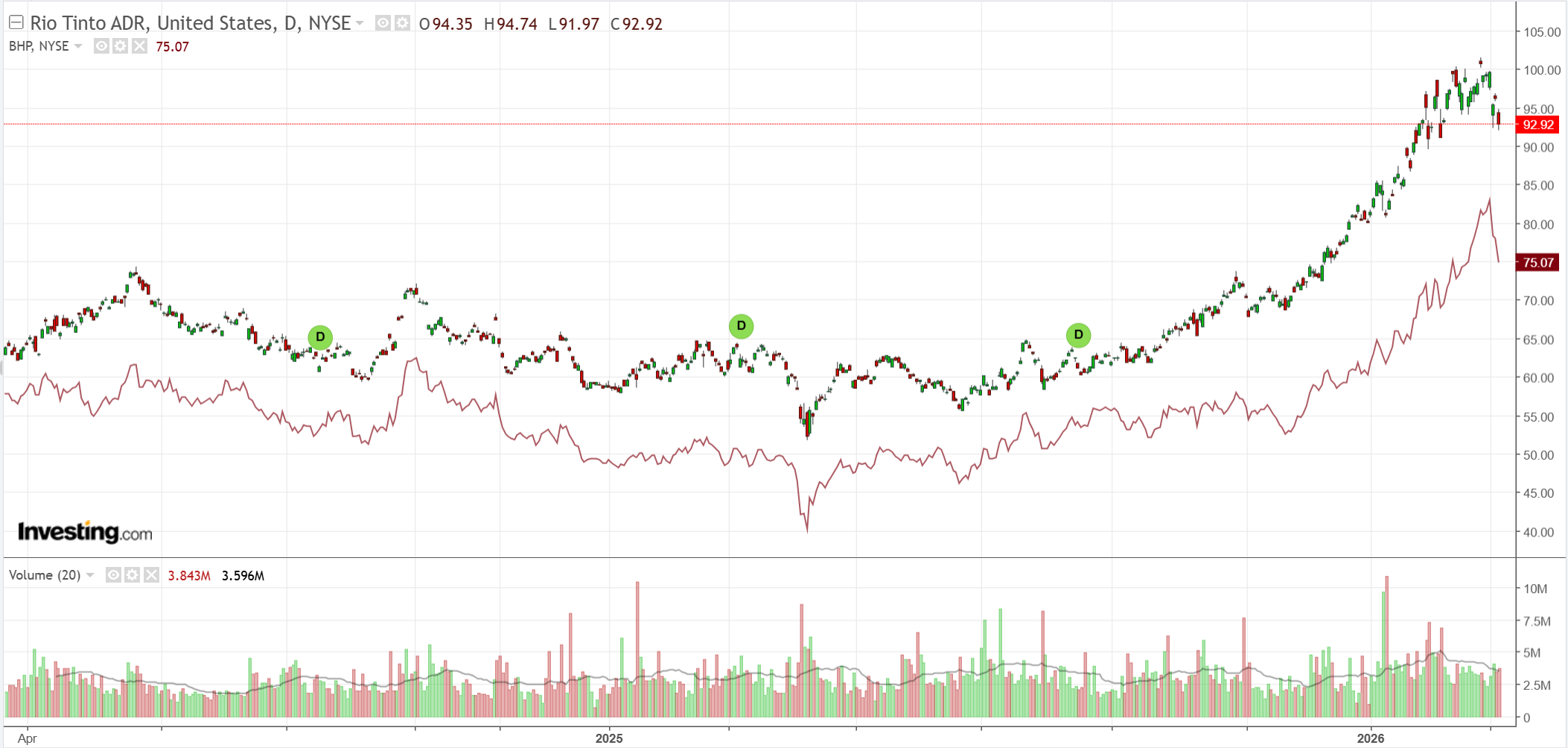
If the BHP share price keeps falling like this, it will have to buckle to Chinese demands, and when it does, more ore instantly hits the market, making a double whammy.
It becomes a triple whammy as BHP then tries to make up lost margin via higher volume.
Meanwhile, the Two Sessions are a bust for iron ore as well, as expected. Here are the key priorities.
Crucial Actions
- Create a robust domestic market
- Urban and rural income growth strategy; special action plan to increase consumption
- Trade-in subsidies of RMB 250 billion (ultra-long bonds)
- RMB 100 billion in special funds for risk compensation, guarantees, and consumer loan subsidies
- Create novel consumption scenarios and initiatives to upgrade service usage.
- Invest more on human development, new urbanisation, and new productivity.
- Create new sources of growth
- Modernising conventional industries
- Start a massive equipment renewal project (using ultra-long special bonds worth RMB 200 billion).
- Establish national advanced manufacturing clusters and upgrade the manufacturing supply chain.
Future and emerging industries
- Execute industrial innovation initiatives while SOEs open application scenarios to expand the low-altitude economy, aerospace, biomedicine, and integrated circuits.
- Provide risk-sharing and investment-growth mechanisms for upcoming industries (e.g., brain-computer interfaces, embodied AI, 6G, and quantum technology).
- The national startup investment guidance fund, Expand V Cusing, is focused on the digital and intelligent economy.
- Expand the “AI+” approach to speed up large-scale industry and commercial applications.
- Construct satellite internet, integrated computing-power networks, ultra-large computer clusters, and enhanced “5G+Industrial Internet.”Boost self-reliance in science and technology
- Nationwide mobilisation for breakthroughs in essential technologies and innovative ideas
- More consistent and larger support for fundamental research
- Integrated planning of key science infrastructure and national labs
- Stronger IP protection and quicker commercialisation through pilot testing platforms
- Coordinated education–science–talent reforms to support innovation
Expand on important reforms
- Create a single national market.
- Create a national unified market legislation and standardise the economic conduct of municipal governments.
- Restructuring the systems for investment promotion, bidding, and tendering
- Limit “involution-style” competition by implementing standards, pricing enforcement, capacity limitations, and quality oversight.
- Reforming the economy, taxes, and finances
- Increase the scope of zero-based budgeting experiments and improve budget coordination
- Increase the proportion of SOE capital returns paid to the state
- Optimise the scope, rates, and collection phases of consumer taxes by reforming municipal tax systems.
- Local financial institutions should be reorganised and reduced.
- Expand capital-market reforms to better safeguard investors and draw in long-term capital.
Support for market entities
- Optimise state capital layout and advance SOE reform
- Boost legal protections for private companies’ fair access to markets and property rights
- Enhance the business climate and expedite the resolution of government debt.
- Pilot-based service sector openings (biotech, healthcare, telecoms)
- Decrease in the negative list for cross-border services trade
- Trade upgrading through digital, green, e-commerce, and RMB settlement
- Better incentives for reinvestment and services for foreign investment
- People’s livelihoods are improved by Belt and Road projects that combine significant infrastructural and livelihood initiatives.
- Employment-first policies that prioritise training, social insurance assistance, and subsidies
- expansion of education (preschool, high school, college, and career training)
- Reforming public hospitals and improving primary healthcare capacity
- Pensions, child care, elder care, and disability services expansion
- More robust public cultural programmes and social aid
Accelerate the shift to green
- Reduce the carbon intensity by 3.8%.
- The national low-carbon transition fund and green industrial upgrading
- creation of low-carbon technologies, green fuels, and hydrogen
- Growth and improvement of the market for carbon trading
- Building new grids, energy storage, and power systems
- Reduce hazards and improve security
- Stabilisation of the real estate market through destocking and the acquisition of affordable housing
- organised and rigorously disciplined debt settlement for the local government
- Risk management for financial institutions depending on the market
There is not much here to excite the ferrous trader. The focus is clearly on consumption and technology.
Property is left to local authorities to manage, leading to further price declines.
There is some mention of steel overcapacity rationalisation, but no plan for it so far, and we’ve heard this record before.
Any greening of steel, which I doubt, will be bad for iron ore as well.
The growth target was lowered to 4.5-5%. Fiscal policy was raised only modestly.
The forthcoming Five Year Plan will be much he same.
Ferrous is a bust here.
