‘Sticky’ inflation to force Aussie interest rates higher
CBA economist, Stephen Wu, has released the Bank’s Q2 2023 CPI Preview, which tips one more rate hike from the RBA driven by sticky services inflation:
Key Points:
- We expect headline CPI inflation decelerated to 0.9%/qtr in Q2 23 (6.1%/yr).
- The trimmed mean CPI on our forecast rose by1.0%/qtr (5.9%/yr).
- Given the still very tight labour market we think, short of a material undershoot in the Q2 23 CPI, the RBA will deliver a 25bp hike at their August Board meeting.
Setting the scene:
High inflation remains the key concern for the RBA, as is the case elsewhere.
And the RBA is committed to returning inflation to target. Pleasingly, compared to just a few short months ago, global inflation developments have arguably lowered some of the upside risk around the inflation outlook.
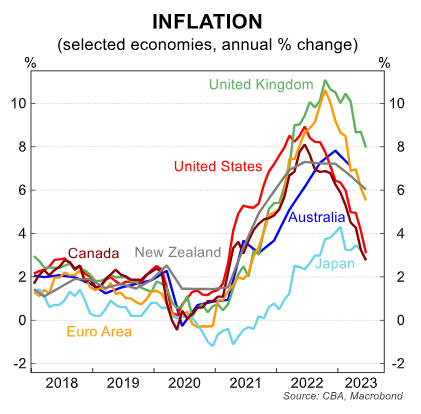
Headline inflation has notably slowed in the US and Canada, where the run rate is now at or below 3.0%/yr. Inflation has also slowed in the UK and in NZ, albeit to varying degrees.
Supply disruptions have largely normalised, with freight costs now back to pre-pandemic levels, and demand has moderated as interest rates have increased.
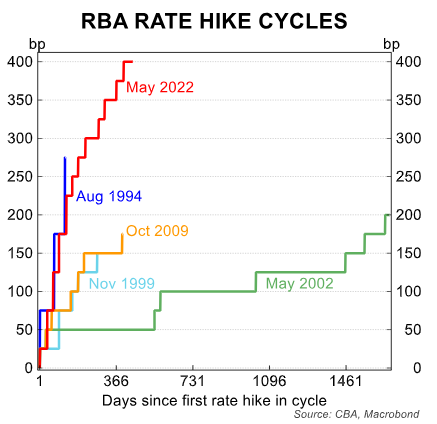
In Australia, the RBA has put through an incredible amount of tightening in a short space of time. The 400 basis points of tightening the RBA has so far delivered will take some time to fully flow through to the economy.
Given the highly indebted household sector in Australia, scheduled mortgage repayments in May increased to around their historical peak of 9.4% of household disposable income.
There is clear evidence that rate hikes are working to slow the economy and contain inflationary pressures.
The Q1 23 figures confirmed that the annual rate of inflation peaked in Q4 22. While the headline CPI rate of 1.4%/qtr was higher than expected, the trimmed mean CPI rate came in at a lower-than-anticipated 1.2%/qtr.
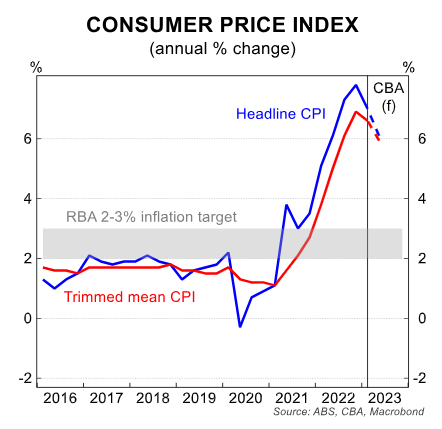
Although inflation remained too high, inflation was clearly moving back towards the RBA’s inflation target.
Demand is moderating at the same time as supply is improving. Household consumption slowed to just 0.2% in the March quarter, and timely indicators show spending remains muted.
Indicators on the supply side show disruptions to global supply chains have largely dissipated.
Material and labour constraints on businesses have also eased further in Q2 23, albeit they still do remain higher than desired.
What to expect in the Q2 23 CPI release:
The ABS’ new monthly CPI indicator provides partial inflation data for the first two months of the quarter.
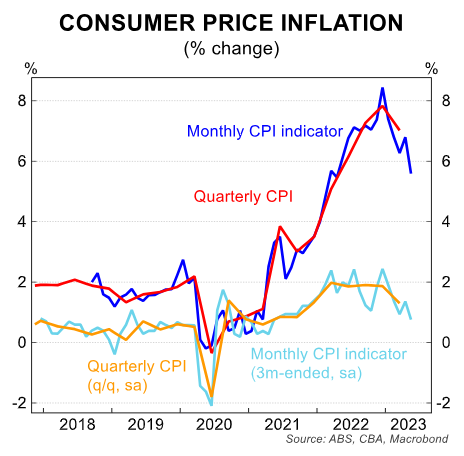
A key takeaway from the monthly inflation data is how volatile the new indicator can be. The April print was higher than expected (released in May), and the RBA responded to the perceived upside risk to the inflation outlook by delivering a 25bp hike in June.
The May print came in well below expectations (released in June), and added to the RBA’s decision to keep the cash rate unchanged at its July meeting.
We expect headline consumer prices rose by 0.9%/qtr in Q2 23. That would represent a further easing in the quarterly inflation pulse and would also see the annual rate fall to 6.1%, from 7.0% in Q1 23.
We expect underlying or core inflation, as measured by the trimmed mean CPI, to have eased to 1.0%/qtr, from 1.2%/qtr previously. That should see the annual rate tip to below 6.0%, from 6.6%/yr in Q1 23.
Such a result would still represent an above-inflation-target outcome, and we do expect some elements of strong price growth in some components of the Q2 23 CPI basket (as we do note in the details in the below section).
But it would be a further deceleration in the pace of inflation and be another sign that monetary policy tightening by the RBA is working as intended.
For a point of comparison, the RBA’s latest forecasts from their May Statement on Monetary Policy (SMP) have the headline and underlying rate of inflation at 1.1%/qtr.
Over the year to the June quarter that would see a headline rate of 6.3% and a trimmed mean rate of 6.0%.
We expect the annual rate of goods inflation to have slowed from the 7.6% rate in Q1 23 to 5.9% in Q2 23.
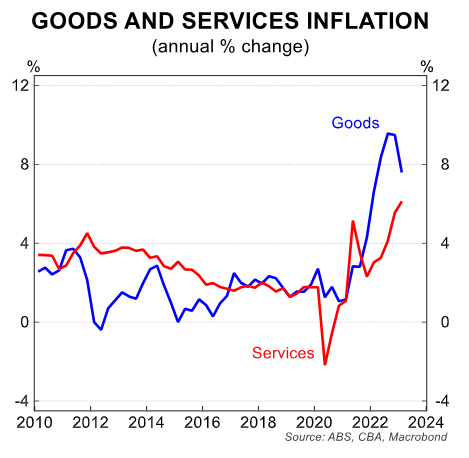
On the other hand, annual services inflation on our calculations stepped up further to 6.3%from 6.1% despite an expected easing in the quarterly impulse.
The evidence from overseas is that services inflation has proved to be stickier on the way down than it has for goods.
In some of our peer economies, labour cost growth –a key input into services – has been above the pace that would be consistent with a return of inflation to central bank targets.
We note that wages growth in Australia of 3.7%/yr is consistent with a return of inflation to target. And real wages growth is deeply negative, in contrast to some of our peers where real wages growth is positive.
The detail of our Q2 23 CPI call
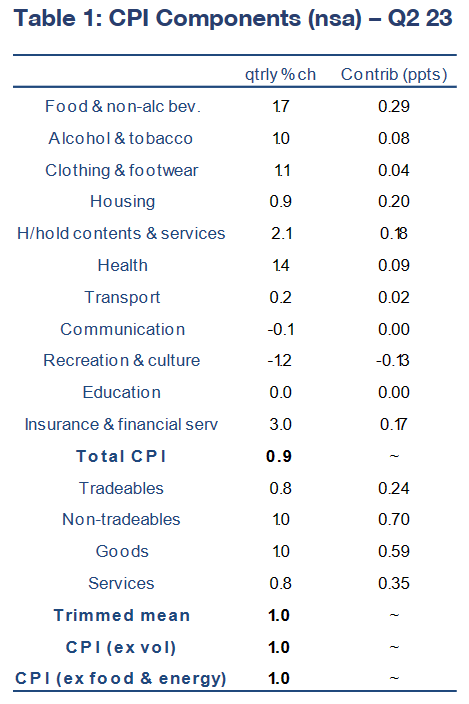
See table 1 below for our detailed forecasts for the Q2 23 CPI.
The main features of our call are as follows:
Food and alcohol & tobacco inflation to remain broadly unchanged from its Q1 23 quarterly pace.
The monthly CPI indicator suggests takeaway and fast food inflation accelerated from 0.9%/qtr in Q1 23 to 2.7%/qtr in Q2 23.
We expect that to offset the expected moderation of food inflation in items such as meat & seafood and dairy.
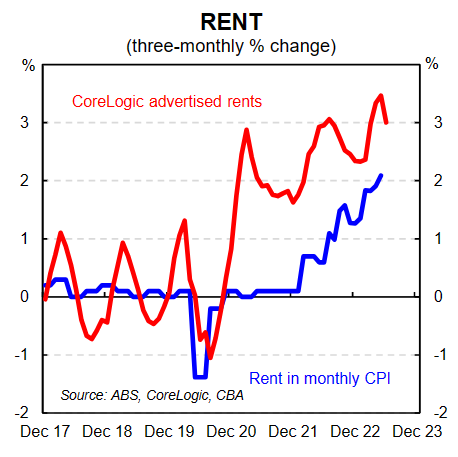
Rent growth to lift to 2.1%, a further acceleration from the 1.6%/qtr rate previously and taking the annual rate to 6.4%/yr.
CoreLogic’s advertised rents series is still rising strongly and in annual terms is running north of 10%.
Very low rental vacancy rates should mean rents push higher over the rest of the year.
New dwelling purchase cost growth for owner-occupiers are expected to ease a touch to 1.1%/qtr but remain above pre-pandemic run rates.
Utilities prices are anticipated to be weighed down by slightly lower electricity prices.
The large 20-30% increase in electricity prices from 1 July 2023 we think will be largely offset by government rebates.
See here for our analysis on the CPI impact of the rebates.
Household contents & services prices rising by 2.1%/qtr, with household goods reversing the post-Christmas discounting in Q1 23.
Household services inflation outcomes are expected to be mixed, with increases in childcare and hairdressing to be offset by a decline in the price of other household services (e.g. gardening services, pest extermination, etc).
Q3 23 should see a large fall in childcare prices.
Insurance & financial services will be an outsized contributor to inflation, with insurance premiums up by 5.3%/qtr in Q2 23 and more than 14% from a year ago.
Premiums are rising in part due to the occurrence of natural disasters, and pandemic-related supply chain issues.
Other financial services, such as fees for legal or accounting services, are expected to increase solidly.
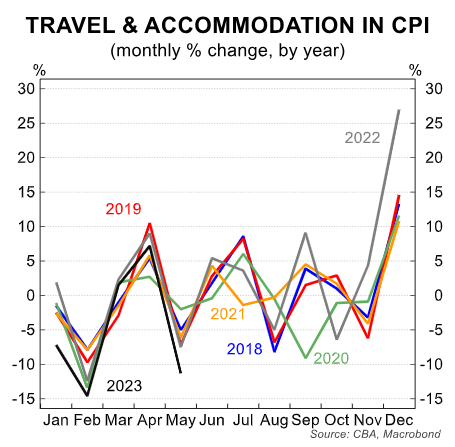
Recreation & culture prices to fall in the quarter, led by a 3.5%/qtr decline in holiday travel & accommodation prices.
Demand for holiday travel remains solid, but prices fell sharply in May after a large increase in April. A 0.7%/qtr increase in other recreation, sport & culture prices will provide a slight offset.
Clothing & footwear prices to increase again following the large 2.6%/qtr decline the previous quarter.
The monthly CPI indicator has shown large monthly variation in clothing prices.
Clothing accessory prices have declined and dry cleaning and other clothing & footwear services inflation has steadily moderated over the past three quarters.
Health inflation to ease to 1.4%/qtr, representing a slower than seasonal increase.
Unlike the large increases in motor vehicle and dwelling insurance to date, health insurance providers have delayed premium increases from their usual April timing to later in the year.
Partly offsetting is the indexation of the Pharmaceutical Benefits Scheme (PBS) safety net threshold to inflation together with the lowering of the co-payment amount.
This means that it will take longer for users to reach the threshold. This should see a smaller than usual decline in medicine costs.
Overall, we expect headline consumer prices to grow at a slower pace than the underlying rate. On our figuring, the trimmed mean CPI increased by 1.0% in Q2 23.
We anticipate some of the large increases in households goods, some food goods items & takeaway, as well as insurance prices to be among the top 15% of CPI items and to be trimmed out.
On the other end of the spectrum, large price declines for domestic holiday travel & accommodation, and smaller decreases in the price of fuel, electricity and pharmaceutical products should see these categories in the bottom of the price distribution and so trimmed out as well.
Finally, our forecasts are for an inflation outcome below the RBA’s latest projections from May. But we don’t necessarily view such an outcome to preclude the RBA from delivering another 25bp rate hike in August.
The RBA Board will receive an updated set of staff forecasts at the upcoming meeting. So the Q2 23 inflation figures, and yesterday’s labour market data, will be viewed in the context of how it influences the RBA’s inflation and labour market forecasts as well as the perceived risks around those point forecasts.
Given that, price pressures for the individual components that make up the CPI basket could well matter here.
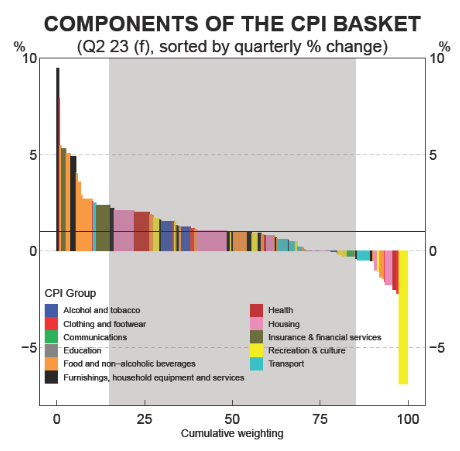
Our base case remains that the flow of data heading into the August Board meeting and the updated set of staff forecasts will not be enough to dissuade the RBA from increasing the cash rate by 25bps in August.
As such, our central scenario remains a 25bp hike, the last of the cycle. A material undershoot of CPI, however, could shift this view.
We will firm up our RBA forecast after the release of the CPI data next week.