Soaring electricity prices a shock to RBA
CBA economist Stephen Wu has published an interesting report examining the impact of soaring electricity prices on Australian inflation:
Large increases in electricity prices will be temporarily masked by rebates
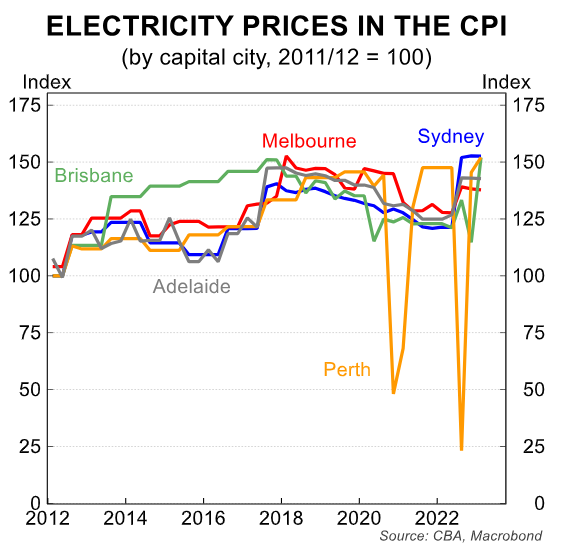
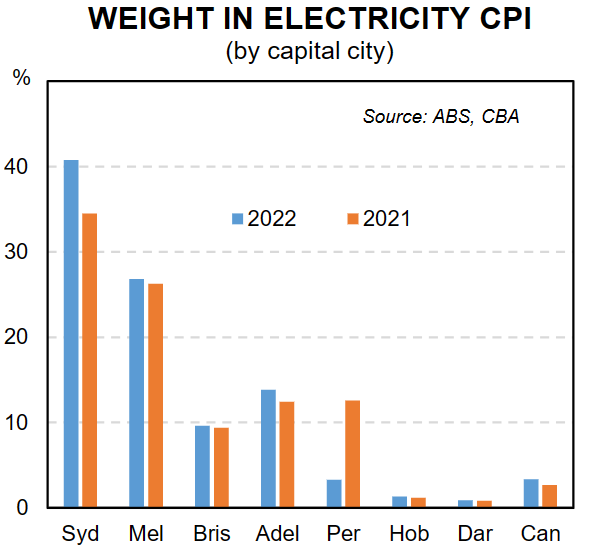
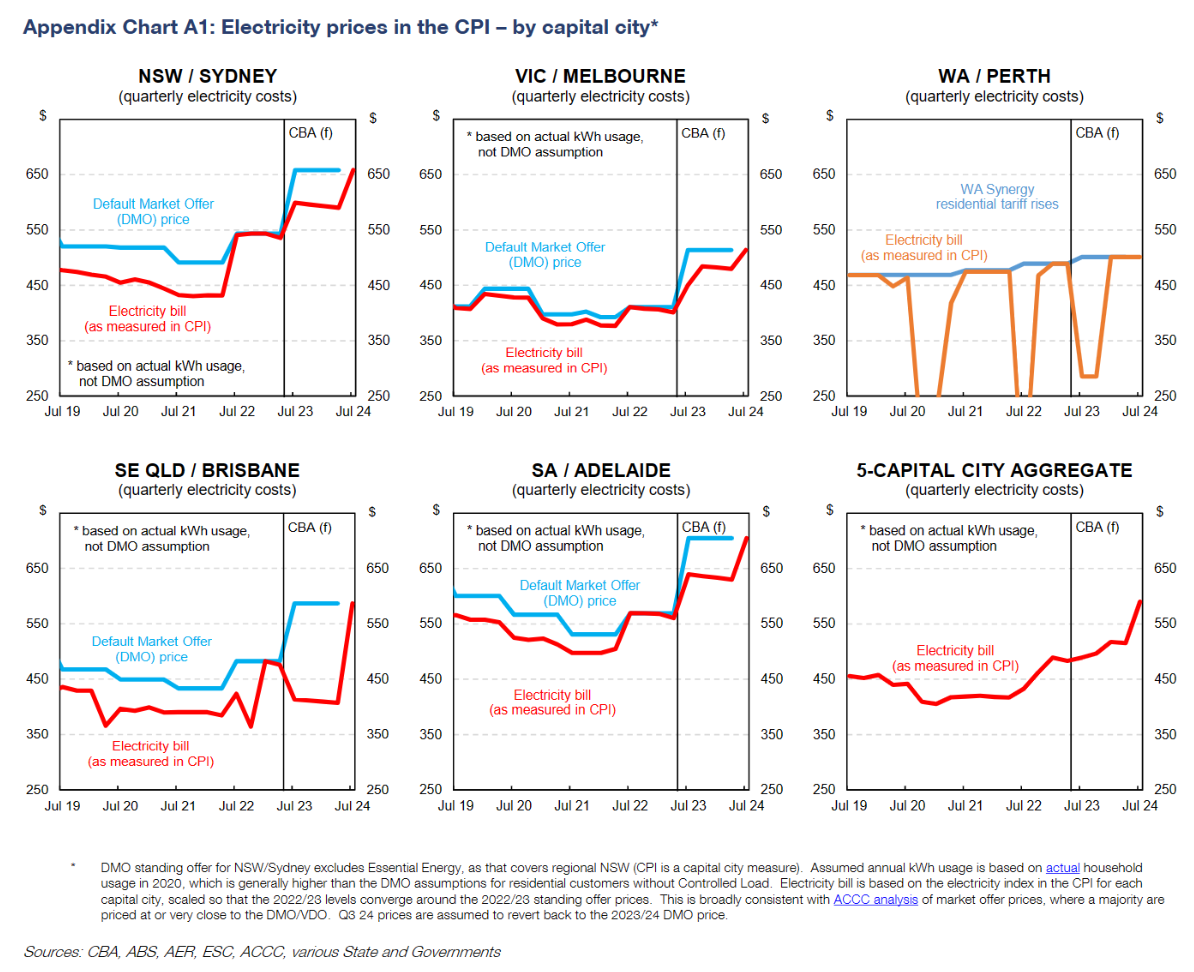
We estimate a profile for electricity prices by building up capital-city based figures and then aggregating. We use a 5-capital city aggregation of Sydney, Melbourne, Brisbane, Adelaide and Perth. These five capital cities account for around 95% of the 8-capital city electricity index.
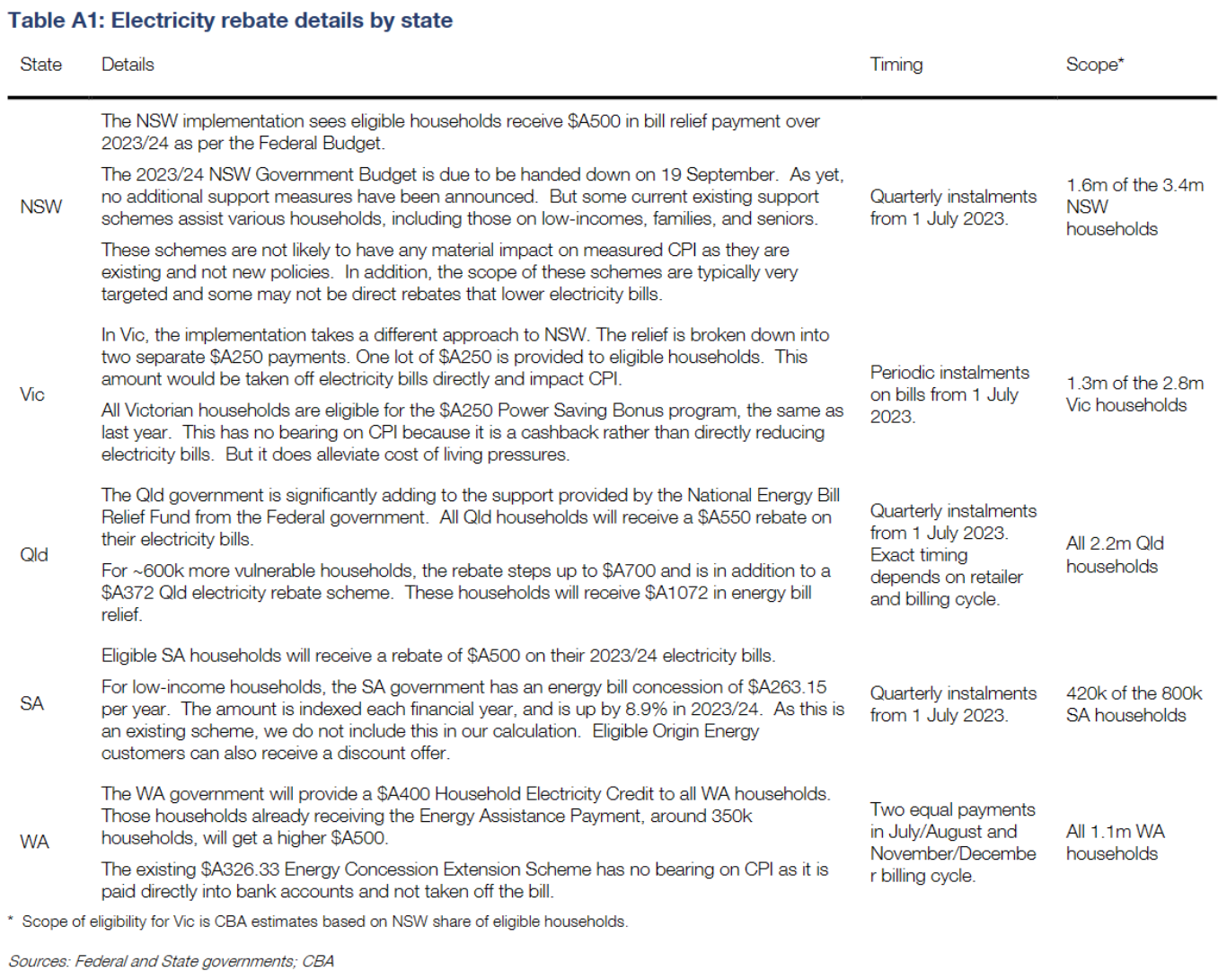
We do this because rebates vary substantially by state/capital city (note that CPI is a capital city measure). Details by state are provided in Table A1.
We assume that market offers increase to the same levels as the regulated standing offer prices.
The Australian Energy Regulator (AER) announced Default Market Offer (DMO) price increases of 20-30% and Victoria’s Essential Services Commission (ESC) announced a 25% increase in the Victorian Default Offer (VDO) price for 2023/24.
In contrast, residential tariffs in WA are increasing by just 2.5%.
We then deduct the relevant rebates in each quarter, calculate the impact for each capital city based on the share of eligible households, and aggregate up to form an aggregate profile.
On our calculations, electricity prices as measured in the CPI will rise by 8% in the 2023/24 financial year. This is a large increase and follows an 11.5% rise in 2022/23.
We expect only a modest increase in Q3 23 (start of FY 23/24), but for the unwinding of these rebates to see larger increases in Q1 24 (due to unwinding of WA rebates) and Q3 24 (unwinding of the remainder states and territories).
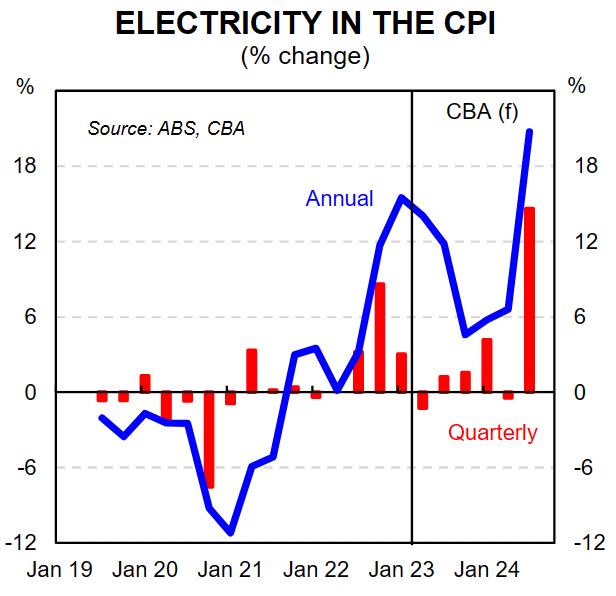
We estimate that absent the Federal and State Government rebates, electricity prices would have increased by more than 20%:
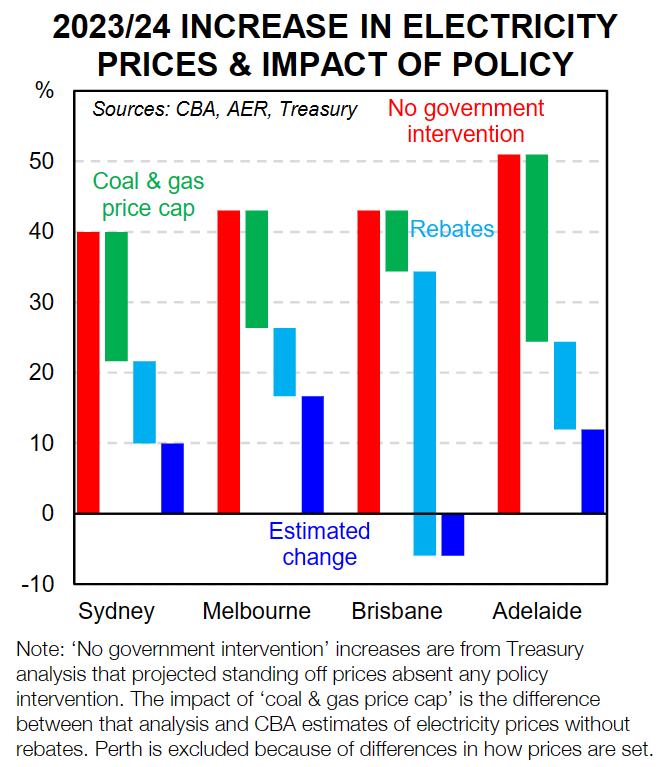
The expected 8% increase in electricity prices at the aggregate level masks large variations between the capital cities. Our calculations suggest that Melbourne will see the largest measured increase in prices, in excess of 16%.
At the other end of the spectrum, households in Brisbane will see a 6% decline in electricity prices in the financial year.
In other words, the combined Qld and Federal Government rebates more than offset the sharp increase in electricity prices in Brisbane. Full details by state are available in Chart A1:
Our estimate is a touch lower than the Federal Government’s forecasts in the Budget for a 10% increase in electricity prices in the financial year.
Our lower estimate could be reflecting the additional measures announced by several State Governments since the Federal Budget and slight differences between the draft DMO and final DMO decision.
Our figures indicate that the State and Federal Government rebates reduce the expected electricity price increase for 2023/24 by 12 percentage points.
Given the 2.22% weighting electricity has in the CPI, this means electricity will contribute 0.18ppts rather than 0.45ppts to overall CPI and similar to the around 0.2ppt contribution in 2022/23.
In other words, headline inflation will reduce by a little over a quarter of a percentage point as a result of the rebates. That is broadly consistent with Treasury estimates.
Overall, these rebates (in conjunction with the gas and coal price caps) will hold down electricity price rises over 2023/24.
They will temporarily subtract from CPI inflation. But, as a temporary price level shift, the unwinding of these measures will conversely add to inflation from 2024.
Assuming prices return to the 2023/24 standing offers once all the rebates unwind in Q3 24 (e.g. what was announced by the AER and ESC), that would see a 14½%/qtr increase in electricity prices.
Another significant increase in the DMO for 2024/25 could see an even larger rise next year. These increases are of course not factoring in any other changes or introductions of rebates next year.
It’s important to stress that there will be a wide range of price outcomes for Australian households.
Many households are not eligible for energy bill relief. And there are additional cost-of-living relief programs that are being provided but we do not consider here (e.g. Victoria’s Power Saving Bonus scheme).
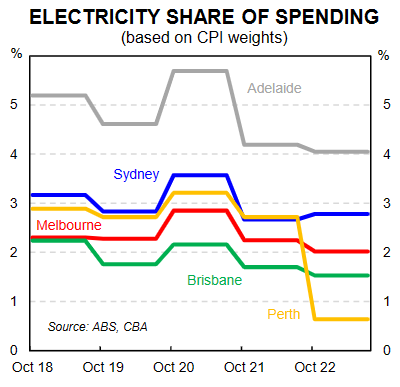
Household spending on electricity also varies greatly by capital city; electricity costs accounted for 4% of total household spending in Adelaide in 2021/22, but just 0.6% in Perth because of rebates.
But the exact impact will depend on consumer response to higher prices
The AER’s DMO sets a price cap for standing offers and is the highest price retailers are allowed to charge consumers.
‘Standing offers’, which are set with reference to the DMO/VDO price, are designed as a safety net for consumers and also to allow for retailers’ costs and margins.
But not all customers are on standing offers. In fact, only 10-15% of households across the National Electricity Market (i.e. NSW, Vic, SE Qld and SA) and 12% of Victorian households are on standing offers.
The remaining 85-90% of households are on market offers. These market offers have increased substantially, converging around standing offer prices, and will increase further in 2023/24(see the ACCC June 2023 report).
As noted above, we think initially market offers will increase to the same level as DMO prices. In WA, price are expected to rise by the same as the 2.5% increase in regulated tariffs.
But there are plausible reasons to think that market offers may be cheaper than standing offers over time.
Given high prices, consumers may be more price-sensitive and willing to shop around. Competition for customers could see retailers offering prices that are below the DMO. And recently, wholesale electricity markets and the price of electricity hedging contracts have eased since the significant ructions of mid to late 2022.
New customers and those that switch retailers could see prices lower than the DMO. For instance, NSW IPART expect offers in the market to “remain 10-20% lower than the DMO”.
The Government has a service at Energy Made Easy designed to facilitate price comparisons. Nevertheless, consumers could take a while to respond.
Government rebates could mean a delay in terms of when consumers actually feel the impact of the price increases. In addition, as electricity is billed in arrears it could be further add to the time taken to respond to higher prices.
Consumers could also change usage in response to the news flow around higher electricity prices, albeit this won’t affect prices in the CPI outside of a potential shift in CPI weights.