
KPMG chief economist Brendan Rynne believes Australia is in store for a prolonged period of economic gloom, brought on by what he states is a “deliberate” policy choice by the Reserve Bank of Australia (RBA).
Modelling by KPMG suggests that unemployment will rise from 3.6% to 4.2% by the close of 2023, before rising steadily up to 4.6% in mid-2024 and reaching a peak of 5% in early 2025.
This suggests an extra 200,000 unemployed Australians in a little under two years.
After a 0.2% increase in real GDP in the first three months of this year, KPMG’s modelling shows a drop in spending would drive growth to almost nil for the remainder of 2023, before a full-fledged recession in the first quarter of 2024.
Annual growth will have fallen below zero by then and will remain negative or flat until early 2025, according to the modelling.
Rynne said Australians should brace for this “prolonged period of economic unhappiness”, but that it would not be “disastrous”.
“It’s not like the ’91 and ’80s recessions. And the reason why that’s the case is consumption: while it’s weak, is being held up by population growth”, he said.
Meanwhile, Corinna Economic Advisory principal Saul Eslake thinks that the RBA might lift interest rates one more time, but that two “would be overdoing it”.
Eslake also agrees with suggestions that the forecast 715,000 net increase in migration across two years might prevent a technical recession.
However, it was “highly likely that the unemployment rate would climb one percentage point over the coming year”, he said.
Recent analysis from Greg Jericho from the Centre for Future Work and The Guardian showed how long it would take for Australian real wages to recover if they grew at the 2002-11 or 2012-20 rates:

According to Jericho, if wages continue to grow at their 2002-11 rate, it will take seven years for real earnings to recover.
If wages continued to increase at their 2012-20 rate, it would take 14 years for real earnings to recover.
We are obviously far more likely to continue the 2012-20 slow growth path (or worse) given our extreme immigration and low productivity growth.
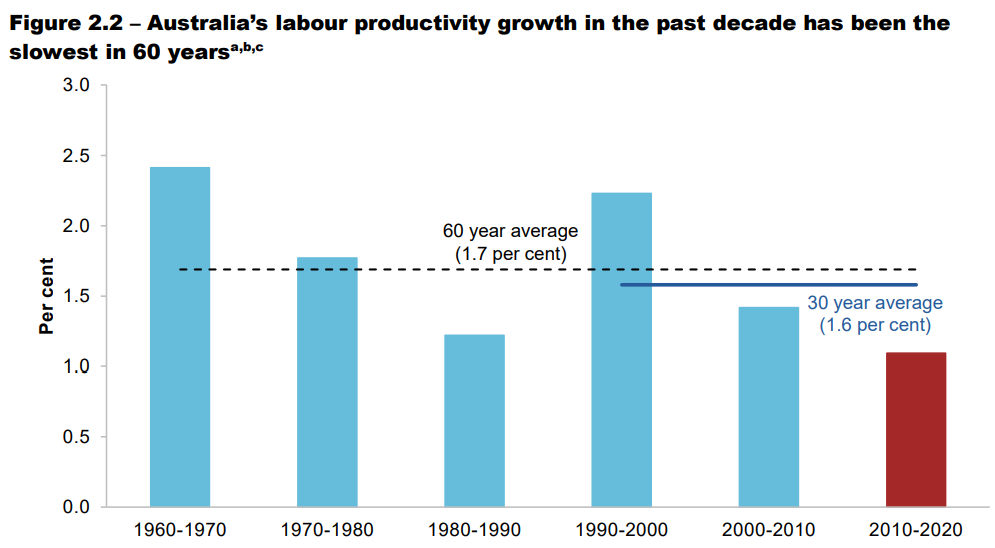
Productivity Commission: Australia’s productivity stinks due to over-reliance on low productivity services industries.
Labor’s extreme immigration program will stifle wage growth and worsen infrastructure and housing strains across the country.
It will result in another ‘lost decade’ for Australians (explained here and here), in which the economy and living standards stagnate in per capita terms, while productivity growth stagnates as migrants are funnelled into low productivity ‘people servicing’ industries.
It also represents another treacherous betrayal of Australian workers, this time by a wolf in sheep’s clothing false “Labor” Party that is just as neoliberal as the Coalition.
Australian workers don’t need enemies when they have friends like the Albanese Government.
