
Pretty good assessment from TS Lombard.
Beijing is cautiously optimistic on the post-Covid recovery. In the economy-focused April Politburo meeting, which concluded last Friday, Xi Jinping noted growth had exceeded expectations but was unsustainable and driven by reopening. Rhetoric on stimulus suggests Beijing is shifting focus towards fiscal and preferred industries rather than withdrawing support. With positive policy continuing through Q2/23 at least, consumer services surging and real estate finding an admittedly weak cyclical bottom faster than anticipated, we upgrade our 2023 outlook to 5.7% yoy, up from 5.3% yoy previously. We still expect covid scarring to weigh on growth in H2. Our asset allocation remains unchanged: China macro has outperformed but markets disappointed in March and April largely owing to geopolitics. We see a temporary lull in US-China sparring and scope for a final rally in reopening trades in Q2/23.
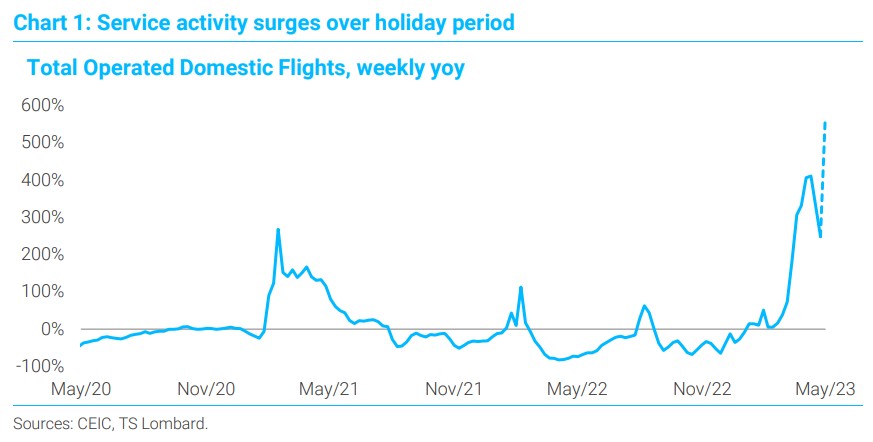
China activity has beaten market and policymaker expectations this year. The Politburo noted last week that “economic growth is better than expected” and that “the triple pressure of demand contraction, supply shocks and weakening expectations has eased”. The emerging data for May Day travel – the first public holiday without the spectre of Covid – will further encourage the leadership. Preliminary numbers show extraordinary growth both yoy and over pre-Covid levels: airline travel is up 569% yoy and rail travel 460% yoy. However, Beijing remains cautious – and rightly so, in our view. As we have repeatedly emphasized, Covid scarring is likely to weigh on economic activity for households, private business and local governments. Authorities characterized activity as “mainly restorative, the internal driving force is not strong, demand is still insufficient”. And they added that “the economic transformation and upgrading are facing new resistance, and the promotion of high-quality development still needs to overcome many difficulties and challenge”.
The full text of this article is available to MacroBusiness subscribers
