
On Monday, Westpac revised its Australian house price forecasts, declaring the bust over and tipping a 5% increase in prices nationally in calendar year 2024:
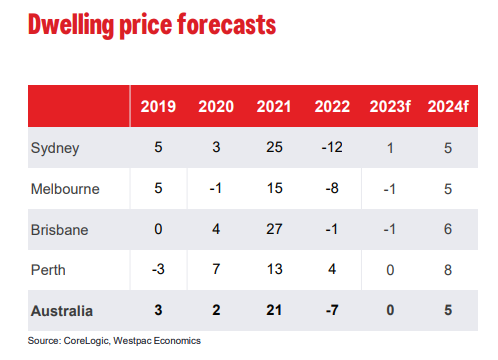
Westpac described “convincing signs of stabilisation”, fuelled by strong migration, surging construction costs and low stock.
NAB’s latest residential property survey also changed track on house prices, now tipping a 3.8% national price decline in 2023 before prices rise by 4.3% in 2024:
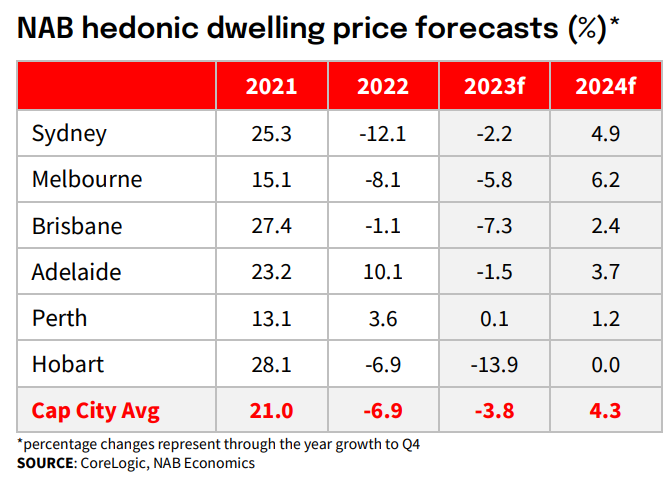
“The price adjustment has largely been driven by a very large fall in borrowing power as rates have risen sharply”, NAB noted in coming to its decision.
“Increasingly, it appears the very rapid pickup in housing demand is offsetting this drag on prices with population growth rebounding more strongly than expected since borders reopened in early-2022”.
Shane Oliver, AMP Capital’s chief economist, told The AFR that “we haven’t revised our forecast yet, but I suspect I might have to”, describing the housing market’s behaviour as “unusual”.
“Normally, when interest rates are rising and high compared to what they used to be, that leads to weaker economic growth, and less demand for housing and yet demand has surged due to resurgence of immigration and low stock”.
“Prices have risen, ahead of rate cuts. We haven’t seen this occur in the past. All the housing recoveries from those previous slumps were preceded by lower interest rates, so this is highly unusual”, Oliver said.
Oliver is right of course. It is highly unusual for house prices to be rebounding strongly in the face of the recent 0.25% interest rate hikes in early February and March.
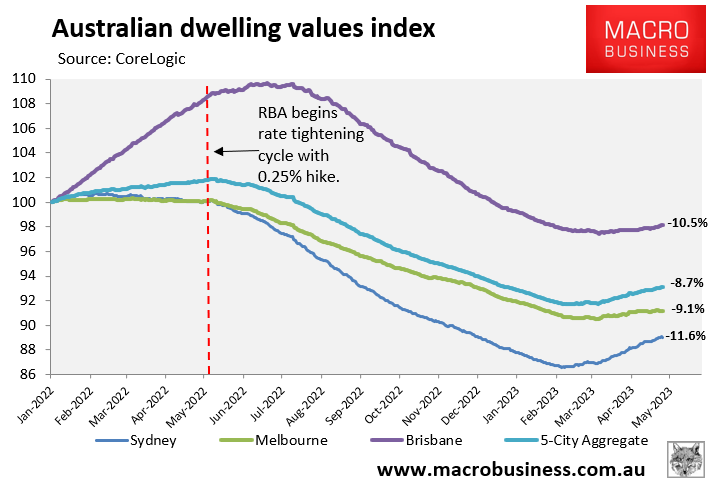
Since bottoming on 7 February, CoreLogic’s daily dwelling values index has recorded a 1.5% rebound across the five major capital city markets.
This increase has been driven by Sydney where values have jumped by 2.9%:
My view is that Australian housing is facing a ‘perfect storm’ of drivers that will see values rise strongly in 2024, namely:
- The RBA will likely cut interest rates late this year, which will increase borrowing capacity and mortgage demand.
- APRA will likely follow by cutting its mortgage serviceability buffer from 3%, which will further increase borrowing capacity and demand.
- Record immigration will increase housing demand, both to buy and rent.
- Housing construction will fall, owing to builder collapses and ongoing materials price increases.
- The rental market will tighten further, prompting more people to purchase.
- Foreign buyer demand will increase, led by China.
The strong rebound in immigration, auction clearances and prices is proof that demand for housing remains robust.
The only thing holding back prices is the sharp decline in borrowing capacity following the 3.5% of rate hikes from the RBA.
Thus, once the RBA begins cutting rates, and APRA follows by reducing its mortgage buffer, borrowing capacity will expand and house prices will take off.
The writing is on the wall, like it or not.
