
Westpac upgrading property prices.
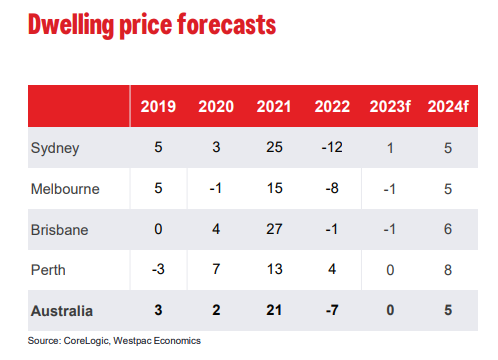
- Nationally, dwelling prices to hold flat in 2023, revised up from -7%.
- Prices now expected to lift 5% in 2024, revised up from +2%.
- Markets showing convincing signs of stabilisation.
- Migration influx, increased cost of new builds and tight supply contributing factors.
- Still significant headwinds but improving outlook for rates and prices will provide support.
- Sustained price gains to emerge once rate cut cycle begins in 2024.
Positive signs
Australia’s housing sector experienced a material correction in 2022, with rapid rate rises driving significant declines in both prices (–9.7% between April 2022 and January 2023) and turnover (down about 30% over the same period).
More recently, markets have shown signs of a stabilisation. Prices nationally held flat in February, posted a 0.8% gain in March and are tracking a similar gain for April based on daily figures for the month to date. While the detail shows gains are still lopsided – centred on Sydney where ‘upper tier’ markets are leading the way – and seasonal boosts are flattering the situation a little, all major capital city markets have now seen prices stabilise or post small rises over the last three months.
Other indicators also look firmer. Auction markets show clearance rates have lifted to be back around long- term averages in April with pre-auction withdrawals also back near long run averages. Turnover also appears to have stabilised, and housing finance approvals figures to February show a clear moderation in the pace of decline – albeit with both still at very low levels by historical standards (25-30% below long run averages when viewed as a proportion of the total number of dwellings).
Not an interest-rate-driven shift
Notably, this shift has come despite further official rate rises in February and March.
These latest hikes follow an aggressive tightening in 2022. As such, it may be that some buyers are starting to position for the next cycle, anticipating an eventual easing in rates and resurgence in prices. However, survey measures suggest most consumers are still bracing for further rate rises near term. Responses to our Westpac Consumer Sentiment survey question on mortgage interest rate expectations show that while views are shifting, few consumers see rate cuts as imminent: in April, only 8% of consumers expect rates to be lower in a year’s time, while 75% expect them to be higher, a little over half of this group expecting a rise of over 1ppt.
Housing recoveries in the past have only tended to flow through to prices once the RBA is actively cutting rates or is very clearly poised to do so. Price gains also tend to follow a sustained lift in turnover, not vice-versa.
Three factors at play: migration; construction costs and low volumes
If it is not interest rates then what is driving the firming in housing markets? Three factors stand out. The first is a strong resurgence in net migration inflows. Border reopening has seen a much bigger than expected lift in immigration with net inflows now expected to be around 400k for 2022 and forecast to remain elevated at +350k in 2023 (see here for more).
There are clear links between population growth and demand for housing, both directly (through new buyers) and indirectly (through the impact on available rental property and the wider physical supply-demand balance). The latest surge has contributed to a significant tightening in rental markets with vacancy rates falling to historical lows and rents rising sharply in all major capital cities.
That said, the flow-through from shifts in population growth to prices is typically quite slow and diffuse. Direct demand from new migrants may impact some market segments but typically takes time to appear and is usually not large enough to shift the wider market (about a third of new migrants eventually end up purchasing, usually at least six months after arrival).
Indirect effects via rental markets also typically act slowly – the main channel being through a rise in rental yields that draws increased investor activity. So far there is little evidence of this effect driving prices.
The second factor that stands out is the sharp rise in construction costs. Nationally, the purchase cost of a newly built dwellings rose 18% in 2022. With prices for existing dwellings declining, this has significantly shifted the relativity between existing and newly built houses. In effect, the ‘replacement cost’ of the non-land component of a dwelling has increased dramatically.
Again though, the flow-through of these sorts of shifts to dwelling prices is not often that evident. The more granular price detail suggests there may be some effects showing through in the suburban fringes of major cities, where newly built dwellings are more prevalent and more likely to affect the price of existing dwellings. However, building cost increases are unlikely to account for shifts in well-established markets.
The third factor is the low level of ‘on-market’ supply. Despite low turnover, listings are even lower. The weak market has clearly discouraged many sellers with both new listings and total stock on market below average across the major capitals (albeit varying to some degree with conditions easier in Sydney and Melbourne but extremely tight in other markets).
More generally, ‘thin’ market conditions mean small shifts in demand can have a bigger than usual impact on prices. It may be that a small demand lift – related, say, to population and/ or construction cost drivers – is seeing an exaggerated price impact due to the scarcity of properties available for sale.
Fundamentals still not conducive to a sustained recovery
While the evidence of stabilisation is now convincing, the discussion above suggests the influence of emerging positives is still limited.
Meanwhile there are still significant negatives in play. As noted, interest rates are high and expected to rise slightly further near term and remain elevated through the rest of 2023. Affordability remains poor. Rate rises are more than offsetting the improvements from lower prices. Even with interest rate cuts next year, the affordability measures we track will still be comparable to the low point in the cycle in 2009-10. Our preferred measure, which includes deposit and mortgage
repayment requirements, shows the total cost of purchase for prospective first homebuyers is up 12.5% on a year ago, comparable to the rise we are seeing in rents.
At the same time, income growth is subdued, declining in real terms and expected to remain under pressure throughout 2023.
The large increase in interest rates over the last year will also see a significant rise in stress across the mortgage belt pushing some borrowers into ‘urgent sale’ situations, although this is not expected to be a material factor for wider markets, partly because the labour market is expected to remain supportive.
However, the stabilisation of lower and middle tier parts of the property market in recent months suggests affordability pressures are not weighing in the same way. More generally, the cumulative increase in interest rates has also not impacted prices as negatively as we had anticipated. Our previous forecast (set out in May 2022) of a ‘peak-to-trough’ price decline of 16% was mainly based on what amounts to an affordability consideration – that is, the extent to which borrowing capacity would be curtailed by higher interest rates. Instead, markets appear to be stabilising after just a 10% price decline.
The explanation here may be around how binding borrowing capacity limits are in practise. Only around 10% of borrowers take out home loans at their maximum borrowing capacity with most instead borrowing significantly less. Notably, average loan sizes have only declined by 5.9% from their 2022 peak, compared to a fall of around 30% in maximum borrowing capacity since the tightening cycle began.
Shifts in this ‘actual vs potential borrowing’ buffer may account for the more muted price impact compared to expectations.
That is, the decline in assessed borrowing capacity has been partially offset by borrowers opting for a smaller ‘buffer’ between their actual and potential loan size.
Certainly, the dampening effect of rate hikes on new borrowing appears to be easing. New housing finance approvals fell sharply over the second half of 2022, with steady declines averaging 4% per month. That pace has abruptly slowed to -2.4% in January and -0.9% in February.
Interest rate cycle still a key catalyst for sustained recovery
As noted, our surveys show most consumers still expect significant interest rate increases over the next year. These fears are overly pessimistic.
Westpac’s growth and inflation forecasts are consistent with the Reserve Bank going on hold following a 25bp hike at the upcoming May Board meeting. As households become progressively more confident with that outlook, rate rise fears will subside and confidence towards housing will likely build.
Confidence in the outlook for prices has already improved markedly in the survey, with the Westpac Melbourne Institute Consumer House Price Expectations Index now 43% above its November low and marginally above long run average reads.
Comfort around the outlook for interest rates should also encourage investors. Indeed, we may see a significant shift in investor attitudes in coming months. Perceived risks around housing, from higher interest rates and falling prices, should ease. Meanwhile, other risk assets, especially equities, are starting to look riskier following recent turmoil in global capital markets with the associated credit disruptions threatening to tip the US economy into recession.
Interest rate moves are not the only consideration. Wider economic conditions are also important, particularly as they pertain to labour markets. Notably, during the deep recessions of the early 1980s and the early 1990s, and during the GFC, housing markets continued to weaken even after interest rates went on hold.
But labour markets were much weaker in those previous periods than they are expected to be over 2023 and 2024. While an economic slowdown is forecast to see the unemployment rate lift from 3.5% to 5.0% by end 2024, this is not expected to involve major rounds of job-shedding. The main dynamic is instead expected to be around a slowdown in new hiring and a lift in labour supply. Employment is expected to rise just 50k over the period, insufficient to accommodate an increase in the labour force of around 260k. The associated rise in unemployment comes from more new entrants to the labour market being unable to find a job rather than from the job loss dynamics that can weigh more heavily on housing markets.
Momentum is important, particularly as it shapes expectations
The ‘mini-rally’ in prices may still be quite fragile. But the momentum shift from negative to stable (possibly positive) is still important as it plays into expectations.
Housing-related sentiment already looks to have become more supportive. While buyer sentiment is still very negative by historical standards, the shift in prices is clearly influencing consumers’ dwelling price expectations. While expectations are not particularly ‘bullish’ they are no longer negative. This will further ‘anchor’ prices, reinforcing the stabilisation.
Our analysis of previous cycles indicates that once momentum shifts a relapse back to the previous trend only really occurs when there is a sudden, unexpected shock to the system. The likeliest source of this shock is if central banks, including the Reserve Bank of Australia, were to extend their tightening
cycles beyond mid-2023. That prospect is not our central forecast given the clear easing in inflation we are seeing globally, and the prospects for deteriorating growth in the advanced economies.
And given the ‘anchoring’ of expectations, it would take quite a substantial shock to trigger another run of material price declines. Certainly, a May rate hike would challenge expectations near term, but this is comfortably within the range of current expectations for most consumers. It is likely to require, at the very least, a sequence of rate hikes to dislodge expectations from here.
Conclusion: prices to stabilise in 2023 with sustained gains unlikely until 2024
Westpac expects conditions to remain a little mixed near term with prices holding flat over 2023. Another major slide seems unlikely although gains will be hard to sustain given interest rates and wider economic headwinds. A May rate hike is likely to ‘check’ the improvement in housing-related sentiment near
term. Some lift in ‘on-market’ supply is also likely to test the depth of demand.
Our revised forecasts mean the correction now sees a peak-totrough decline nationally of 10% rather than 16%. For calendar 2023, the flat result compares to our previous forecast, which implied a further 7% decline (allowing for a slightly weaker than expected 2022 result – our previously published calendar 2023 forecast of -8% was on the basis of a 6% decline in calendar 2022).
The recovery is expected to move onto a firmer footing in 2024, with interest rate cuts providing clearer support. Prices are now expected to lift +5%, up from our previous forecast of +2%.
Further rate cuts and an improving economic backdrop will see momentum carry into 2025 although affordability is likely to constrain upside prospects.
The main risks continue to centre around inflation, particularly if disappointing progress on bringing inflation under control leads the RBA to resume hiking rates later in the year, but also if ongoing high inflation constrains the Bank from easing policy in 2024. Both developments would clearly undermine housing market improvements and could potentially lead to a reversal.
