
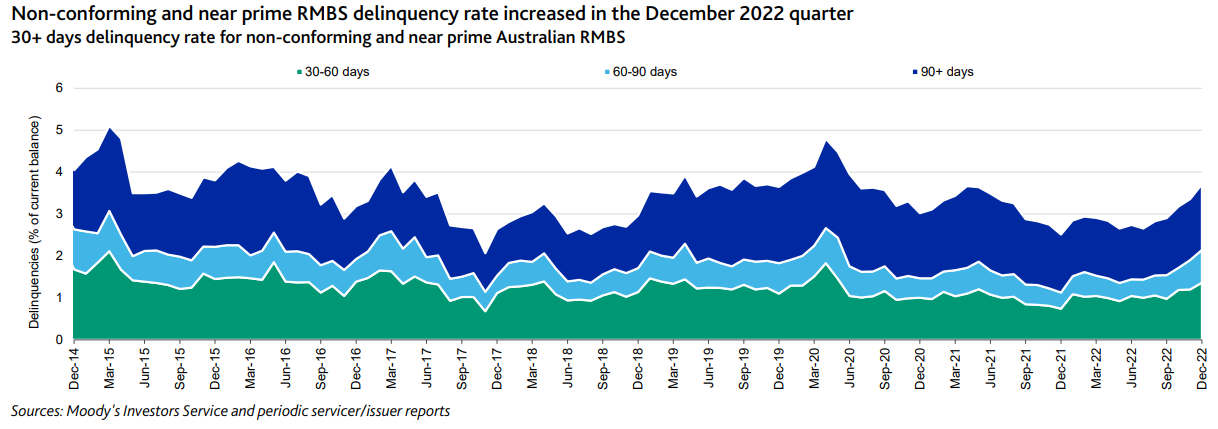
Moody’s latest mortgage delinquencies data showed that delinquency rates for Residential Mortgage-backed Securities (RMBS) backed by non-conforming and near prime mortgages (like loans to borrowers with adverse credit histories or those where lenders use truncated means to verify incomes) rose far more than prime mortgages, to 3.71% in December 2022 from 3.00% in September 2022:
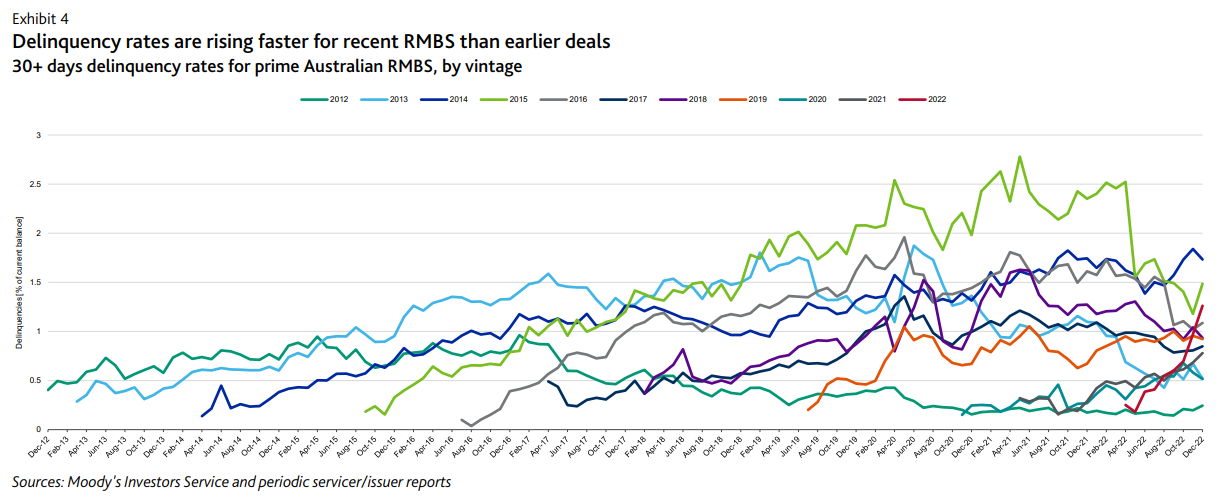
RMBS taken out in 2021 and 2022 are also rising much faster than earlier vintages, according to Moody’s – a situation that will likely deteriorate as the fixed rate “mortgage cliff” rolls off over the next few months and borrowers are stung with variable rates that are double to triple their current fixed levels:
The good news is that the RBA’s aggressive rate hikes look to have stifled riskier types of lending:
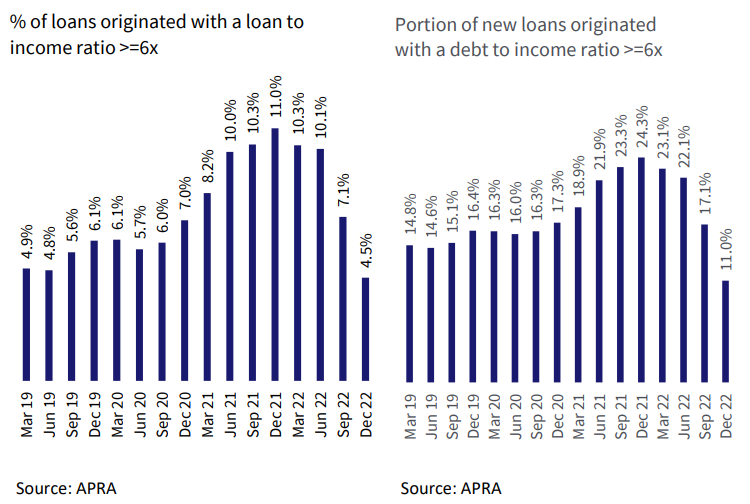
According to APRA’s latest quarterly ADI statistics, the portion of new loans originated on a debt-to-income ratio of six or more fell to just 11.0% in the December quarter, after peaking at 24.3% a year earlier.
The portion of new loans originated with a loan to income ratio of six or more also dropped to 4.5% from 11.0% a year earlier.
CoreLogic’s Head of Research, Eliza Owen, noted that “the sharp drop-off in lending at high debt-to-income ratios, and loan-to-income ratios coincides with the bulk of the current rate-hiking cycle flowing through to prospective borrowers, which has limited borrowing capacity. Both of these ratios represent record lows, though on a relatively short back series to March 2019”.
“The portion of new loans on interest-only terms also declined, though by a smaller margin, to 19.0% of loans originated in the quarter. This is down from 19.3% in the previous quarter, with historic lending data suggesting a much higher peak (upwards of 40% in the mid-2010s)”.
Finally, “the portion of loans originated with a loan-to-valuation ratio of 90% or more (ie a deposit of 10% or less) declined to a record low 5.9%, down from 6.2% in the previous quarter”.
Eliza Owen believes “the latest APRA data points to ongoing stability in Australia’s mortgage market, as well as a more prudent lending environment as interest rates rise”.
Not that it will help those who stretched themselves to enter the market near the peak in late 2021 and early 2022. They are facing a tough adjustment. Some will also lose their homes.
