The ferrous complex was mixed on November 10, 2022:

Short term we’re obviously going to follow the global relief rally. But, beyond that, the outlook is still dour. It’s the property bust, stupid. Goldman with the note.
From GS Global Commodities team: Reopening upside.
With China outlining the path to re-opening the economy last week, the commodities complex has reacted positively and investor conversations were dominated by discussions about the impact on commodities demand. GS macro team believes that the government is probably working on an exit strategy but also notes that we are still at least a few months away from the actual reopening, mainly because: i) elderly vaccination rate in Mainland China is still too low; ii) other preparations also take time; and iii) China is in the middle of the fall/winter flu season. Specifically for commodities, however, we note that allocation into the sector has been (and remains) low, so pockets of positive news have triggered some short covering and some bullish positions. And while a relatively better macro sentiment and some restocking could provide some further positive momentum, metals demand outlook is rather unchanged.
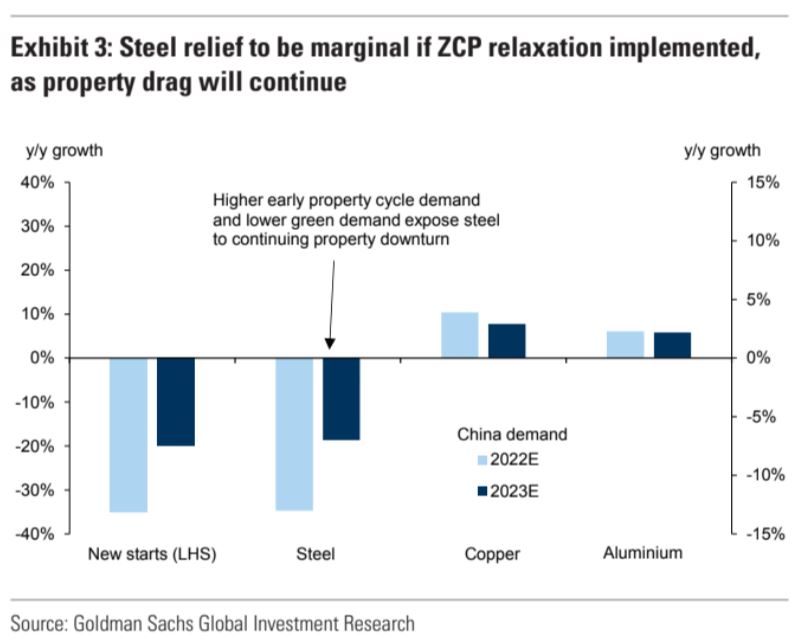
In fact, GS commodities team notes that lockdowns curtail activity (OPEX), not investment (CAPEX). As a result, reopening would shift onshore fundamentals more in OPEX commodities – LNG, crude and soybeans – than in CAPEX commodities – ferrous, copper and aluminum. As a result of property-offsetting stimulus and the smaller impact that lockdowns have had on metals, the team expects demand for metals to rise by 0.5% vs nearly 15-20% for Chinese natural gas consumption as factories restart. GS China Properties team continues to anticipate a 20% decline in new starts in 2023 vs. +5% for completions, so we also keep out preference for late cycle commodities (eg, copper,aluminum) over early cycle (iron ore, steel).
While our economists still see a policy shift occurring in 2Q23, to begin to realize a reopening upside, they believe the market needs to see policy shifts announced formally and with greater clarity. In addition to that, China requires restock. While they see a limited boost to demand from reopening (on average less than 0.5% addition to 2023 China demand growth rates), the expectations channel will affect downstream stockpiling as well as market pricing. Yet with the Zero-COVID Policy sapping supply chain confidence, downstream consumers have continued destocking as onshore metals demand has recovered as a function of exponential growth in the green economy alongside improving transmission of infrastructure stimulus. If China were to return its stock to consumption ratios to pre-2020 levels, that would imply substantive restocking additions to onshore aluminum (850kt) and copper (500kt) demand next year, with even a partial restocking requiring elevated imports given restrained onshore supply.
Despite the possibility of incremental restocking, the path past Zero COVID is only just starting to emerge.