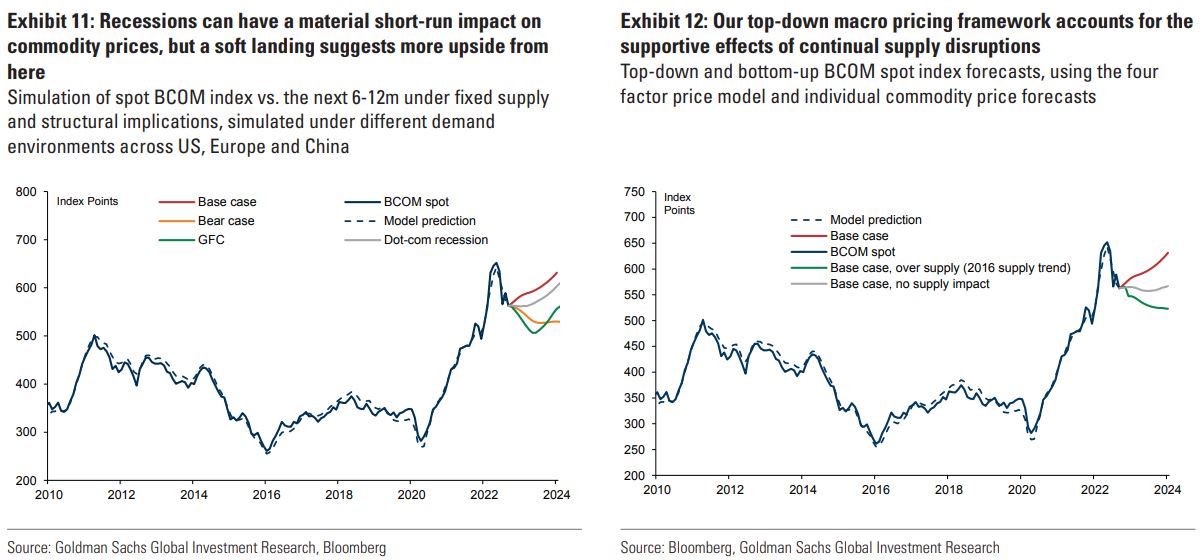
As is so often the case with Goldman’s research, its tools are exceptional and sophistication unmatched. But its conclusion are coloured by an overly bullish culture that renders the former next-to-useless in bear markets.
What if the Chinese property adjustment is structural? What if the Fed fails to deliver a soft landing? These are both base cases in my book. If so, there is no commodities super cycle and it is a wasted effort looking for one.
I’ll be buying commodities at the bottom of the cycle, probably right at the moment when Goldman capitulates.
It’s not done telling you to lose more money.
A unified macro framework. Two years ago, we called for a structural bull market in commodities. For the first twenty months, many elements of our thesis played out, from surging household demand to shrinking spare capacity.
Yet today, investors face the most macro uncertainty since March 2020, balancing Europe heading into recession, the Fed trying to soft land the US economy and China inching toward reopening. With the dollar too dominant to get long, but fundamentals too tight to get short, how should investors navigate this complex environment? To separate the structural from the cyclical, we introduce a four-factor pricing framework that explicitly delineates – and models – each monetary, financial and fundamental driver of commodity performance. In doing so, we can estimate the net price impact from the recent investor positioning flush, a stronger dollar, slowing growth and supply disappointments against the structural drivers of under-investment, deglobalisation and the green transition. With a range of possible outcomes for growth ahead, we simulate the impact of a hard landing for commodities, noting how even under such a bearish scenario, structurally tight supply buffers the price impact of a GFC-like fall in demand (average -7% drawdown vs. -14.7% with ample supply).
Navigating a commodity-constrained recession. As growth slows but commodity supply falls, investors now face the risk of a rare macro situation where commodity demand destruction drives a decline in real activity, or what we term a “commodity-constrained recession”. Looking back to 1953, we identify similar periods of commodity-driven macro volatility, and highlight the specific relationships we expect today. We find that when constrained, commodities are more tied to real incomes than interest rates, with commodities outperforming, before falling as demand destruction bites, but outperforming once again as the real income shock fades. Until sufficient investment in production capacity is made, real incomes will likely continue to bump up against physical constraints, creating periodic scarcity and a persistent state of volatile commodity prices.
Timing the supercycle. We construct an illustrative ‘smart beta’ strategy from our unified framework, explicitly modeling turning points in commodity trends to give investors a guide on how to time the supercycle. Crucially, we show how long-run investors can outperform by investing, not trading commodities – buying and holding throughout the upswing of the super cycle, and having a structural short position during periods of growing supply and falling physical inflation. For investors with a shorter horizon, we show how tracking both the investment cycle and business cycle can lead to persistent outperformance.