Pantheon with the note.
In one line: Korean 20-day exports indicate continued deterioration in global demand.
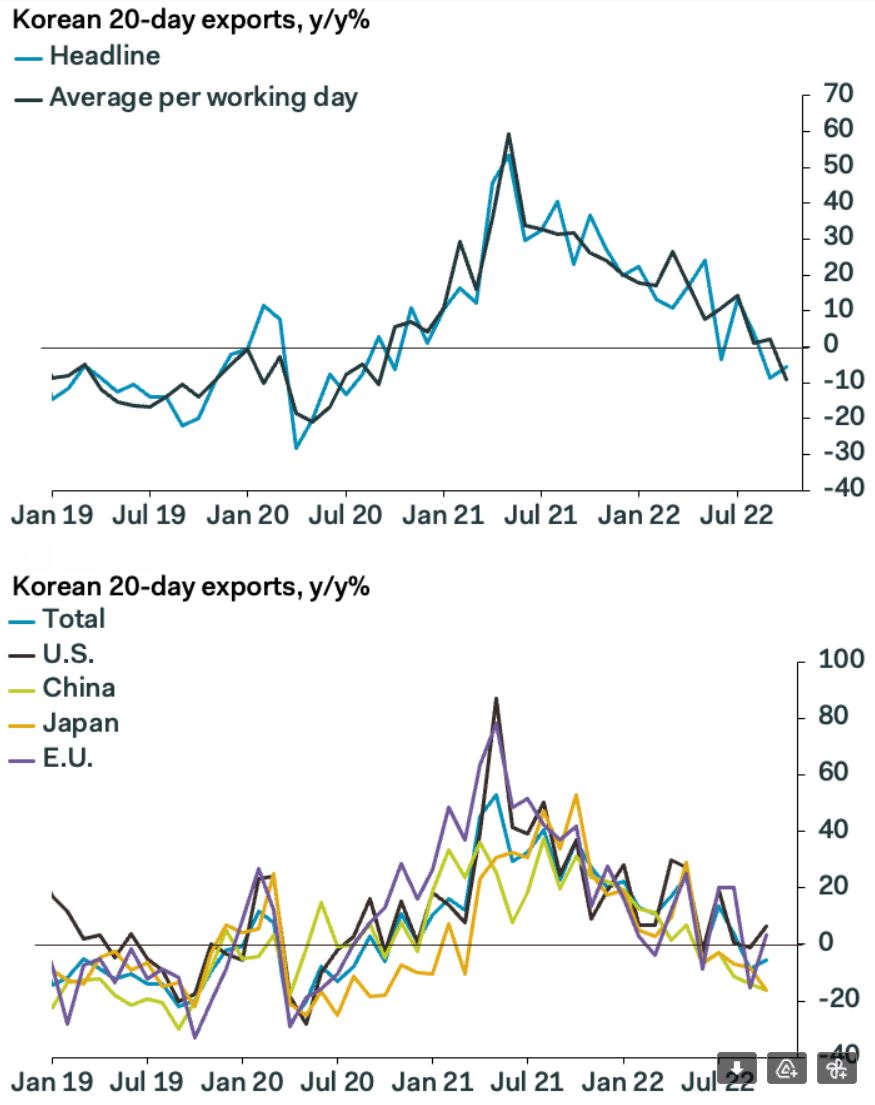
- Korea: 20-day exports fell 5.5%, after falling 8.7% in September and growing 3.9% in August. Bloomberg reports no consensus.
Korean 20-day exports rose 1.0% m/m, seasonally adjusted, in October, rebounding from falls of 6.2% in September and 3.7% in August. When adjusted for working days, however, the pace of export decline accelerated to 4.8% in the first 20 days of October from 2.4% in September. The upshot, confirmed by the still rapid pace of year-over-year fall, is that the global demand picture suggested by Korean export figures remains weak.
Moving to bilateral trade, Korea’s 20-day exports rebounded to the U.S. and the E.U., but worsened to China and Japan. Exports to the U.S. rose 6.3% y/y in September, up from -1.2% in August, while exports to the E.U. increased 3.4% in September, up from -15.5% in August. Exports to China fell 16.3% in September, accelerating from -14.1% in August, while exports to Japan decreased 16.2% in September, after falling 8.3% in the previous month.
The seasonally adjusted month-to-month data also indicates stronger demand in the U.S. and the E.U. in the first 20 days of October. This again contrasts with weakness in China and Japan, though the pace of decline for exports to both countries moderated. The view of north-east Asia’s economies using this data is less bleak than the year-over-year data, but hardly promising.
Exports ex-petroleum and ships fell 6.6% y/y in the first 20 days of October, moderating from the peak decline of 13.1% in September. Besides petroleum, the only other categories to see positive year-over-year growth in October were cars and car parts. This reflects manufacturers clearing order backlogs after the previous supply chain blockages because of global auto chip shortages.
Semiconductor exports fell 12.8% in the first 20 days of October, down from 3.4% growth in September. This is likely because of the new U.S. restrictions on China accessing advanced chips and chip-making technology. These include restricting non-US companies from exporting to China if their products contain U.S. technology. The restrictions on exports on chip-making equipment and technology came into effect on October 7, and a licensing requirement for support of foreign items destined for use in Chinese chip company development and chip manufacturing came into effect on October 12.
Trade lawyers are still examining the extensive rules for workarounds. In the interim, however, many technology companies have taken a conservative approach to minimise the risk of being subject to U.S. government sanctions. This is reflected in the trade data for chips.
We expect Korean exports to remain weak, owing to the slowing global economy. At best, the full-month export data for October will show a momentary moderation in the pace of decline. The trend will continue downward this winter, especially given the gloomy economic picture for China and Europe.