
Aussie housing facing “sharper price falls as interest rates rise”
Australia’s house price crash continues to build momentum.
Dwelling values across the five major capital cities have now fallen by 4.3%, driven by the Reserve Bank of Australia’s (RBA) four consecutive interest rate hikes.
Values are down a hefty 7.4% across Sydney and 4.6% across Melbourne, with Brisbane’s also now trading 2.9% below their peak:
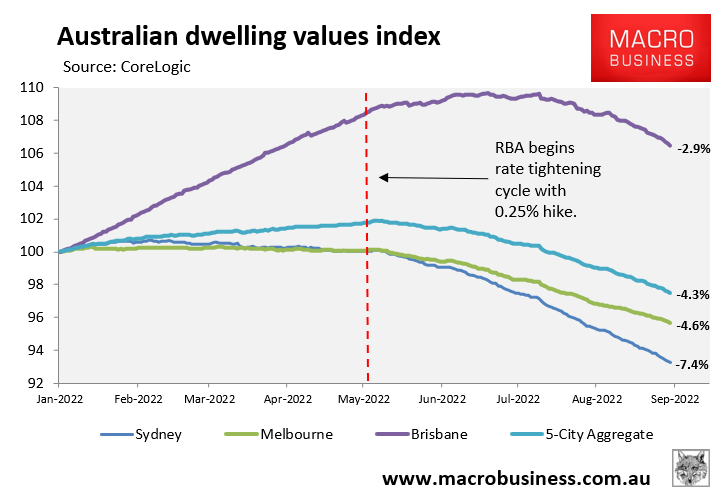
House prices falling sharply following rate hikes.
The pace of decline is especially sharp, with quarterly values falling at their fastest pace since 1983 across both Sydney and the 5-City aggregate level, whereas Melbourne’s quarterly prices are falling at their fastest pace since early 2019:
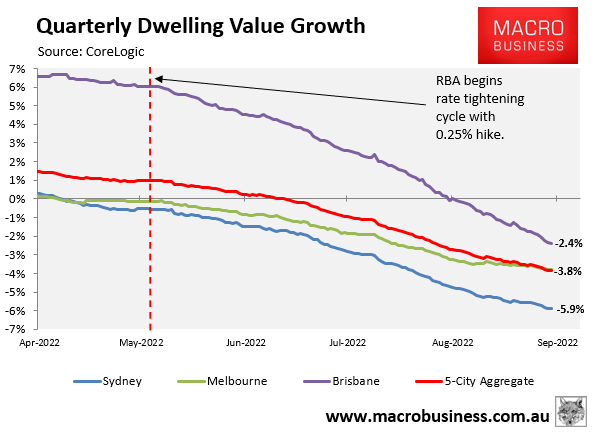
Quarterly dwelling values falling at their fastest pace since 1983.
AMP Capital’s chief economist, Shane Oliver, believes that price falls will continue and spread to the other capital cities and regions as the RBA hikes rates further:
“It seems that the price falls in Melbourne have stabilised and Sydney is no longer accelerating, but these drops are substantial and could still get worse”.
“Brisbane is now weakening quite rapidly, and I expect the other capitals will also see sharper price falls as interest rates rise further.”
Ultimately, how deep the housing correction goes depends on how aggressively the RBA hikes interest rates.
For example, the futures market is now tipping the official cash rate (OCR) to soar to 4.0% by mid-2023, which would send the average discount variable mortgage rate to 7.35% – it’s highest level since 2008:
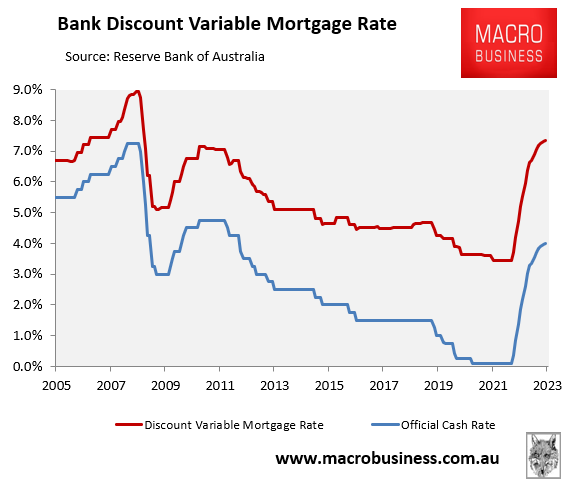
Futures market: Discount variable mortgage rate to climb to 7.35%.
If true, that would lift mortgage repayments by more than half versus their level in April 2022 before the RBA commenced its interest rate tightening cycle.
In turn, mortgage demand and borrowing capacity would be severely curtailed, likely resulting in massive price falls – especially across Sydney and Melbourne.
The Australian housing market’s fate is well and truly in the hands of the RBA.
