
The bond market wants to crash Australian house prices
The Reserve Bank of Australia (RBA) is expected to increase the cash rate for a fifth consecutive month next Tuesday, with most tipping a 0.5% rise.
The case for further rate hikes strengthened following yesterday’s unexpectedly strong retail sales data, as well as the hawkish tone of US Federal Reserve chairman Jerome Powell at the Jackson Hole economic symposium.
In response, the bond market has aggressively lifted its official cash rate (OCR) forecast, and is now tipping rates to peak at 4.0% by July 2023:
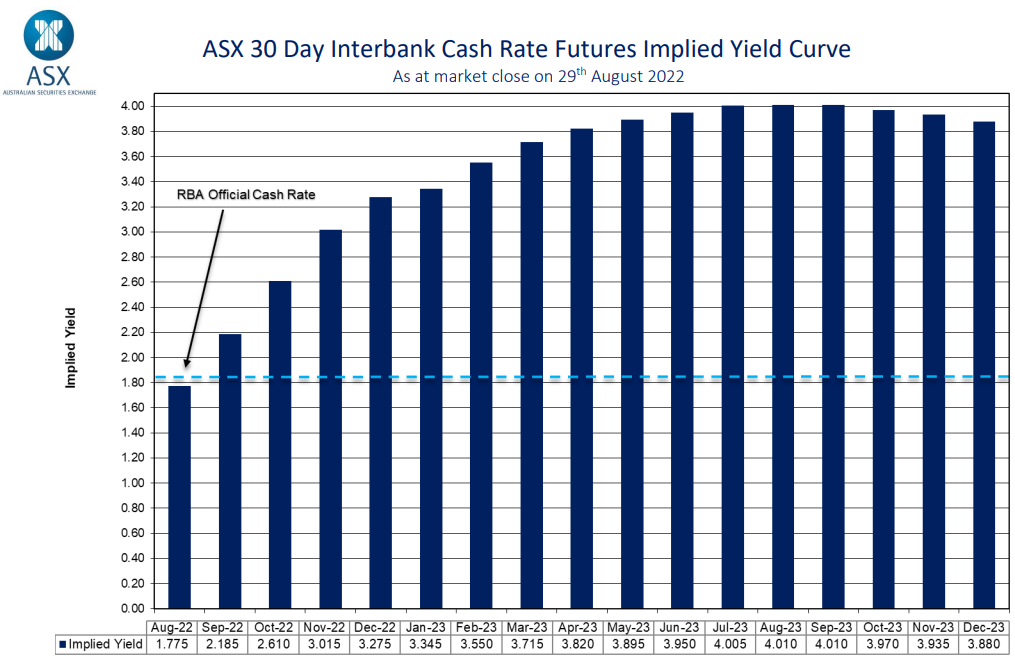
Bond market hikes OCR forecast to 4% by mid-2023.
As illustrated in the next chart, a 4% OCR implies a discount variable mortgage rate of 7.35% by July 2023 – more than double the 3.45% that presided in April 2022 before the RBA commenced its rate tightening cycle:
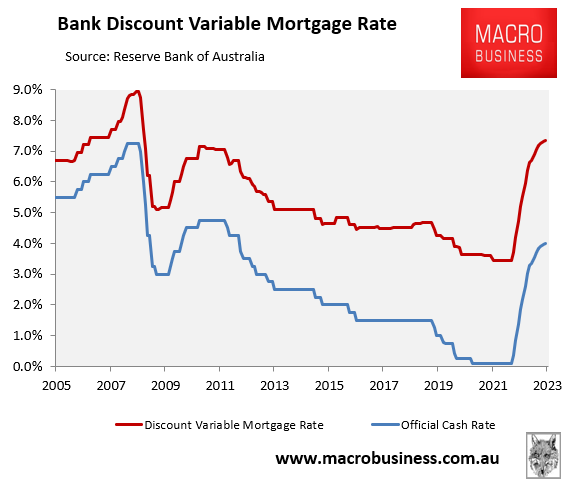
Bond market: Discount variable mortgage rate to climb to 7.35%.
In fact, Australia’s discount variable mortgage rate would soar to its highest level since October 2008 under the bond market’s OCR forecast.
The impact on Australian mortgage holders would be devastating. Average mortgage repayments would soar by 54% versus their level in April 2022 immediately before the RBA’s first rate hike:
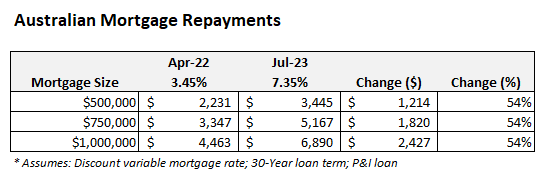
Australian mortgage repayments would soar by more than half.
For a household with a $500,000 mortgage on a discount variable rate, this would represent an increase in monthly repayments of $1,214, whereas a household with a $1,000,000 mortgage would see their monthly repayments soar by $2,427.
The impact on house prices would be calamitous. According to the RBA’s own modelling, “a 200-basis-point increase in interest rates from current levels would lower real housing prices by around 15 per cent over a two-year period”.
Therefore, the bond market’s 3.9% increase in the OCR would shave nearly 30% off real house prices nationally, under the RBA’s modelling, with Sydney and Melbourne experiencing even bigger falls.
Australia’s army of highly leveraged borrowers better hope that the bond market is wrong on interest rates. Otherwise, many will face extreme mortgage pain while they drown in negative equity.
