
Earlier this week, CoreLogic released its Mapping the Market report, which showed that dwelling values fell across 41.9% of Australia’s 3,085 house and unit sub-markets over the June quarter – up significantly from 23.6% of markets over the March quarter.
Given this data was only current to 30 June, it only captures the first two RBA rate hikes and misses the 0.5% increase delivered at the beginning of this month.
The next chart plots CoreLogic’s daily dwelling values index since the start of the year and shows that dwelling value falls have spread from Sydney and Melbourne north to Brisbane (including the Gold Coast):
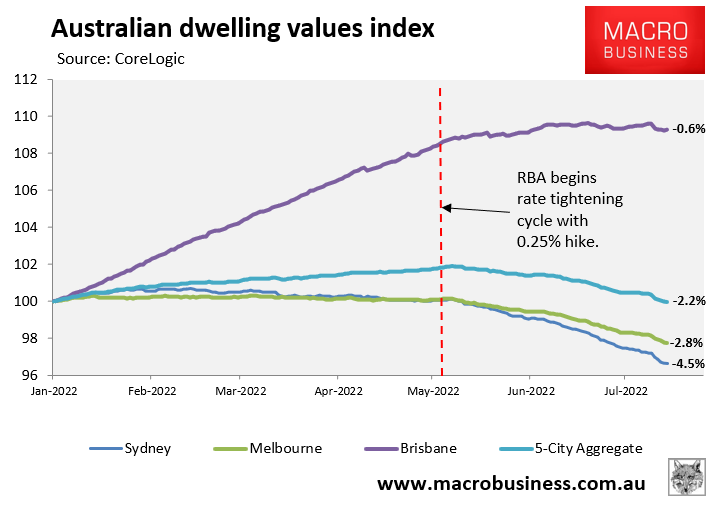
Dwelling values are now falling down the East Coast.
Dwelling values have now fallen 4.5% across Sydney, with the pace of decline steepening after the RBA’s first 0.25% rate hike in early May.
It is a similar story for Melbourne, whose values have fallen 2.8% from peak. Again, the rate of decline has steepened since the RBA’s first rate hike.
Brisbane (including the Gold Coast) dwelling values have only recently begun to fall, down 0.6% from their 19 June peak.
Indeed, CoreLogic’s research director, Tim Lawless, yesterday noted that Brisbane “has abruptly joined the decline trend with the rolling four-week change in dwelling values turning negative through the first week of July”. Lawless added that “housing values [are] broadly slowing around the country, and it is likely more regions will succumb to negative movements over the coming months”.
With further aggressive rate hikes forecast over the next four months, price falls are certain to spread right across the nation.
What began in Sydney and Melbourne will become a national house price correction, and likely the largest in living memory.
