
A report released last week by the OECD showed that Australian home ownership rates have collapsed over the past 40 years across every generation.
However, the decline in ownership has been greatest among younger and poorer Australians, with those aged between 25 and 34 suffering a 40 percentage points plunge in ownership for the bottom 20% of income earners between 1981 and 2016.
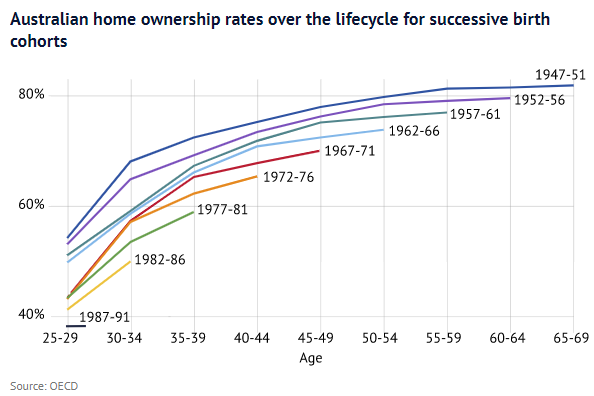
Australian home ownership plunges across the generations.
Separate survey data from Digital Finance Analytics, shows that the median age of a first homebuyer in Australia has risen by 10 years over the past two decades, from 24 years in 2002 to 34 years in 2022:
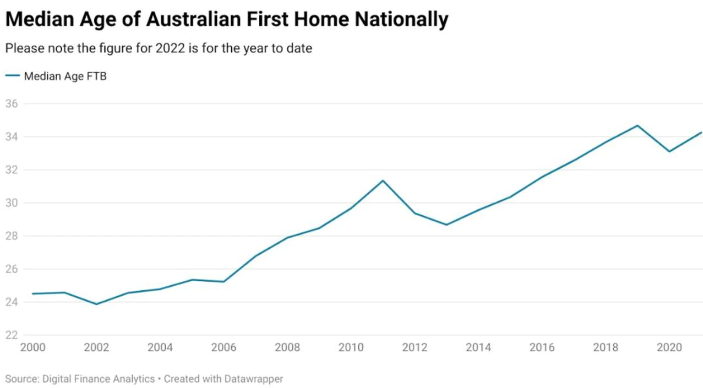
First home buyers in Australia are getting older.
First home buyers in Australia’s two largest cities have fared worst, with a median age of around 35 in Victoria and 36 in NSW.
You will notice from the chart above that the median age of first home buyers took off in the mid-2000s. This coincided with the sharp increase in Australia’s immigration intake:
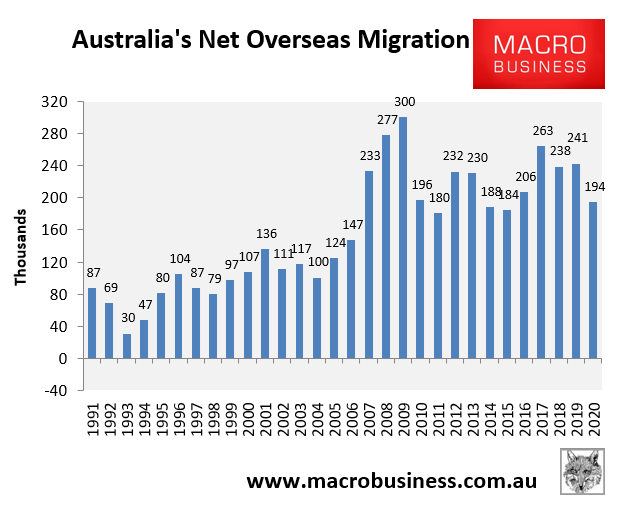
Australia’s net overseas migration surged from 2005.
Australia’s net overseas migration (NOM) jumped from an average of 90,500 between 1991 and 2004 to an average of 219,000 between 2005 and 2019 – representing an annual average increase in immigration of 140%.
Obviously, jamming an extra ~130,000 migrants annually significantly increased Australia’s housing demand and contributed to the worse outcomes for first home buyers.
The situation facing first home buyers is unlikely to improve given the Intergenerational Report (IGR) projects that NOM will ramp up to 235,000 people a year for decades to come, swelling Australia’s population by 13.1 million (50%) over the next 40 years – equivalent to adding another Sydney, Melbourne and Brisbane to Australia’s existing population:
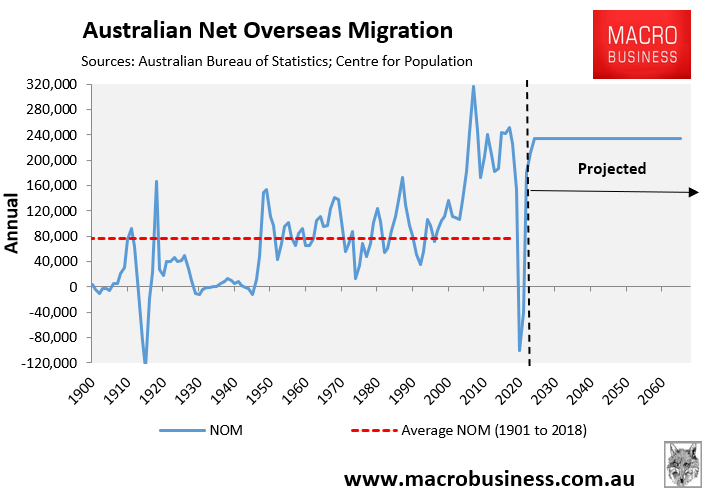
‘Big Australia’ immigration to lock in permanent housing shortages.
All indications from the Albanese Government is that it go beyond the IGR and will ramp-up immigration to record levels following September’s jobs summit.
In doing so, it will make life even harder for first home buyers and renters alike, who will be forced to compete even harder for housing.
