For years we watched in dismay as The Guardian’s left-leaning economic poster boy, Greg Jericho, defended Australia’s mass immigration program, arguing that immigration doesn’t suppress wages, among other things.
Jericho likened any criticism of Australia’s immigration program to “racism” and “dog whistling”:
“Immigration – because there are many desperate to hate – must be treated with extreme care by politicians and journalists… The inherently racist parties will seek to use any discussion and any seeming evidence of the negative impact of migrants as fuel to burn their fires of hate”.
In July 2021, Jericho even lambasted the Reserve Bank of Australia for daring to admit that 15 years of mass immigration harmed Australian workers:
Advertisement
It is regrettably far too easy in Australia to blame migrants. From societal to educational to economic woes – migrants are the easy target.
Last week the head of the Reserve Bank suggested migration could have caused lower wages growth. It was an unfortunate statement that goes against evidence and ignores the many other factors at play…
Blaming migrants for our economic woes is not new…
Most studies suggest migration has a positive impact on wages growth…
Blaming migrants for lower wages growth is easy but absurdly simplistic.
Today, Jericho has penned an article mirroring my analysis last week, showing the collapse in immigration is behind the fall in Australia’s unemployment and underemployment rates to 2008 lows:
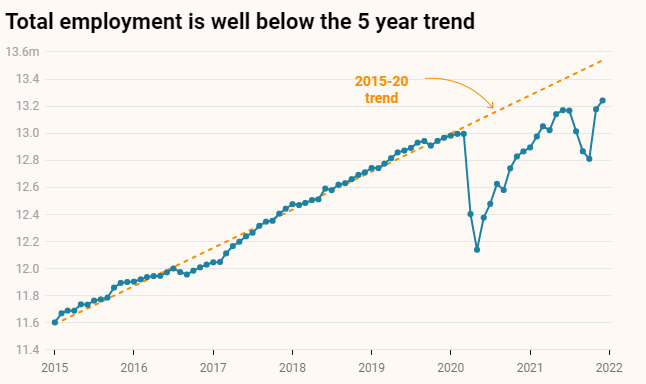
Prior to 2020 employment was growing around 4.2% every two years, so you would have been excused from thinking to get unemployment down so low, job growth must have taken off and we would be well above 13.5 million people employed.
And yet, no. Employment since the end of 2019 has increased just 2.1% – in effect at half the speed it had been in the period up to the pandemic:
The level of employment is around 2.2% below what would have been expected…
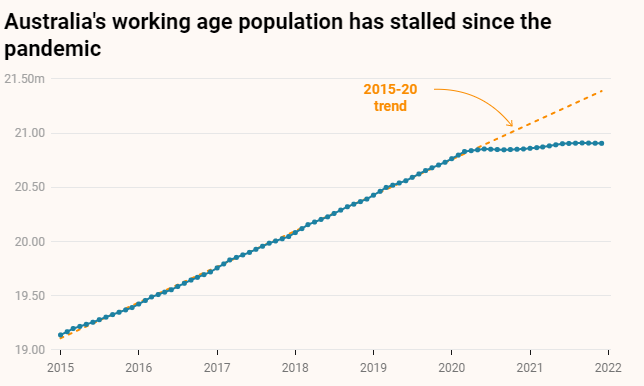
One of the big changes since the pandemic is the absence of migration has meant the pool of working age people has barely grown at all:
And thus with a barely growing labour force, employment does not need to grow as fast in order to see unemployment fall.
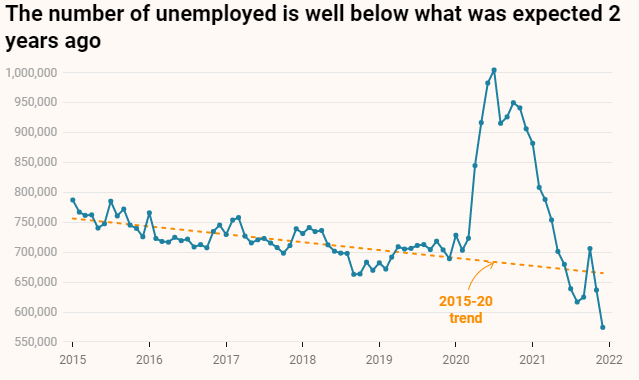
As it is, the level of unemployment is well below what would have been expected a couple of years ago:
…And so the unemployment rate is likely to get below 4% sometime this year – it’s already at 4.2%. But it is worth reflecting that we got to that level due to very unusual circumstances, and that just looking at the rate itself hides a lot of what is going on in the labour market.
… reduced labour force might provide a better looking unemployment rate, but not necessarily a better economy or community.
Advertisement
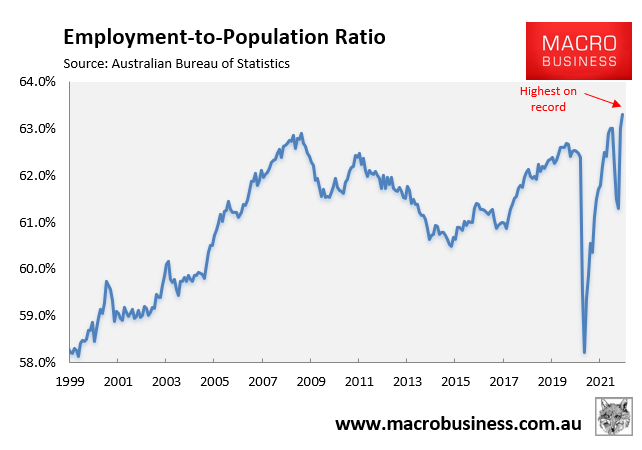
Greg Jericho could also have shown that Australia’s employment-to-population ratio is running at the highest level on record, thanks to the collapse in immigration:
Yet Jericho still concludes that workers facing the best labour market in generations does not mean “a better economy or community”.
Advertisement
Well, what does the best labour market in 40 years mean then, Greg? A worse economy and society because you’re in the pocket of big business?
I hope you don’t take these biases to your new position as Policy Director: Labour Market and Fiscal at the progressive Centre for Future Work.
Leith van Onselen is Chief Economist at the MB Fund and MB Super. He is also a co-founder of MacroBusiness.
Leith has previously worked at the Australian Treasury, Victorian Treasury and Goldman Sachs.