Last year, RBA Governor Phil Lowe broke rank and warned that Australia’s high levels of immigration had contributed to the nation’s decade of poor wage growth and had given businesses an incentive not to train their workers.
These statements were immediately met with fierce condemnation from the Big Australia lobby and its captured media and economists.
On Friday, RBA Governor Phil Lowe flipped the script and warned that the closure of Australia’s international border to immigration has constricted business investment:
Lowe said local businesses have constrained their investment and expansion plans because they have been unable to obtain the necessary talent from overseas.
“So you might think it’s good that more demand for domestic Australian workers… on the other hand it has made it harder for firms to expand their capacity, and that’s bad for wealth generation in the end,” Lowe said.
Australia must be “very careful drawing longer-term lessons” from a “short sharp cessation” in immigration…
Dr Lowe says, turning off the tap of foreign labour would also mean “less investment, less confident business, less output, lower capital stock and a less dynamic economy”.
The notion that immigration spurs business investment is easily debunked.
Advertisement
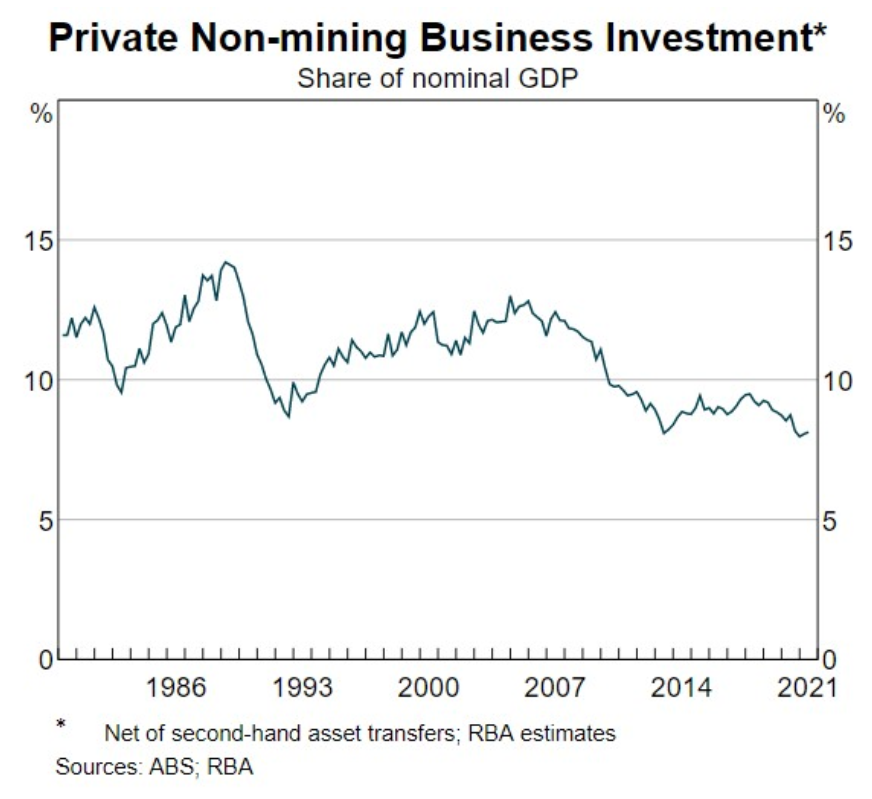
The RBA’s own data shows that non-mining business investment trended sharply lower after immigration was ramped-up in the mid-2000s:
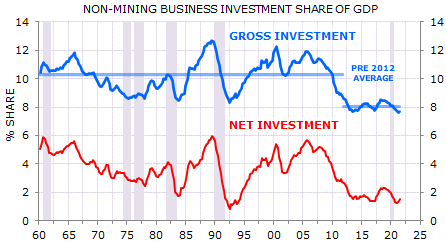
Gerard Minack’s latest research, published on Monday, also shows that non-mining business investment collapsed to recessionary levels as immigration boomed:
Advertisement
Non-mining investment has typically fallen to around 8% of GDP in recessions. Over the past decade it has averaged 8% (Exhibit 4).
In short, prior to the pandemic trend growth in per capita GDP and per capita spending were running at 70 year lows; real wages were stagnant; and non-mining business investment had spent a decade at levels only seen before at recession nadirs.
Hence, Phil Lowe’s claim that lower immigration will deliver “less investment,… lower capital stock and a less dynamic economy” is categorically false. Otherwise business investment would have boomed alongside immigration. Instead, Australia’s economy became less “dynamic”.
To the contrary, there are strong reasons to believe that running a high immigration model reduces the capital stock.
Advertisement
First, infrastructure investment required to keep pace with population growth is much more expensive than in the past, due to diseconomies of scale (e.g. tunnelling and land buy-backs). This means that every additional unit of infrastructure increases average costs across the economy, acting as a productivity drain.
Second, the increased labour supply and downward pressure on wages caused by high immigration necessarily disincentivises employers from investing in labour-saving technologies and automation to lift productivity (see here and here). After all, why invest in these productivity enhancements when you can instead import low cost workers to do the task?
Third, high immigration diverts resources (eg, capital and labour) from the tradable to non-tradable sectors. Tradable goods and services are those that can be sold at locations other than at the place of production (i.e. can be exported overseas). Non-tradable products are those than can only be sold at the place of production (eg, coffees, personal training and haircuts). Tradable firms are typically more capital intensive and productive than other businesses because they benefit from economies of scale and must be competitive against firms both nationally and internationally.
Advertisement
Thus, the diversion of resources resulting from high immigration encourages growth in low productivity ‘people-servicing’ industries, alongside diverting investment and productive effort into houses and infrastructure.
Australia is also unique in that it pays its way in the world mostly by selling its fixed endowment of minerals. So, importing a bigger population via immigration necessarily means this mineral wealth must be spread among more people, resulting in lower wealth per capita (other things equal).
Rebooting the ‘Big Australia’ mass immigration model is very likely to achieve exactly the same result as last decade: poor business investment, sluggish productivity and per capita GDP growth, low wage/income growth, and overall falling livability as both housing and infrastructure are crush-loaded.
Advertisement
It is a recipe to enrich those that have already hoarded assets and capital, namely the already entrenched, wealthy and corporate interests such as big business, the property industry, and the education-migration industry.
Sadly, those are also the groups that pull our policy makers’ strings, including Phil Lowe’s.
The Nordic, German and other advanced economies have achieved high living standards without resorting to extreme population growth. Those are the nations Australia should try to emulate.
Leith van Onselen is Chief Economist at the MB Fund and MB Super. He is also a co-founder of MacroBusiness.
Leith has previously worked at the Australian Treasury, Victorian Treasury and Goldman Sachs.