
The loss of 500,000 temporary migrants and the closure of Australia’s international border to foreign workers has done a wonderful thing for Australia’s labour market – it has pushed the underemployment rate to its lowest level since June 2014, as revealed in last week’s March labour market release from the Australian Bureau of Statistics (ABS):
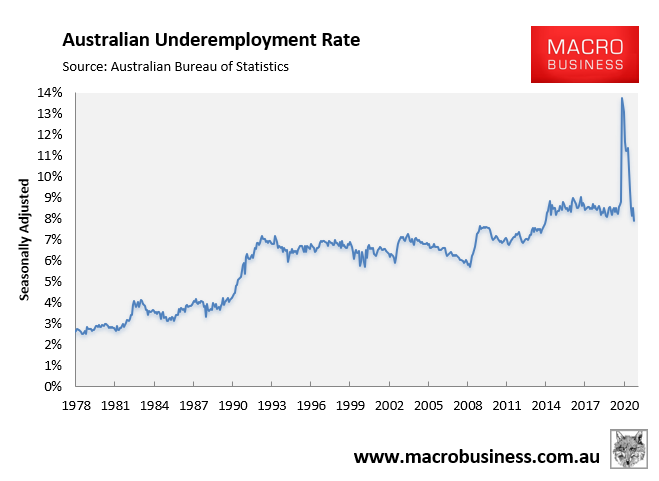
Australia’s underemployment rate has fallen to a seven year low.
Historically, Australia’s underemployment rate has shown a very strong correlation with wage growth – certainly much stronger than the headline unemployment rate – as illustrated previously by Economist Phil Soos, as well on this site (see here).

Australia’s underemployment rate has historically been strongly correlated with wage growth.
Therefore, if Australia’s underemployment rate continues to fall in the months ahead, then Australians could soon face the prospect of rising wage growth – something that has evaded workers for more than a decade:
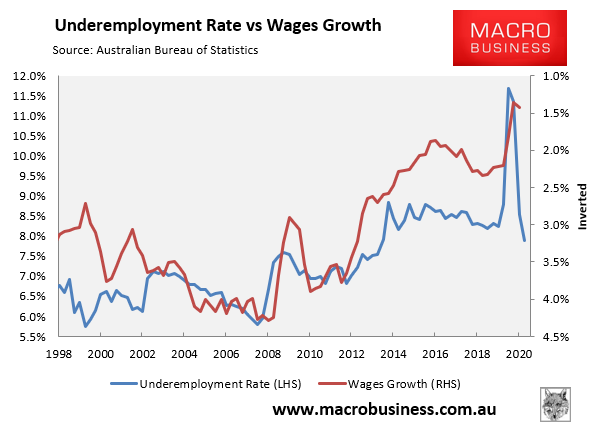
If underemployment continues to fall, wage growth will likely follow.
The prospect of having to offer higher wages to attract workers explains why business groups are lobbying so hard for foreign workers to be allowed into Australia to alleviate purported ‘skills shortages’.
As explained by ABC Business Editor, Ian Verrender yesterday:
There’s an easy fix to skills shortages — pay higher wages.
Instead, the push has been on to import large numbers of extra workers.
There are two reasons why. The first is to depress the price of labour. And the second is that rapid expansion of the population results in a bigger economy and a larger potential market which makes it easier for businesses to make more money without any need for innovation….
[Yet] stagnating wages is the single biggest factor behind the Reserve Bank’s inability to fire up the economy. The RBA has failed for almost six years to get inflation off the mat, into the sweet spot between 2 and 3 per cent, primarily because of weak wages growth.
The closing of Australia’s international border to immigration has reduced the supply of labour and increased workers’ bargaining power. In turn, the problem of chronically low wage growth is about to be solved by simply allowing the labour ‘market’ to allocate workers to areas of highest return (as measured by wages).
Sadly, the fake right Morrison Government only believes in the ‘market’ when it suits its big business mates. Accordingly, it is seeking to undermine the ordinary functioning of the labour ‘market’ by giving businesses unfettered access to cheap foreign workers via its proposed ‘skilled’ migration reforms.
Australians have already suffered a decade of stagnating real wage growth on the back of mass immigration. The Coalition’s reforms would be a final fatal blow for wages, living standards and productivity.
