
The end of the road is fast approaching for Foxtel, which is drowning in debt, strangled with high legacy costs, and has lost its only competitive advantage over its online streaming rivals.
Before the COVID-19 economic meltdown hit, Foxtel had already suffered a decline in subscription numbers over the prior two years. And this came at the same time as its online streaming rivals all experienced strong growth:
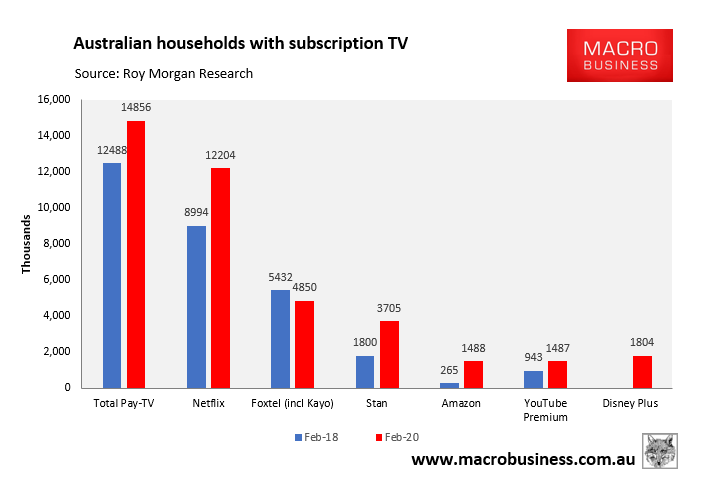
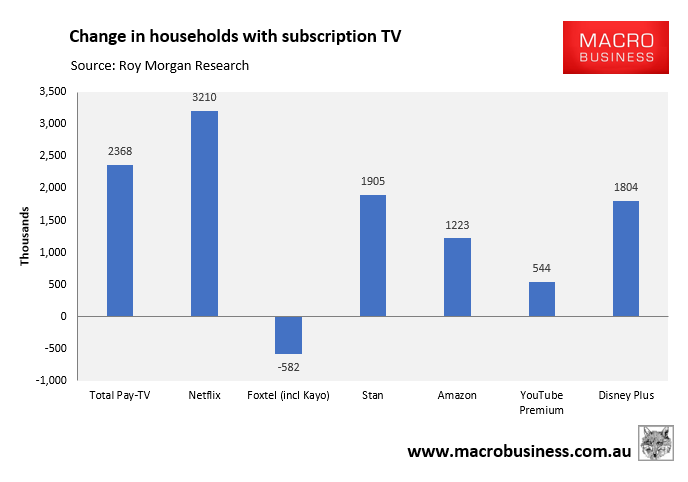
As shown in the charts above, which have been derived from Roy Morgan data, Foxtel lost 582,000 subscribers in the two years to February 2020.
Over the same two-year period, market leader Netflix grew its Australian subscriber base by a massive 3.2 million, whereas Stan (1.9 million), Amazon (1.2 million), YouTube Premium (544,000) and Disney Plus (1.8 million) also significantly grew their subscriber numbers.
Since February, the situation facing Foxtel has unambiguously worsened. The COVID-19 pandemic has postponed sporting events across the globe, including Foxtel’s prime NRL and AFL seasons. This has resulted in an avalanche of customers seeking to cancel their subscriptions to Foxtel’s traditional Pay-TV service, along with its online-only Kayo Sports service.
Falling subscription revenues also means higher costs per subscriber. This is because Foxtel’s TV rights are set at a set price. Therefore, as subscriber numbers fall, costs per user rise.
Foxtel is also weighed down financially by its high reliance on legacy hardware like cable boxes. Rather than simply running an App, these boxes require production, maintenance of infrastructure, as well as lift the barrier to entry for new customers.
The upshot is that Foxtel’s cost base is far above its online streaming rivals. Thus, so too are its subscription packages, which start at $25 – roughly double its online rivals.
These dynamics have rendered Foxtel uncompetitive, in turn leading to the loss of subscribers as they flee to cheaper, more convenient alternatives. It’s a subscription doom loop.
Finally, Foxtel is drowning in $2.3 billion of debt, which is obviously becoming harder to repay as its revenues and profitability collapse.
Foxtel’s short-term solution was to cull 200 jobs and place a further 140 into furlough. But these are band-aids that will merely slow the bleed, not stop it.
Unless it can dramatically transform its business into a low-cost streaming business, Foxtel will surely go the way of the dodo. It’s only a matter of time.
