
Don’t cry for universities over Chinese international student ban
Australia’s universities are in full panic mode over the federal government’s announced travel bans related to the coronavirus.
Yesterday, the CEO of the International Education Association of Australia (IEAA), Phil Honeywood, appeared on national television to explain the huge impact the loss of Chinese students would have on the education and accommodation sectors:
Unis have delayed classes and told students to stay away due to the #coronavirus.
A taskforce led by @PhilHoneywood hopes regulators will be able to work with the Chinese Government to allow for online classes.
“It’s very difficult to get that bilateral agreement happening.” pic.twitter.com/X8XR6rUuRM
— News Breakfast (@BreakfastNews) February 2, 2020
This came after Honeywood on Monday warned that the travel bans could cost Australia’s education industry around $8 billion:
Taskforce chair Phil Honeywood said the entry ban on non-citizens who had been in mainland China was a worst-case scenario for universities, English-language colleges and schools relying on the arrival of 200,000 Chinese students this year.
“Most of the new and continuing students have been caught off guard because many were brought home to celebrate Chinese new year,” he said.
“The industry is worth $39 billion a year and if we take Chinese students out of that equation for first semester, you would be looking at a minimum $8 billion budget hit for the international education sector and the wider economy”…
Meanwhile, Universities Australia has joined the IEAA in condeming the treatment of Chinese students by Border Force Australia officers on 2 February. The lobby groups claim that Border Force Australia overreacted when students arrived at various airports on the day after the federal government announced its coronavirus travel ban. They believe the students’ valid visas were cancelled, and that they were placed in detention and had their belongings confiscated. In turn, Border Force Australia’s actions have put the global reputation of Australia’s $39 billion international education industry at risk:
About 70 Chinese students, enrolled at several universities, were intercepted at Sydney airport and lesser numbers in Melbourne and Brisbane. Some students who were refused entry were already on their way to Australia when Scott Morrison announced the travel ban on Saturday afternoon…
“The government treated the students absolutely disgracefully,” one university official said…
“These reports are very disturbing and have been the subject of discussions with government today. We expect swift action to remedy the situation,” UA chief executive Catriona Jackson said.
“At this hugely difficult time, the welfare and safety of all of our students is our top priority. We hope to welcome these students into our communities as soon as possible”…
“Where agreed protocols have been breached these students and their families deserve official apologies, any fees and charges waived, and the greatest attention possible given to their ongoing welfare,” said Phil Honeywood, CEO of the International Education Association of Australia.
“Clearly certain officials have interpreted what was supposed to be clear guidelines. On behalf of the taskforce members, we offer our sincere apologies for the stress caused.”
Thankfully, The Australian’s Judith Sloan, who is not under the cosh of Chinese money, gave a sensible take on the situation, lambasting the universities for putting all of their eggs in the China basket:
…it’s hard to muster too much sympathy for the universities, hellbent as they have been on pursuing more and more international students, even if it has been at the expense of local students and the quality of courses. Have the senior officials or the councils of these universities ever stopped to consider the vulnerability of their business models, their dependence on international student fee income, particularly from Chinese students?
In 2002 there were about 50,000 students from China studying here; it is now about 260,000, the vast majority of whom attend universities.
International student fee income accounts for about 25 per cent of total university revenue; the percentage is much higher for some universities…
It was interesting to observe federal Education Minister Dan Tehan joining the education sector’s panic last week when he declared that “Australia must send a message” that the country is still open to international students and that all schools should follow the advice that pupils must be in class.
He chastised independent schools for instructing Chinese students and other students who had visited China to stay home to avoid spreading the virus.
Talk about the mighty dollar taking precedence, attempting to question the right of independent schools to make their own decisions, and acting as some sort of amateur public health specialist.
Of course, the lack of a moral compass is rife within the university sector…
Researchers have been belling the cat on the excessive number of international students at Australian universities even if their concerns have fallen on deaf ears.
…it’s surely time for reflection on the lack of diversification of our exports, particularly international students. The universities may need to start cutting their cloth in response to this new environment.
With about two million temporary migrants living in Australia, including a large number from China, it is also time to consider changes to our immigration arrangements to ensure that the number of temporary migrants can be reduced to more manageable numbers and thereby place less pressure on our large cities.
Spot on. Australia’s universities have become recklessly dependent on Chinese students and have a concentration that dwarfs other developed nations:
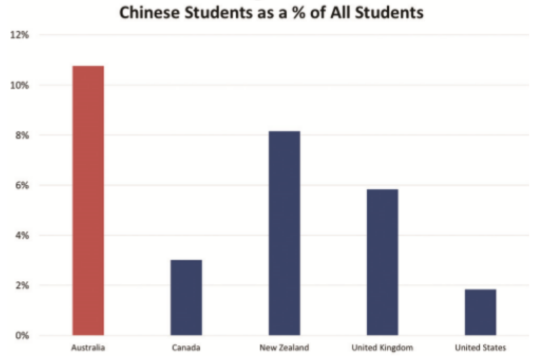
Now they are paying the price for this lack of diversification.
The fact remains that the travel ban on China is entirely appropriate, as were the actions from Border Force Australia. In the event of potential global pandemic, early over reaction is the correct course of action. It is better to be proactive than reactive when it comes to viruses. Preservation of human life must always trump concerns around loss of income.
How would the universities feel if the coronavirus spread through their campuses and they then faced litigation because they were more interested in dollars than health?
As I said yesterday, there is also a silver lining to this. At least English-language standards at our universities will improve, rates of cheating will fall, and local students will no longer be forced to work on group assignments where everyone gets the same mark but only a few locals fluent in English meaningfully contribute.
The coronavirus fallout is the hit “our” universities needs to wean themselves off the sugar teat of Chinese students.
