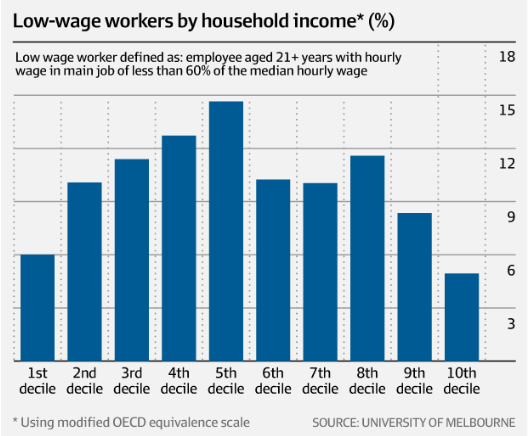
Analysis provided to The Australian Financial Review by the Melbourne Institute of Applied Economic and Social Research shows that 13 per cent of workers effectively on minimum wages live in households that enjoy the top 20 per cent of incomes in the nation.
Many are young adults in study, potentially living at home, and primarily aged between 21 and 34 years. Many are women with a secondary income.
The figures challenge Labor leader Bill Shorten’s assertion last week – as he called for a dramatic surge in hourly pay for low income workers – that “the minimum wage is no longer a living wage”…
Using Household Income and Labour Dynamics in Australia data on workers receiving no more than 60 per cent of the national median income, the research shows that only 21 per cent are what might be termed “harvester workers” – or those supporting a household on a single, minimum wage…
“The big story – to the extent that there would be wage gains from a decision to increase the minimum wage – is that a lot will be captured by rich households,” said Mark Wooden, professor at the Melbourne Institute.
“Almost 44 per cent are in the top half of the income distribution, and only 16 per cent are in the bottom quintile,” he said.
“As an anti-poverty measure, this is pretty crude and so unlike what Australia has been doing for the last 50 years…
Since when has an adult child’s income and wealth automatically been linked to their parents? Using this logic, a 30 year old locked out of the housing market and forced to live with their parents are deemed automatically to be “rich”, even if they are subsisting on the minimum wage. Moreover, the fall in home ownership across Australia is likely biasing household incomes upwards due to more income-earning children living at home for longer, thereby inflating overall household income.
Sure, Labor’s policy to lift the pay of the 2.3 million people on the minimum wage might be a bit “crude”, and Australia would do better to significantly lift unemployment benefits. But this analysis by the Melbourne Institute of Applied Economic and Social Research is equally “crude” and draws misleading conclusions.

Living at home with your parents doesn’t make you “rich”

Leith van Onselen
Thursday 8 February 2018
Advertisement
About the author

Leith van Onselen is Chief Economist at the MB Fund and MB Super. He is also a co-founder of MacroBusiness.
Leith has previously worked at the Australian Treasury, Victorian Treasury and Goldman Sachs.
Advertisement