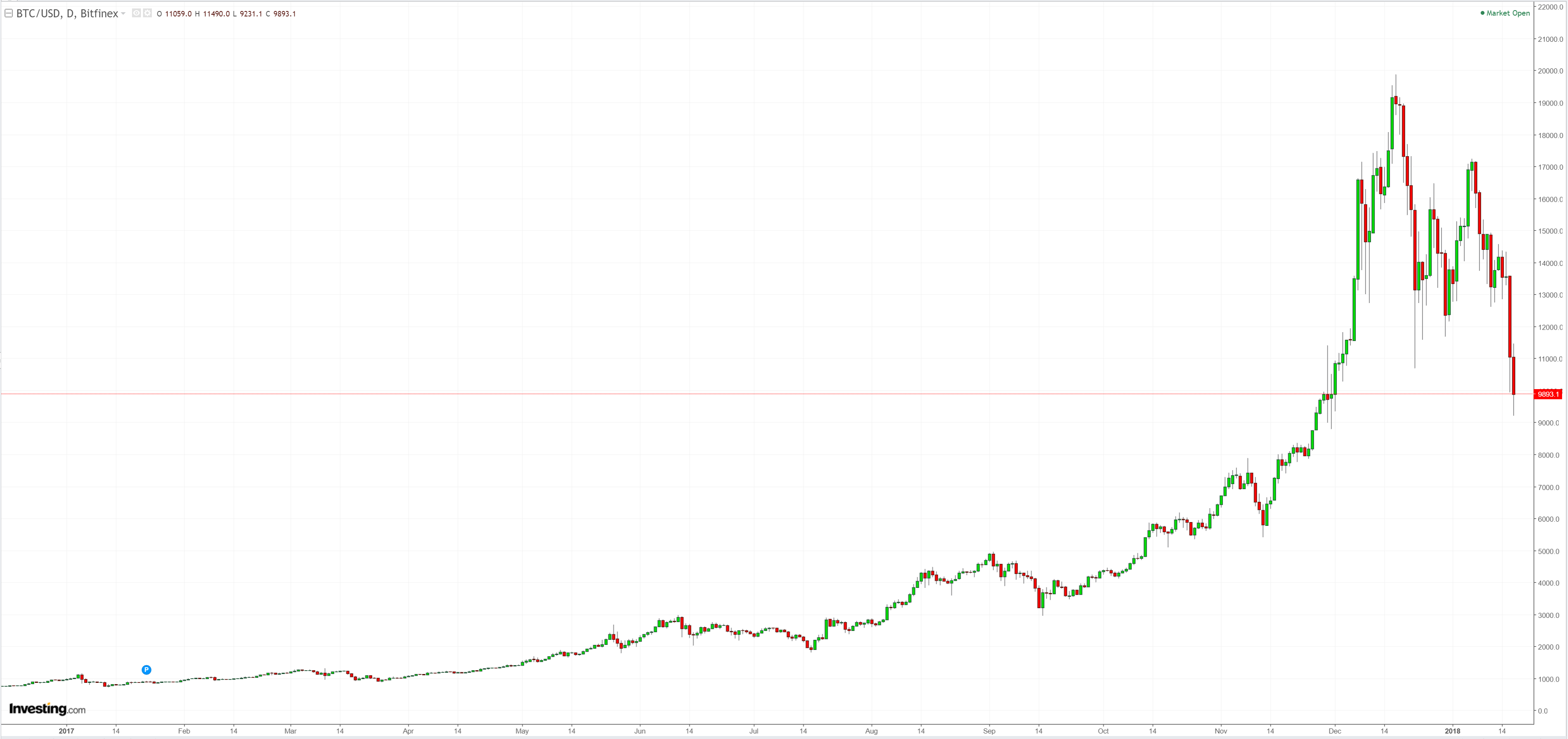
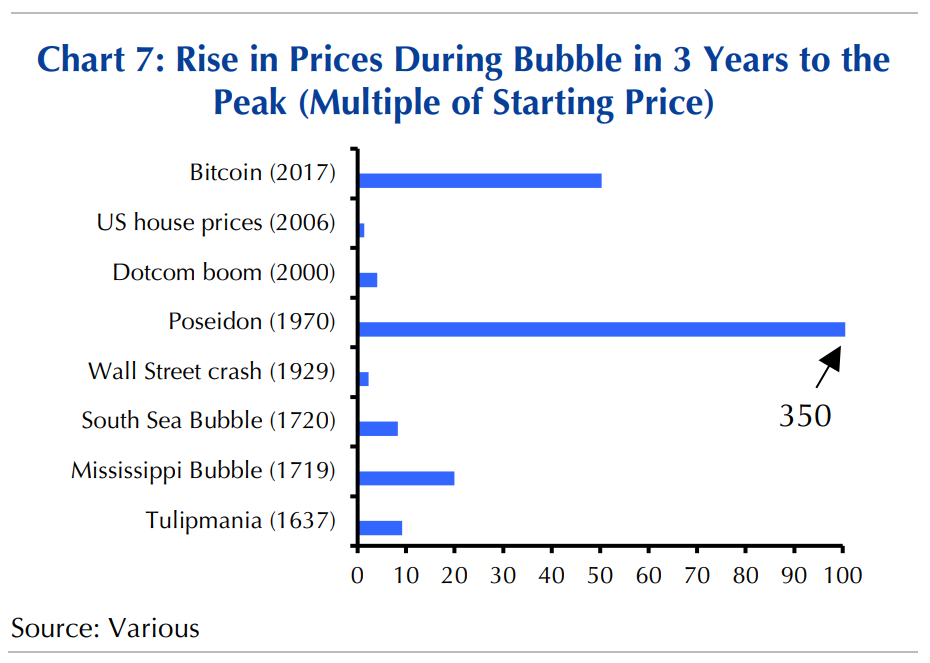
A note from Capital Economics is uncharacteristically blunt:
Claims that cryptocurrencies will replace established fiat currencies are rubbish; our view is that Bitcoin is a bubble. Indeed, the latest price falls suggest that the bubble is bursting – although with prices still ten times higher than a year ago, they have a lot further to fall yet. At least the economic fall-out from this should be small. And some long-run good will come of the blockchain technology underpinning the spread of cryptocurrencies, although it remains to be seen how big its effects will actually be.
• Bitcoin bulls point to its long-run potential to replace national currencies, but there are various reasons to doubt this. Admittedly, some of these are just technical – such as Bitcoin’s slow processing power – that might be solved over time. But even if this is the case, Bitcoin is clearly at risk of being usurped by a “better” cryptocurrency.
• And replacing national currencies with a cryptocurrency is not economically desirable in any case. A key feature of most cryptocurrencies is that they have an exogenously determined supply, meaning that governments or central banks cannot inflate away their value. But this means that swings in money demand therefore lead to big changes in prices or activity. A widespread adoption of Bitcoin could prompt a rerun of the problems seen under the Gold Standard.
• In any case, most people are buying Bitcoin, not because of a belief in its future as a global currency, but because they expect it to rise in value. Accordingly, it has all the hallmarks of a classic speculative bubble, which we expect to burst. Triggers for the bubble to burst could be a further crackdown by regulators or a major hacking attempt.
• At the moment, a Bitcoin crash would not have wide economic consequences. Bitcoin’s market capitalisation is still small; it is not held by institutions; and it has little correlation with other financial markets. That said, the more that Bitcoin becomes a mainstream asset class, the greater the risk of fall-out from a crash. The advent of Bitcoin derivatives trading, for instance, has made it easier for institutions to get exposure to Bitcoin, potentially raising the systemic risk of a large drop in prices.
• Even if Bitcoin is a flash in the pan, the blockchain or “distributed ledger” technology behind it has the potential to be a longer-lasting development with important implications. Not only could it transform the financial system – by removing the need for banks to act as intermediaries – but it could have applications elsewhere, for example, in maintaining tax and hospital records. A particularly interesting element is smart contracts, which could transform supply chains and trade finance.
• Another lasting legacy of the cryptocurrency phenomenon could be the issuance of central bank digital currencies. Note that these would differ from Bitcoin in that they would be a digital form of existing national currencies, rather than a new currency altogether. Of course, digital central bank money already exists to some extent in the form of commercial banks’ reserves. But blockchain technology could make it feasible to offer all individuals and firms an account at the central bank and – crucially – to allow them to exchange money in the same decentralised way that Bitcoin does.
• Varying the interest rate paid on these accounts would give central banks another monetary policy tool. Indeed, if physical cash were phased out altogether, central banks would have the option to set negative interest rates. Meanwhile, people would have a risk-free way to hold funds. However, if people moved their money from commercial banks to the central bank at times of uncertainty, bank funding would become significantly more volatile and credit growth would become squeezed.
Ross Norman, a gold dealer with a store tucked in a corner of London frequented by the upper classes, started exchanging gold for bitcoin via an intermediary three months ago. He describes his customers as almost embarrassed by their new-found fortunes. They often store it in safety deposit boxes in his underground vault, following extensive due-diligence to prevent money laundering.
“We’re seeing trades north of a million pounds every couple of weeks,” said Norman from his shop in St James’s St. “It’s been a welcome addition to our business in a period when physical demand from more traditional sources has been subdued.”
Customers as young as 25 come in carrying laptops holding bitcoin they accumulated when it traded at $1 or below. One, Norman said, had 1,000 bitcoin he intends to turn into physical metal. The company, owned by Degussa Goldhandel GmbH, doesn’t take possession of bitcoin. Customers buy via an intermediary.
“Bitcoin is a bit of a lobster pot — it’s easy to get in, but hard to get out,” Norman said. “Gold also offers investors 4,000 years of history as a store of value, and that’s looking quite appealing right now.”
Advertisement
Good time to get out, for sure. Not a great time to buy gold, in my view, with the USD massively oversold. Then again, if you’ve just made 15m pounds and are cashing out for the long haul then bravo!
Finally, the great thing about a digital Millennial ponzi scheme coming undone is that it is sure to unleash the internet:
David Llewellyn-Smith is Chief Strategist at the MB Fund and MB Super. David is the founding publisher and editor of MacroBusiness and was the founding publisher and global economy editor of The Diplomat, the Asia Pacific's leading geo-politics and economics portal.
He is also a former gold trader and economic commentator at The Sydney Morning Herald, The Age, the ABC and Business Spectator. He is the co-author of The Great Crash of 2008 with Ross Garnaut and was the editor of the second Garnaut Climate Change Review.