
Back in March, federal opposition leader, Bill Shorten, went on a tirade labeling those arguing for a sensible and sustainable immigration intake “political extremists” and effectively playing the race card to shut-down debate:
Shorten said that “political extremists” are telling Australians “that cutting migration will clear-up traffic and make housing cheaper”.
“It will make our internet faster, our schools better and our weather sunnier,” he said. “And citizens who feel like they’re not getting a fair go are told to blame minorities, to demonise difference.”
Shadow Treasurer, Chris Bowen, repeated the dose in July, launching a classic straw man argument against cutting Australia’s mass immigration program, disingenuously conflating the issue with rising global trade protectionism:
There is of course a populist offering available in both Australia and around the world.
A populist offering which blames false causes of immigration and open trade and offers simplistic, counter-productive solutions.
The Productivity Commission has highlighted this week the potential costs of going down this road.
Now contrast Labor’s ongoing support of mass immigration and a ‘Big Australia’ with its views about temporary foreign workers.
In May, Labor proposed to triple the cost of temporary foreign worker visas to encourage bosses to look locally.
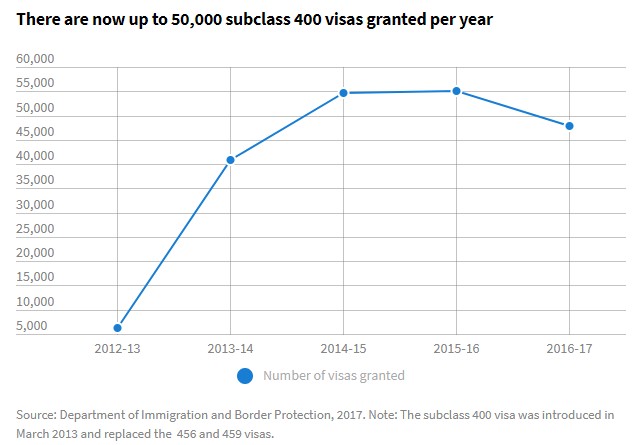
And over the weekend, it demanded the Government crack down on so-called short stay 400 visas, fearing they are undermining local workers. From The SMH:
[Labor has expressed] concern that subclass 400 visas are being used as a “back door” to undermine the government’s foreign labour crackdown.
The call for action follows a recent Fairfax Media report that detailed how the 400 visa – designed to parachute international specialists into short-term roles – has emerged as a “sleeper” category with looser restrictions than the high-profile 457 visa.
“Peter Dutton needs to make sure 400 visas aren’t being used to get around skills shortage lists, bypass genuine labour market testing or undercut local wages and conditions,” opposition immigration spokesman Shayne Neumann told Fairfax Media.
“Labor has genuine concerns that 400 visas are being used as a back door to bypass the Turnbull government’s own skilled migration rules. Loopholes in our visa system undermine the integrity of Australia’s skilled migration program and impacts local workers trying to get a job”…
The three-month 400 visa was introduced by the former Labor government in early 2013, superseding two previous categories. The Coalition government then modified the visa to allow an extra three months for eligible people.
Earlier this month, Fairfax revealed that subclass 400 visas have exploded in popularity and are being used to bypass the new skills shortage lists and avoid labour market testing.
While it is good to see Labor confront the temporary migrant worker issue, it is merely fiddling at the edges. The sad reality is that there are now entire business lines, firms and sectors whose business models rely heavily on the systematic undermining of wages and, worse, running virtual slave labour.
We have seen this in fast food, convenience stores, agriculture, building, mining, accounting, IT, engineering, education, transport, the gig economy and no doubt it is even more widespread.
Labor would do well to make closing down Australia’s various visa rorts a central plank to its inequality agenda and election pitch.
It should also seek to normalise Australia’s mass permanent migrant intake, which is currently set at around 200,000 people a year and is the key long-term driver of Australia’s immense population pressures in the big cities:
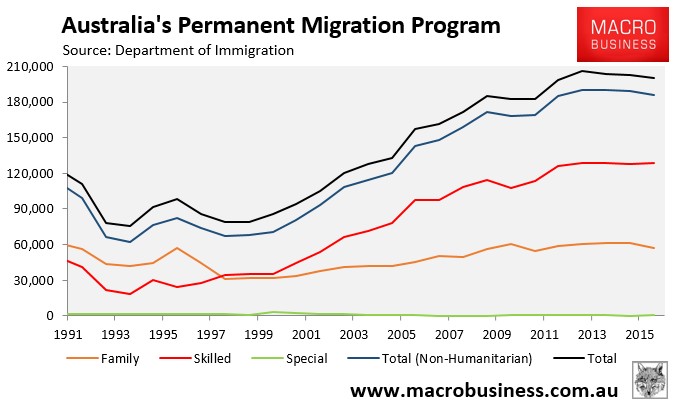
Labor’s inequality agenda would be greatly strengthened by also halving the permanent migrant intake – i.e. returning it back to something more in line with the historical average.
Income inequality and home ownership would be improved as there would be less upward pressure on house prices, particularly in Sydney and Melbourne, and less economic rents flowing to the owners of capital (who benefit the most from mass immigration while ordinary residents bear the costs).
Wages growth would also improve, other things equal, as there is less competition for jobs and workers’ bargaining power is increased, which would also help to reduce inequality.
There would be less youth unemployment, as employers are incentivised to hire and train young workers and graduates rather than taking the easy route of importing a migrant.
Australia’s economic growth and job creation would also become more broad-based and less concentrated in inner Sydney and Melbourne. Lower population growth would take pressure off interest rates and the currency. Thus, the Australian dollar would fall more quickly than otherwise helping to cushion the post mining-boom adjustment as tradable sectors become more competitive more quickly. This would spread benefits much more widely than just the “citizenship export” sectors of education, as well as simply piling more unproductive consumers into Sydney and Melbourne (blowing the current account deficit and increasing debt).
Lower population growth would also lift productivity and income by decongesting cities and, over the long-run, shares the depleting Australia’s fixed national endowment of resources among fewer people, also ensuring higher income per capita.
Labor needs to ask itself: how is maintaining a mass immigration program – which is projected to flood Sydney and Melbourne with 87,000 and 97,000 people a year respectively for decades to come – compatible with a fairer, more sustainable and socially cohesive Australia? Such turbo-charged immigration necessarily will make housing affordability worse, dilute workers’ bargaining power, enrich the capital owners and wreck overall livability (e.g. via worsening congestion).
Labor is onto a good thing addressing inequality and its reform matrix to deliver it is much better than the Coalition’s. But why it allows pro-immigration extremism [remembering that nobody here is arguing to cut it beyond the historical average] to work against those very outcomes is the question we must ask.
unconventionaleconomist@hotmail.com
