Ever since the 7-Eleven migrant worker scandal broke in 2015, there has been a regular flow of stories emerging about the systemic abuse of Australia’s various migrant worker programs.
The issue was highlighted in all of its hideous glory when the Senate Education and Employment References Committee released a scathing report entitled A National Disgrace: The Exploitation of Temporary Work Visa Holders, which documented the abuses of Australia’s visa system for foreign workers.
Despite this Senate report being released last year, there has so far been minimal action from the federal government, with widespread rorting of Australia’s visa program continuing unabated.
Advertisement
As reported in Fairfax last month,Fair Work Ombudsman Natalie James has revealed that people on visas continue to be exploited at an alarming rate, particularly those with limited English-language skills:
Of all requests for assistance from the ombudsman in 2016/17, 18 per cent came from workers on visas – an increase on the previous year and significantly disproportionate to the total number of workers on visas.
Half the cases that made it to court involved a visa worker, Ms James told Fairfax Media.
“It is pretty outrageous and it’s sad we are still seeing examples of vulnerable visa holders being exploited in this way,” she said…
Now another class of visa rorting has been uncovered by Fairfax in the form of so-called short stay 400 visas:
Advertisement
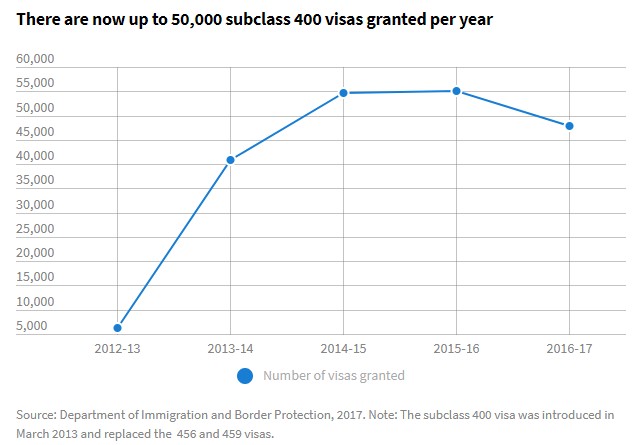
A little-known visa category has become a “new frontier for unscrupulous employers” looking to exploit cheap foreign labour at the expense of Australian workers.
The 400 visa, designed to parachute international specialists into short-term roles, has emerged as a “sleeper” category with looser restrictions than the 457 foreign worker visa…
In the past decade, hundreds of thousands of workers have been employed on short stay visa categories, including the 400’s predecessor the 456, with at least 11 cases before the Fair Work Ombudsman. But experts warn despite the examples of exploitation, the Department of Immigration and Border Protection has little detail on the employment of these workers.
Among them, Chinese labourers flown in to dismantle the former Mitsubishi car plant in the Adelaide Hills paid $1.90 an hour, Filipino metal fabricators paid $4.90 an hour to install animal feed mills in NSW, and nine Indonesian timber workers flown into Tasmania and promised bonuses when they returned home.
“The fact that a couple of exploitation cases exist really shows that there is a real opportunity for this visa to be exploited,” said Joanna Howe, an associate Professor in Law at the University of Adelaide.
“They have no local or community networks, they have very little English, it’s very difficult for them to even know that the fair work ombudsman exists.”
Documents seen by Fairfax Media show 400 visas are sometimes approved within 24 hours with seemingly minimal oversight. Despite the government’s requirement that the work be “highly specialised”, the visa has been used to fill semi-skilled positions for which apparently qualified Australian applicants were available…
Dr Chris F Wright, a senior lecturer at the University of Sydney Business School said… “For the 400 there is not much information at all. It’s a sleeper visa category not much attention has been paid to it.”
Dr Howe said the lack of transparency meant it was easier to use the 400 than the 457 “for any unscrupulous employer that wants to subvert Australian law, that wants to use a migrant workforce because they aren’t unionised and less likely to complain”.
In January, a Freedom of Information request from Dr Howe and colleague Irene Nikoloudakis showed the Department had “no documents” referring to the number of visa holders by occupation…
AIMPE says positions that were previously being filled by 457 visa holders are now being filled by 400 visa holders, accusing multiple companies of abusing the category…
Labor MP Julian Hill said… “It appears that some employers are still finding ways to bypass the new skills shortage lists and avoid labour market testing,” Mr Hill said. “Reports that 400 visas are being handed out like lollies by Peter Dutton’s department are disturbing.”
More of the same, I’m afraid. The sad reality is that there are now entire business lines, firms and sectors whose business models rely heavily on the systematic undermining of wages and, worse, running virtual slave labour.
We have seen this in pizzas, convenience stores, agriculture, building, mining, accounting, IT, engineering, education, transport, the gig economy and no doubt it is even more widespread.
Advertisement
Labor would do well to make closing down Australia’s various visa rorts a central plank to its inequality agenda and election pitch.
Leith van Onselen is Chief Economist at the MB Fund and MB Super. He is also a co-founder of MacroBusiness.
Leith has previously worked at the Australian Treasury, Victorian Treasury and Goldman Sachs.