Back in March, the Australian Bureau of Statistics (ABS) released its annual migration report, which revealed that Indians are Australia’s fastest growing migrant group, increasing their share of the Australian population from 0.8% in 2006 to 1.9% in 2016.
With their growing numbers has come increasing lobbying efforts on behalf of India’s migrant community.
Last month, we witnessed India’s Ministry of External Affairs issue a terse statement against the Turnbull Government’s minor changes to the ‘skilled’ 457 temporary visa scheme, where Indians make up one quarter of 457 visa numbers. Even Indian Prime Minister, Narendra Modi, got involved claiming the visa changes risked a future ‘free trade’ deal between the two nations.
Advertisement
India’s lobbying came despite compelling evidence that Indians have been behind much of the visa rorting under the 457 system, not to mention the rorting of student visas.
Last June’s 7.30 Report featured Melbourne Indian community leader, Jasvinder Sidhu, explaining his first-hand accounts of blatant visa rorting and corruption by his fellow countrymen in both skilled and student visas:
NICK MCKENZIE: The visa scam came as little surprise to Jasvinder Sidhu. He knows of many Indians who’ve paid large cash sums to corruptly obtained skilled or student visas in an effort to get permanent residency.
JASVINDER SIDHU: I’ve been hearing it eight, nine years and the last time I heard was last week when somebody paid $45,000 cash.
NICK MCKENZIE: Now Sidhu is determined to expose what he’s learned about Australia’s immigration underworld.
JASVINDER SIDHU: These people will then create your fake timesheets, fake pay slips and they will pay in your bank account and obviously everything else will also be fake, which is superannuation and other related documents.
NICK MCKENZIE: So you’re paying for a fake, a phantom job and in return you get your skilled visa?
JASVINDER SIDHU: Yes. So you are paying extra to get or create a job which doesn’t exist and to create a service which was never delivered and you’re getting permanent residency, which is not fake. This is a real output.
Advertisement
In a similar vein, the Australian Population Research Institute’s (APRI) recent report entitled “Immigration overflow: why it matters”, examined the widespread rorting of Australia’s visa system, especially by Indian IT firms:
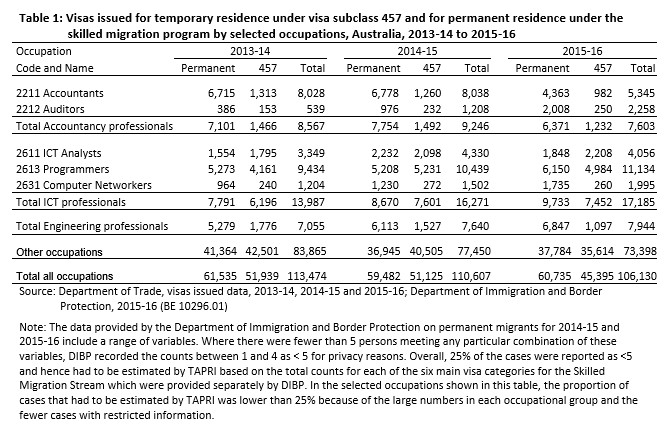
One of the findings from this report was “the high and increasing numbers of IT professionals being granted 457 visas”, which “constitute by far the largest occupation group within the 457 program”:
Advertisement
The APRI showed that Indian IT service companies have been successful in winning a major chunk of Australia’s IT consulting work on the basis of these 457 visa holders, partly because they are paying them much lower salaries than the market rate for IT professionals in Australia:
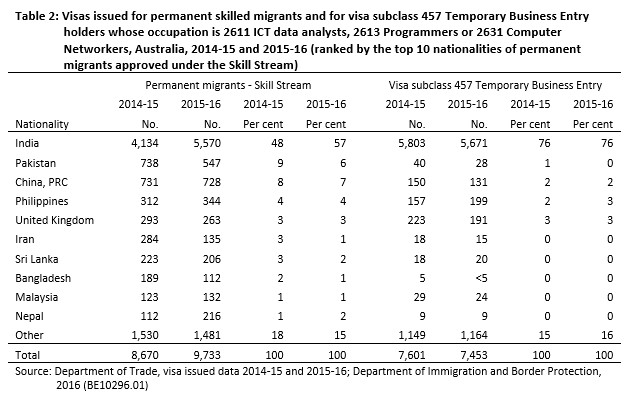
As Table 2 shows, some 76 per cent of the 7,542 457 visas issued in the three IT occupations listed were to Indian nationals. The great majority of these were sponsored by Indian IT service companies as intra-company transferees…
Once in Australia their staff are being paid at much lower rates than experienced resident IT professionals and in some cases even new local graduates.
Even more disturbing is the relatively high proportion of these Indian IT professionals (28 per cent) whose 457 visas were approved at the extremely low base salary of $53,900 or less. This is despite the fact that only eight per cent of the 457 visas granted to Indians in the two ICT occupations in 2014-15 were aged less than 25.
The median starting salary for local ICT graduates under the age of 25 is around $54,000. Coincidentally, the 457 minimum salary ‘floor’ is set at $53,900…
Now, the Australian Indian community is howling outrage at the cost of the Turnbull Government’s announced 15,000 visas per year that will be granted to elderly parents of migrants. From SBS News:
Advertisement
‘We have to fight this. It’s a disgrace,’ say members of the Indian community in Australia of the government’s proposal for a new parent visa as an online petition is launched.
The new parent visa which is yet to pass the parliament, will allow migrants to seek a three year visa for their parents for $5000, a five year visa for $10,000 and a ten year visa for $20,000.
As many as 15,000 people each year will be granted these visas which could deliver hundreds-of-millions in visa fees to the government.
Along with visa fees, children will have to bear the financial burden of healthcare for migrant parents, with sponsors legally required to pay for their private health insurance…
Melbourne resident, Ankit Mistry was hoping the new visa, which was expected around July 2017, would have enabled him to bring his parents to Australia for a long stay. He now says that the new provisions are “too expensive.”
Arvind Duggal, an Adelaide resident, who kick-started the ‘Long Stay Visa for Parents’ campaign that saw national participation before federal elections, told SBS Hindi: “This new visa is blackmail. We are being blackmailed into shelling out thousands to be able to live with our parents. This is a lot of money plus the health insurance”…
Jasvinder Sidhu, a community leader in Melbourne told SBS Hindi: “We are not happy with this change as it is exploitative and a joke with migrant communities. After the citizenship related changes this is another blow. It is also a breach of election promises which the Federal Government made because the bond money has now become fees”…
Vishal Patel in one online group wrote: “Coming to Australia and becoming citizen of Australia shouldn’t mean we turn our back on our aged parents”…
Nobody should migrate somewhere with the expectation of bringing their elderly parents with them.
The fact remains that these new parental visas will cost incumbent Australian residents a lot – certainly far more than the $2,000 in annual fees charged by the Government for these visas. This is because they will place increasing strain on Australia’s already overloaded public infrastructure and services, which has been accumulated and paid for by incumbent taxpayers.
Advertisement
Sure, the new visas will require the migrants to have private health insurance. But given that they would be old, and very heavy users of health services, they will likely place upward pressure on private health insurance premiums for everyone else. Younger Australians, who for decades will be required to hold private health insurance under Australia’s Lifetime Health Cover (without actually needing it), will be subsidising these elderly migrants (as they do for existing older Australians).
These elderly migrants will also place greater pressure on health care professionals – both private and public – whose training is paid for, to a large extent, by the taxpayer. They will also increase the need for more hospitals and ancillary health services to be both provided and built.
It is worth reiterating that the Productivity Commission’s (PC) Migrant Intake Australia report, released last year, recommended significantly tightening parental visas and raising their price, because they are costing taxpayers an estimated $335 000 to $410 000 per adult, or between $2.6 and $3.2 billion in present value terms (and growing):
Advertisement
There is a strong case for a substantial increase in visa pricing in relation to some elements of the family reunion stream. This would provide scope to recoup at least a portion of the high fiscal costs typically associated with immigrants in this category. In the medium term, the allocation of parent visas should be revised…
The contributory visa charge of just under $50 000 meets only a fraction of the fiscal costs for the annual intake of roughly 7200 contributory parents. And an additional 1500 parents make a minimal contribution. Overall, the cumulated lifetime fiscal costs (in net present value terms) of a parent visa holder in 2015-16 is estimated to be between $335 000 and $410 000 per adult, which ultimately must be met by the Australian community. On this basis, the net liability to the Australian community of providing assistance to these 8700 parents over their lifetime ranges between $2.6 and $3.2 billion in present value terms. Given that there is a new inflow each year, the accumulated taxpayer liabilities become very large over time. This is a high cost for a relatively small group.
Ultimately, every dollar spent on one social program must require either additional taxes or forgone government expenditure in other areas. It seems unlikely that parent visas meet the usual standards of proven need, in contrast to areas such as mental health, homelessness or, in the context of immigration, the support of immigrants through the humanitarian stream, and foreign aid.
Given the balance of the costs and benefits, the case for retaining parent visas in their current form is weak.
Rather than heed the PC’s advice, and reduce the burden on taxpayers, the Coalition has instead chosen to increase the quantity of elderly migrants flowing into Australia, thus adding to strains on infrastructure, housing, the Budget, as well as exacerbating the ageing of the population.
The Australian Indian community has little justification for complaining – the $2,000 per year visa charge is a very good deal for them, but a poor deal for incumbent resident taxpayers who will provide the subsidy.
Advertisement
Australia already has a generous three month tourist/visitor’s visa that parents can use to visit their children and grandchildren. This should be the extent of parental visit, except in exceptional circumstances.
Leith van Onselen is Chief Economist at the MB Fund and MB Super. He is also a co-founder of MacroBusiness.
Leith has previously worked at the Australian Treasury, Victorian Treasury and Goldman Sachs.