
Spooking markets this, via 21st Century Herald:
MPA exam in April issued a sharp decline in the number of 15%
bank financial management to retail transition trend showThe issuance of the top ten banks, only Minsheng Bank in April than in March, the issuance of the increase, the remaining nine bank circulation all reduced, more than 10% decline, of which the Agricultural Bank fell 48%.
Financial supervision, the impact of the specific business of the financial institutions on the market immediately. Following the extravagance financial management into the MPA (macro-prudential assessment system) after the assessment, the CBRC 7 documents for the same industry add “straw.” The first quarter of this year, the scale of financial growth has declined, on this basis, the reporter according to wind terminal statistics, the number of financial products issued in April the number of ringments in March fell 15%.
The same industry is the most important task of intensive supervision. A number of related business and analysts told reporters in the 21st century economic report, the current banks are in the same industry financing business, is expected to shrink the trend of this short-term will continue. It is expected that the size of the financial market will be more substantial decline. Internal structure point of view, with the size of the larger financial sector contraction, personal finance business is accelerating growth, financial business development to retail transition trend is obvious.
Industry Keywords: Compression
MPA will be included in the financial management is mainly to control the scale of growth. Data show that the first quarter of 2017, the scale of bank financing to further slow down the pace of growth, the chain growth rate fell to 2.92%, growth rate fell 1.55 percentage points over the previous quarter. But since April, the intensive launch of the regulatory and inspection operations, it directly affects the existing business.
According to wind statistics, in April, the number of bank financial products issued for the 10038, compared to the 11823 in March decreased by 15%. In addition, the issuance of the scale of the top ten banks, only Minsheng Bank in April than in March, the increase in circulation from 260 to 353, the remaining nine banks in all the reduction in circulation, more than 10% , Of which the Agricultural Bank fell 48%.
The industry is not surprising that the size of this financial issue has dropped significantly. Pu Yi standard researcher Wei Ji-kao told reporters that in April the size of the banking financial products to reduce the size of the two main reasons, one is due to the impact of the end of March the impact of the time, the bank demand for funds larger, through a large number of The issuance of high-yield financial products to absorb funds has become a common way for most banks. With the end of the assessment, the bank’s demand for funds has slowed (by the central bank’s monetary policy changes in the impact of market liquidity is still showing a neutral tight trend), so the size of the product distribution appeared contraction.
Another reason is that since the end of March to start the regulatory upgrade also makes the issuance of bank finance more cautious, around the supervision of the resident, making more non-standard products to suspend the issue, coupled with the supervision of the impact of the industry, The same size of the same financial management contraction.
“The end of the asset does not come, the cost of capital is high, we are in the same size, the issuer and the investment side are in the pressure.” A financial platform with the industry financial researcher told reporters that he believes that this Scale trend may continue to continue, at least until the third quarter, “the second quarter of the bank self – examination, the third quarter of checks, the fourth quarter may be to rectify.
Wealth management products down 15% month on month in April as regulators force banks to back out. Recall the rest from earlier today. Caijing: 多地房贷利率上调:广州进9折时代 上海现9.5折
Shanghai area before the first home lowest interest rates was 10% below the benchmark, now this has been cut to 5%; second-home interest rate is still generally the benchmark interest rate plus 10%.
Guangzhou area, May 1 small holiday after the mortgage interest rate to accelerate into the “90% era.” Previsouly. state-owned banks and a number of listed banks offered first-home mortgages with discounts of 10% to 15%. Previously first-home mortgaged rates ranged from 10-15% discounts, with some listed banks already cutting the discount to 5%.
According to Rong 360 latest report shows that since April, Shanghai, Shenzhen, Guangzhou, Chongqing, Fuzhou, Suzhou, Xiamen, Nanchang, Ningbo and other cities have interest rates rise. The statistics show that in the 35 cities nationwide 533 banks, 122 banks first suite interest rate discounts rose, accounting for 22.89%.
Rong 360 analyst Li believes that the mortgage interest rate increase and the current first-tier cities, second-tier cities have introduced limited loans, restrictions on the policy of landing, the role of policy control has begun to bear fruit.
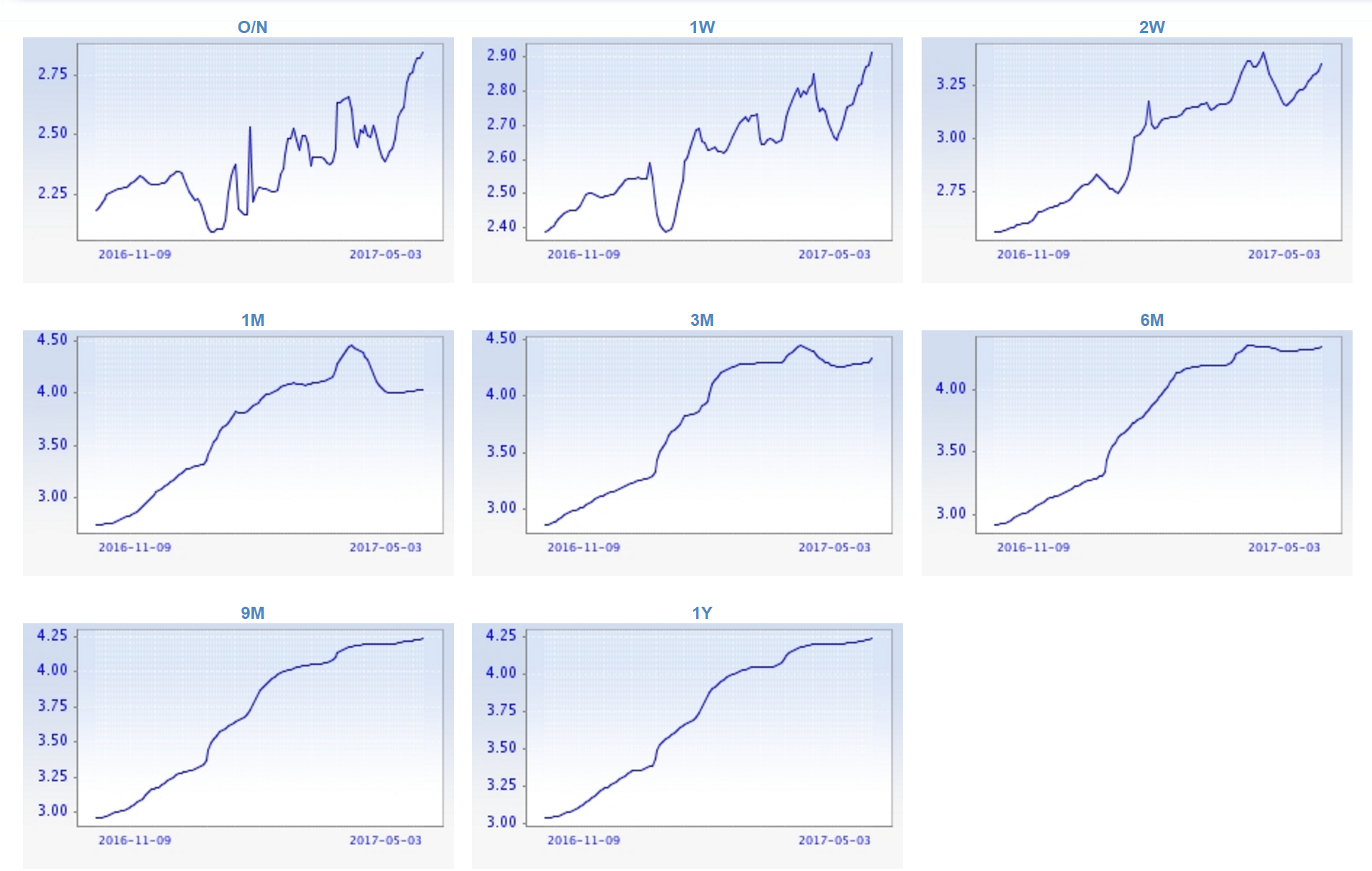
Interbank markets:
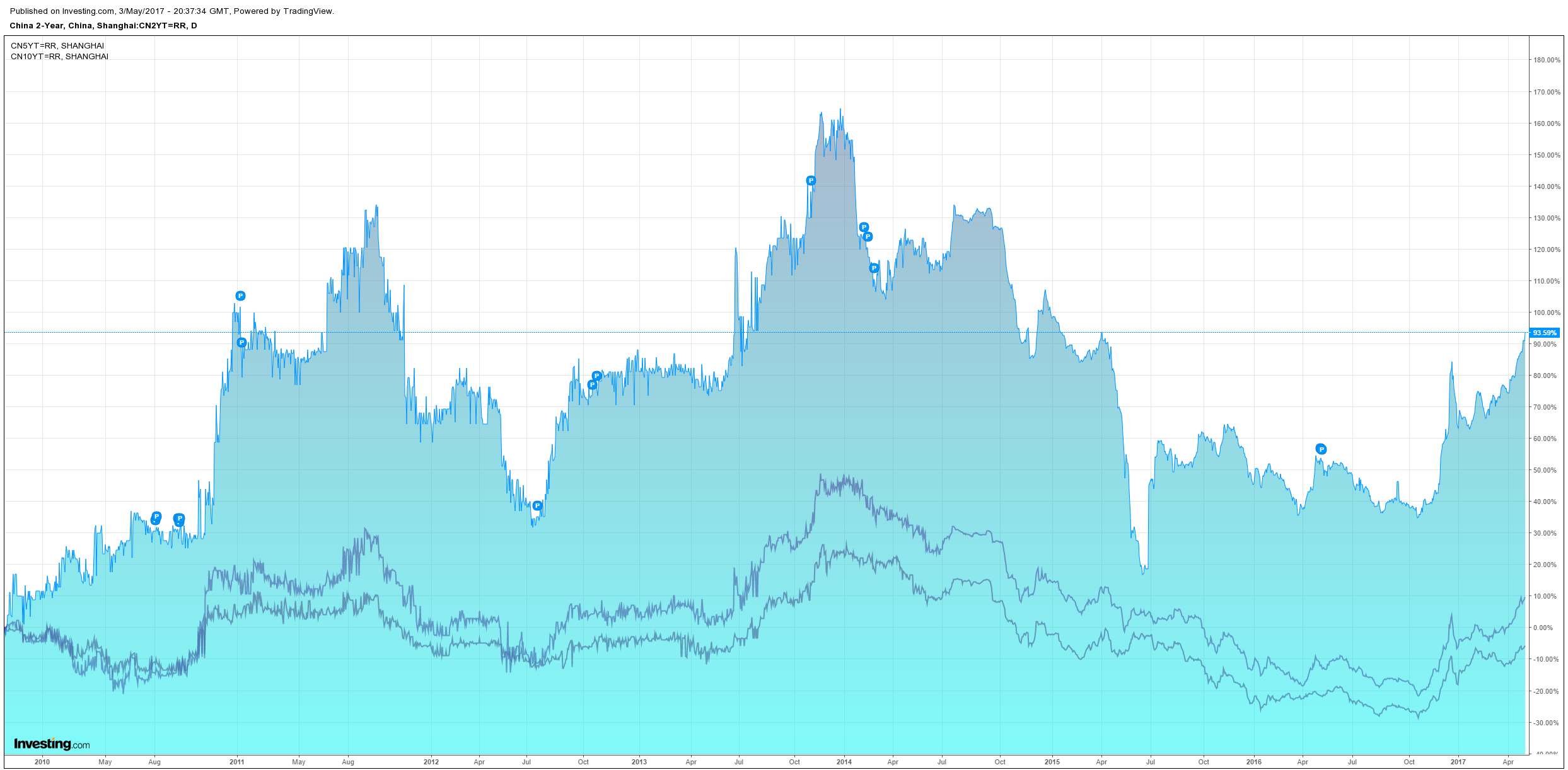
Bonds:
Kyle Bass explains the regulatory crackdown:
One does not need to be as bearish as that to know what’s coming here.
iFeng: 4月楼市全面降温 部分城市限制住房持有年限
In April, the national property market overall cooling. According to the Central Plains real estate research center statistics show that in April the overall decline in the property market, including a second-tier cities were varying degrees of decline in volume, third-tier cities year on year, month on month a slight increase. Shanghai, Guangzhou, Fuzhou, Suzhou and other cities of the transaction fell significantly, fell more than thirty percent.
Bulks bust.
