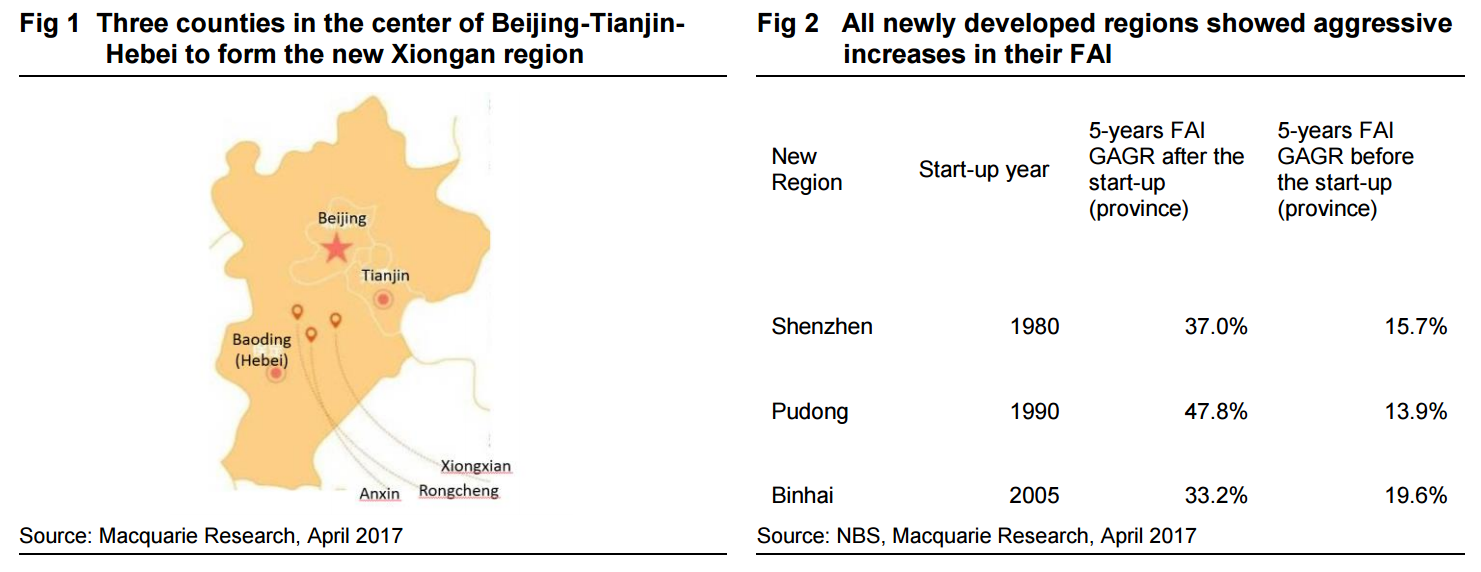
China’s central government announced last weekend that it would establish a new region called “Xiongan New Area” in Hebei province, as part of measures to advance the coordinated development of the Beijing-Tianjin-Hebei region. This New Area includes three counties that are located at the center of this triangle (Fig.1), which will cover 100 square km initially and be expanded to 200 square km in the medium term and 2000 square km in the long term. This move is said to help phase out Beijing’s non-capital function so that it can relieve the big population, logistics and environmental pressure that Beijing city is currently facing. The central government views this new region as the one with national significance, similar to what they took for Shenzhen Special Economic Zone and Shanghai Pudong New District, and call it as the “sub-capital center”.
This is not the first time that China has tried to reduce the burden on Beijing city. In late 2015 they announced plans to develop the Tongzhou region as the sub center of Beijing city. However, compared with Tongzhou that has a total area of 907 square km, the long-term plan for the new Xiongan region is more ambitious and more importantly it will be built from scratch, as these three counties are much less developed. This means the government will basically build a new city near Beijing, which should lead to extra demand for commodities, particularly building materials.
The full text of this article is available to MacroBusiness subscribers
David Llewellyn-Smith is Chief Strategist at the MB Fund and MB Super. David is the founding publisher and editor of MacroBusiness and was the founding publisher and global economy editor of The Diplomat, the Asia Pacific's leading geo-politics and economics portal.
He is also a former gold trader and economic commentator at The Sydney Morning Herald, The Age, the ABC and Business Spectator. He is the co-author of The Great Crash of 2008 with Ross Garnaut and was the editor of the second Garnaut Climate Change Review.