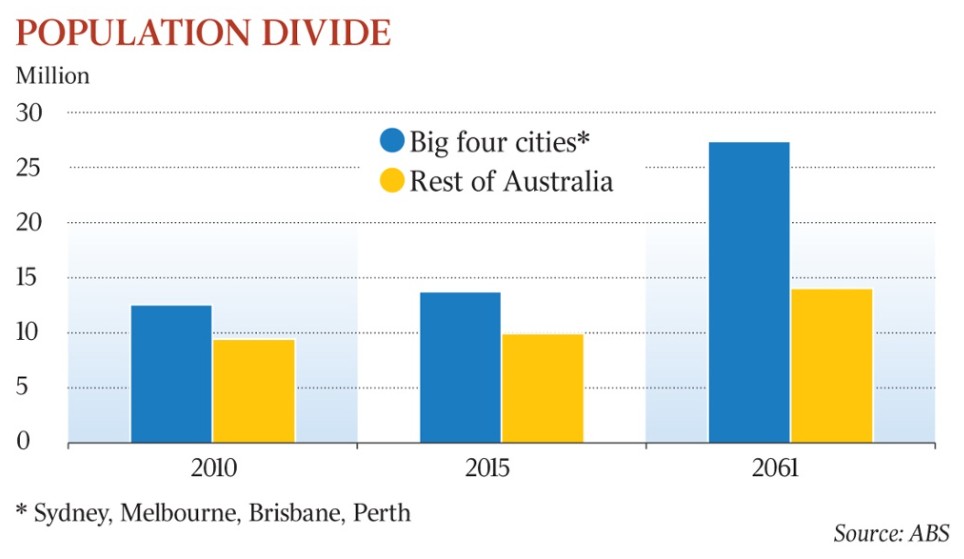
Following his weekend warning that unless Australia undertakes a massive infrastructure investment program we will be overrun as the population bulges, Infrastructure Australia chief, Mark Birrell, has returned to warn that Australia is facing a future whereby the four biggest cities will grow to nearly 30 million people, accommodating two out of every three Australians, and causing huge strains on housing and infrastructure. From The Australian:
Infrastructure Australia chairman Mark Birrell has warned that if the nation grows as forecast, housing and other cost-of-living pressures will increase on city residents while the regions are starved of economic activity.
“We will all be disappointed in 20 years’ time if nearly all of the growth in Australia has occurred in only four cities,’’ Mr Birrell told The Australian. “If we don’t watch it, the outcome will be that four cities grow enormously and the share of growth in other centres is disappointingly low.’’
Australia does not have a national population policy, and last year the federal government formally rejected a submission by Infrastructure Australia to develop one to manage and reshape our projected population…
“If we are going to deal with the likely population growth and also, the pressures of trade growth, it would be in the national interest to see the outcome of that spread across more than just four cities.’’
Mark Birrell has once again done a good job identifying the problems. And he is 100% correct in calling for developing a national population strategy – something MB has advocated for some time.
Advertisement
But as usual, Birrell has avoided mentioning the most obvious solution: cutting Australia’s mass immigration program.
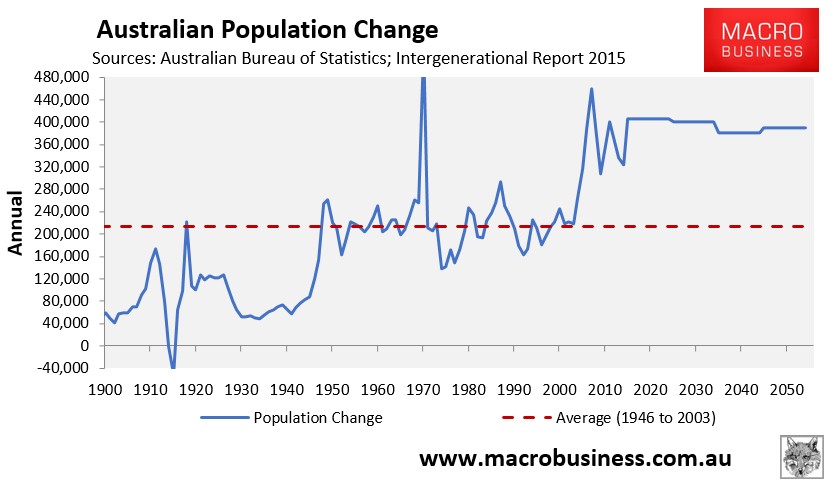
Under the Intergenerational Report’s projections, Australia’s population will grow by nearly 400,000 people a year for decades to come, with around half of these people piling into the already stressed cities of Melbourne and Sydney:
Advertisement
The fact of the matter is that strong population growth is a policy choice determined by Australia’s immigration intake, not a fait accompli. The government has never clearly articulated why Australia needs to run a mass immigration program, nor provided a detailed plan on how all the extra people will be accommodated.
The current approach has been to ‘grow and hope’, leading to the inevitable problems of rising congestion, deteriorating housing affordability, reduced productivity, environmental degradation, and overall lower living standards.
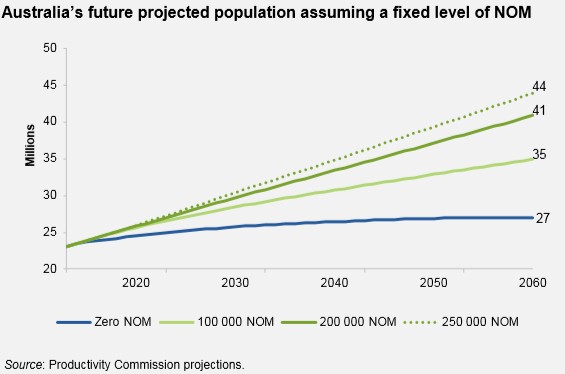
As shown in the next chart, which comes from the Productivity Commission, Australia’s population will reach more than 40 million mid century under current immigration settings, at least 13 million more than would occur under zero net overseas migration (NOM):
Advertisement
That’s a helluva lot of extra people to build infrastructure and housing for versus a lower or zero NOM policy.
Instead of everyone hand-wringing over inadequate infrastructure and the other problems that come from perpetual mass immigration, why not reduce immigration to sensible and sustainable levels? Or at a minimum, let’s have a national discussion and debate over Australia’s mass immigration settings, which are the demand-driver causing the problems in the first place.
Advertisement
Because under current policy settings, Australia will need to build the equivalent of a new Melbourne every ten years ad infinitum. Blind Freddy can see that this is unmanageable, unsustainable and undesirable. We are already seeing standards of living tumble and political parties fall apart under the resulting pressures. Yet we are pursuing this Big Australia agenda without even a national plan to cope with gigantic further growth.
Leith van Onselen is Chief Economist at the MB Fund and MB Super. He is also a co-founder of MacroBusiness.
Leith has previously worked at the Australian Treasury, Victorian Treasury and Goldman Sachs.