Iron ore should remain a very good industry for low cost players
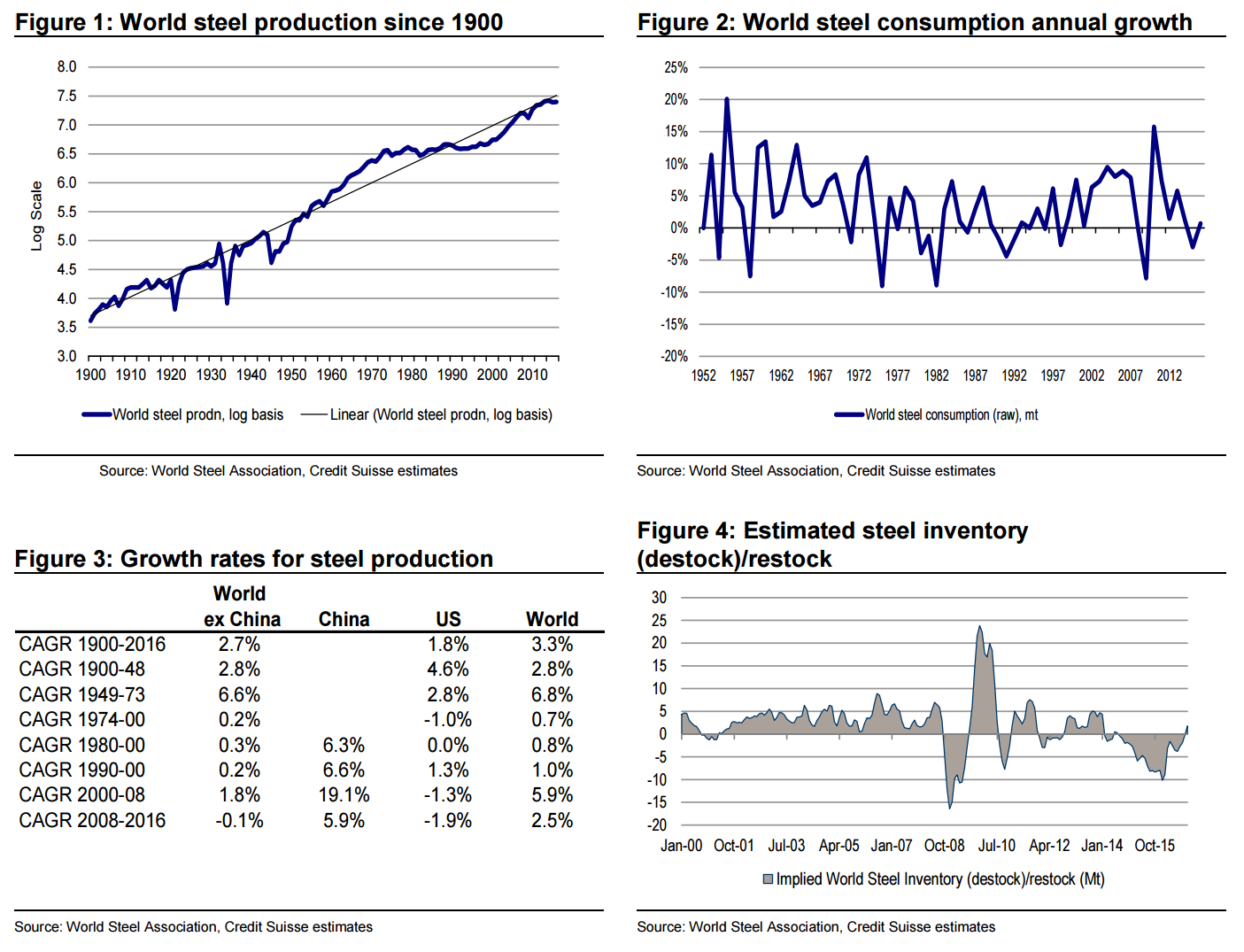
Now that FMG and RIO have provided financial information on realised prices & unit costs, we have been able to look at cash flow generation within their iron ore businesses. We have also been able to update our long run database for 2016 steel production. Before turning to iron ore, we would make the following observations about steel:
■ Long run, global steel production grows at an average of 2.5% p.a. Through time, growth rates can vary from trend in a substantial manner. From 1980 to 2000 steel output grew at just 0.8%. Subsequent to the financial crisis, steel has grown at long run trend rates.
■ Year to year, production (and consumption) are volatile and reflect variations in demand plus the vagaries of inventor cycles. We have come through a two-year destocking cycle which has weighed on apparent demand but we now look to be moving into a restocking phase.
■ CS forecasts world steel production to be up 2.7% in 2017 and in light of inventory cycles and latest China trends, this looks to be conservative.
China steel consumption up 8.9% in December (on pcp)
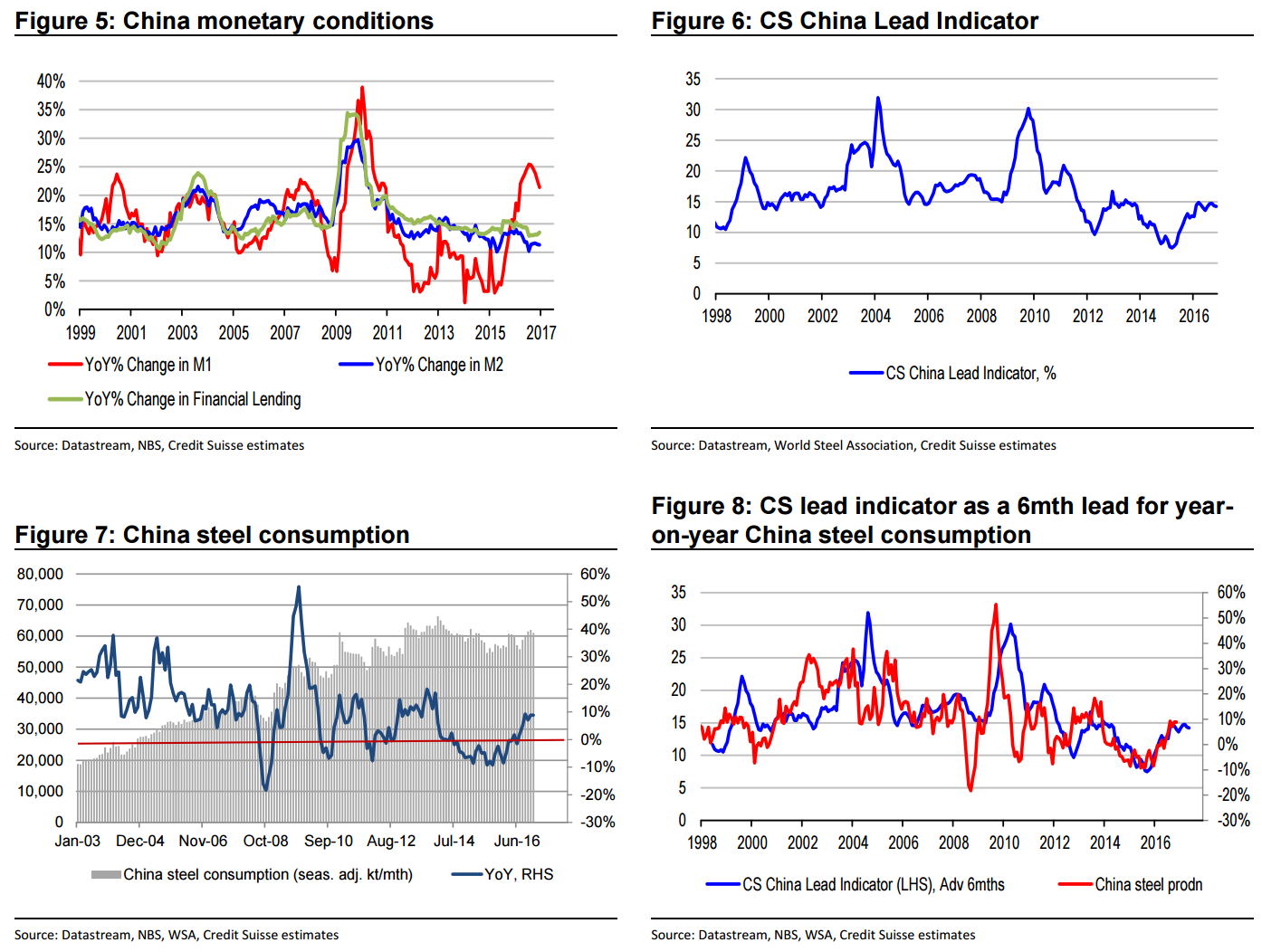
As we have noted, the latest China data releases point to a slowing in the rate of monetary expansion. Money growth is still expanding (Figure 5) but at a lower rate and this sees our lead indicator now flattening out (Figure 6). That said, our lead indicator is supportive of China steel production (and consumption see Figure 8) remaining at strong levels—and in the last two months it has run at around 840mtpa on a seasonally adjusted basis. Steel consumption in December was up 8.9% on previous corresponding period and is now approaching the high rates of late 2013 (Figure 7).
The current China steel output rate of 840mtpa compares to our house forecast of 2017 steel production of 812mt. At this stage, the risk to this forecast looks very much to be to the upside.
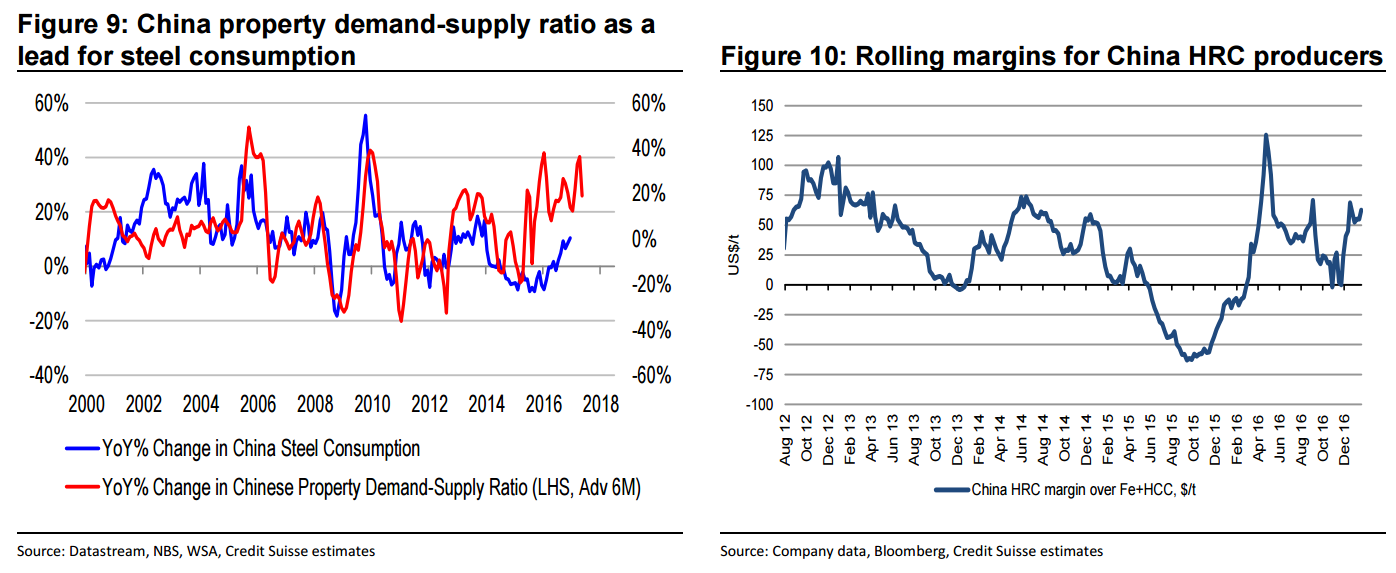
■ China continues to show a positive demand-supply ratio for property—i.e., demand as measured by property sales is greater than supply as measured by starts and property under construction (Figure 9).
■ China’s steel mills are making solid margins on most steel products (Figure 10) given improved China steel prices and lower metallurgical coal prices.
Furthermore, our Australian strategy team has noted that after the Chinese New Year, many Chinese provincial governments announced their infrastructure spending plans for 2017. This is an annual routine that not only reviews governments’ work in the prior year but also sets targets for the year ahead. China’s north-western province, Xinjiang, plans to invest Rmb1.5 tn in infrastructure this year, which is 50% more than what the province invested in 2016. China’s eastern coastal provinces, Jiangsu and Shandong, intend to spend Rmb5.3 tn and Rmb5.8 tn respectively in 2017, which will be 10-15% higher than the actual spend last year. The list of provinces that announced their infrastructure spending plans are in Figure 11. Some of the pick-up in infrastructure spend is because the provinces underspent more recently—and they are intending to catch-up to their targets made in recent five-year plans. For example, the five-year plan of the Xinjiang Province, targeted FAI growth of at least 12% p.a. from 2016-20 (failing this target will be politically unpalatable). Fixed asset investment in the province contracted by 5% last year so the 2017 announcement looks to be an attempt to catch-up to the plan. Further, there is always a distinction between what is approved and what is committed. While the national political transition in 2H17 and 1H18 provides further reason for the provinces to keep their economies running steadily by investing more in infrastructure, investors will probably remain skeptical until data confirms these spending plans.
Fair enough. As I’ve said many times, I expect much the same for infrastructure. I take those various leading indicators with a grain of salt, especially for property, which appears firmly in the regulatory gun now. Even so, I only expect it to slow not crash.
Note that steel consumption is still well short of its peaks and the coming property slowdown ought be enough to pull steel production back and trigger a reversal in the wild restocking pulse which is now far beyond those I’ve seen before. It’s also pretty obvious that the falling yuan played a big role in triggering it so ignoring that in your analysis does not make a lot of sense.
The fundamentals support iron ore in the $50 range right now, the rest is froth.
David Llewellyn-Smith is Chief Strategist at the MB Fund and MB Super. David is the founding publisher and editor of MacroBusiness and was the founding publisher and global economy editor of The Diplomat, the Asia Pacific's leading geo-politics and economics portal.
He is also a former gold trader and economic commentator at The Sydney Morning Herald, The Age, the ABC and Business Spectator. He is the co-author of The Great Crash of 2008 with Ross Garnaut and was the editor of the second Garnaut Climate Change Review.