
From The Australian:
A plan to slap a $2 billion annual mining tax on BHP Billiton and Rio Tinto in Western Australia would have the unintended consequence of delivering a windfall in GST funding to all the other states, new modelling suggests.
The study, to be released today by the Minerals Council of Australia, says the biggest beneficiary of West Australian Nationals leader Brendon Grylls’s policy would be NSW, which would collect $733 million in extra annual GST funding. Other states would share in the bounty, including Victoria ($574m), Queensland ($453m) and South Australia ($158m) and Tasmania ($47m).
Western Australia would lose $2.02bn — more than Mr Grylls’s proposed tax would generate — as the extra mining revenue was factored into the annual GST carve-up, thereby exacerbating the state’s current low share of the GST.
“WA would suffer a unique double whammy as a result of the Grylls tax,” says the report, which backs concerns previously raised by opponents of the policy about its GST impact.
“Its budget would be worse off and it would subject its economy to all manner of sovereign risk issues, with adverse impacts for regional employment and investment and to its reputation as a good place to do business.”
The report was written by a Minerals Council executive who worked at the Commonwealth Grants Commission.
It appears the MCA could not find a blood-sucking economics consultancy corrupt enough for this assertion so it’s simply produced it in-house. The last time I looked WA was in Australia thus it is a part of horizontal fiscal equalisation:
As in other federal or decentralised unitary countries, there are inherent fiscal disparities between the Australian states arising from differences in service costs and revenue raising capacities beyond the control of governments. Absent any policy action, these differences would imply that Australian citizens face different state tax burdens, and levels of service provision, depending on where they choose to live. Such differences in the tax/service mix become more extreme as fiscal disparities between states increase.
Through the Inter-government Agreement (IGA), the states and commonwealth have agreed that the states should have ‘comparable’ fiscal capacities so that Australians face a similar tax burden, and level of service provision, regardless of their state of residence. This objective, derived from notions of equity and the need to support a national market for the movement of goods, services, people and capital, has underpinned inter-governmental relations in Australia since federation. It is not unique to Australia, and is a central principle in inter-governmental relations in many countries.
The objective is implemented in Australia by distributing the GST revenue pool to the states in such a way that seeks to ‘equalise’ state fiscal capacities, that is, to take account of differences in service costs and revenue raising capacities beyond state control in such a way that gives states comparable fiscal capacities. This process is known as horizontal fiscal equalisation (HFE). It is administered by the Commonwealth Grants Commission (CGC) which uses a formula to calculate differences in service costs and revenue raising capacities across states. The Commission then converts these measures into ‘relativities’ that are applied to the GST pool each year following recommendations to the treasurer.
As a result of applying HFE to the distribution of the GST pool, states with relatively strong fiscal capacities – perhaps because they have a comparatively strong revenue base – receive less funding per person from the GST pool relative to states with weak fiscal capacity. Conversely, states with relatively weak fiscal capacities – perhaps because they have a comparatively weak revenue base – receive more funding from the GST pool per person in order to achieve equalisation of fiscal capacities. However, after equalisation, states have comparable fiscal capacities consistent with the overarching objective behind HFE.
Other anlayses have shown that WA will lose roughly half of the new levy to other states via lower than otherwise GST, which is not to say it would be lower, just less high as it adjusts post-boom.
WA certainly did see its GST revenue fall through the latter part of the boom as other revenue sources exploded:
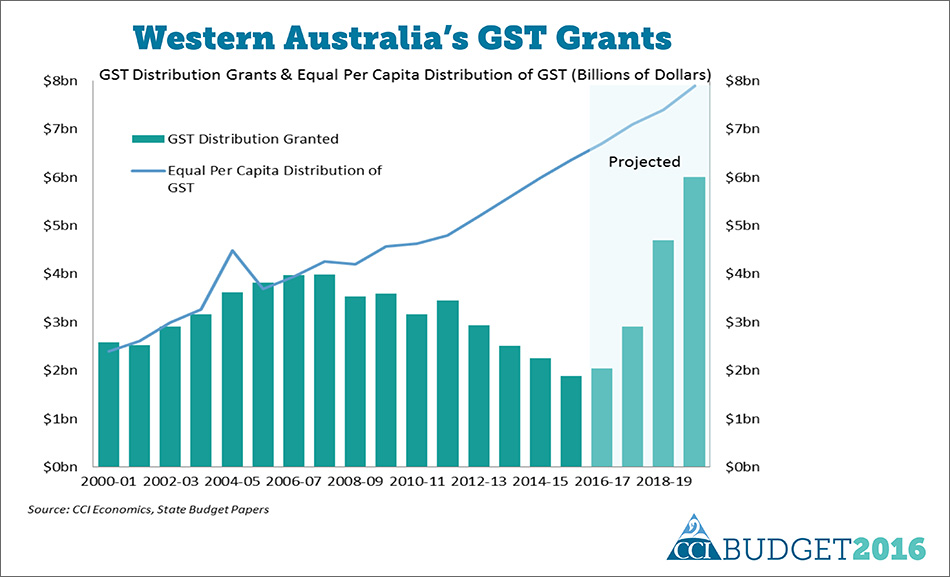
But, it received way more than it should until the GFC because the formula lags. You might want to criticise the slowness of the update but that’s to prevent short term phenomena from making revenues too volatile. Besides, everyone knows the formula lags so effective state government plans accordingly.
The fact is the WA state government did not do so so any shortfall now is not something other states should make up for. Moreover, it is an entirely separate question to whether or not miners pay their fair share. They don’t.
Today the miner’s Pilbara margins to costs are above 200%:
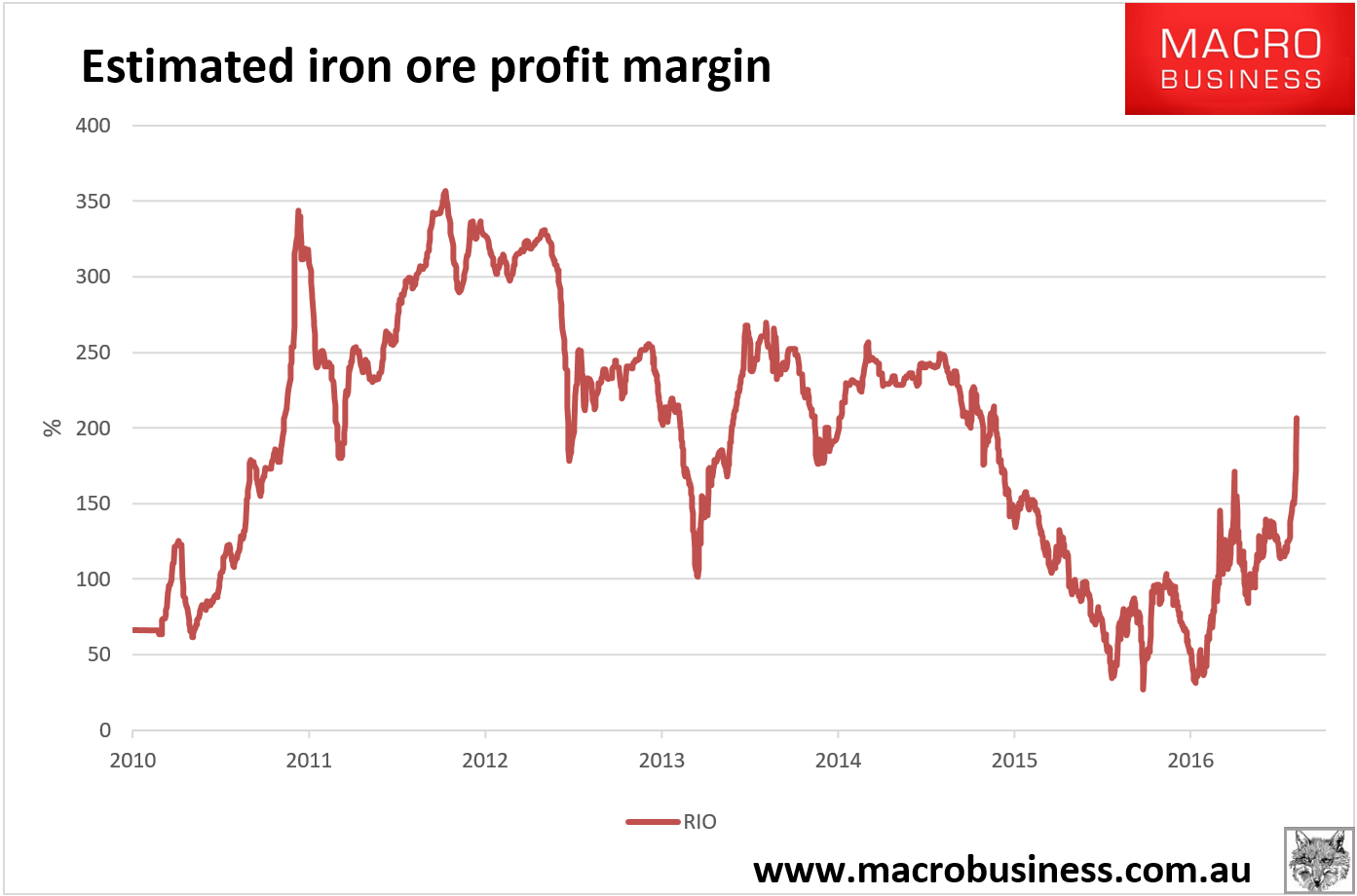
These are super profits and the people of Australia are being reamed for the privilege of developing their dirt. Remember that this is a non-renewing natural resource owned by the people of WA and Australia. It’s depleting nature needs to be reflected in the revenue being received by them and us. The tax take should be more like 80% (not kidding) such as it is in Norwegian oil.
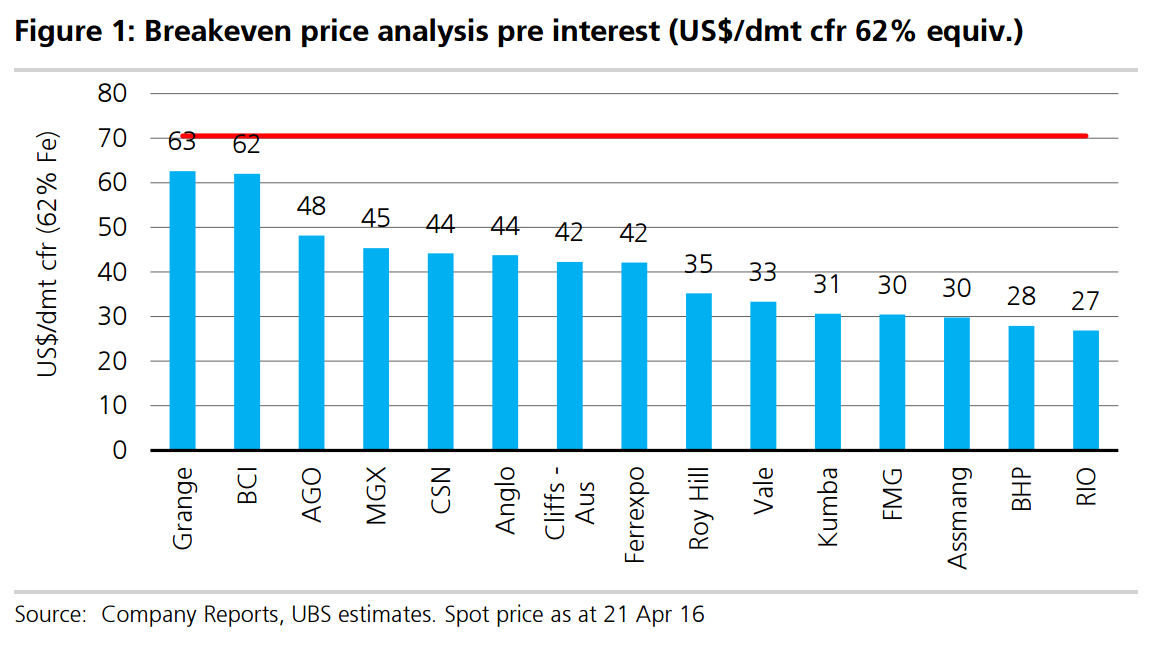
Of course affordability for the miners will change over time. And $2.50 is a better number for the levy to ensure that no investment is lost to Brazil in the future:
By the same token, Mr Grylls should also commit to paying down debt with the windfall (or invest it strictly in infrastructure or an SWF). If the debate is about equity over generations then the revenue should be accordingly distributed over time.
