On Friday, ABC News published an article revealing how almost all of Sydney’s trains are over capacity during the morning peak:
Sydneysiders may take some small comfort in the fact that it is not just their train route that is overcrowded during the morning peak, almost all of them are, new data has revealed.
The Bureau of Transport Statistics considers trains operating at 135 per cent of capacity to be “uncomfortable” and “behind schedule”.
But dozens of peak hour trains are running at well over 135 per cent capacity, with one — the Northern Line from Hornsby — reaching 180 per cent.
The Western and Illawarra lines are above 170 per cent…Transport Minister Andrew Constance said the increase in commuters was unprecedented.
“Over the last 12 months it’s off the charts in terms of increased patronage,” he said.
“The Government is going to have to act super quick…
Opposition transport spokeswoman Jodi McKay has called on the Government to outline a plan for the overloading of trains…
“We know that right across the network there is congestion, now we’ve said this to the Government, they know this.
“But they are moving too slowly to fix this.”
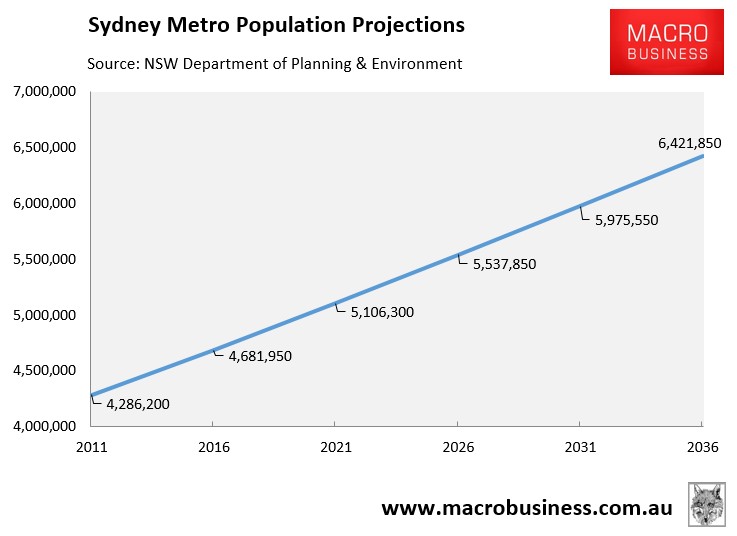
An “unprecedented” rise in patronage, hey. I wonder why that is? Could it be because of the circa 400,000 increase in Sydney’s population over the past five years, which is also projected to increase by another 1.74 million over the next 20 years, representing growth of around 1,650 people per week or 87,000 people per year, and is equivalent to adding 4.5 Canberra’s to Sydney’s population?
It’s the same situation in Melbourne where the train system has become “crush loaded” from incessant population growth (read immigration).
The road system, too, is struggling under the weight of the population influx.
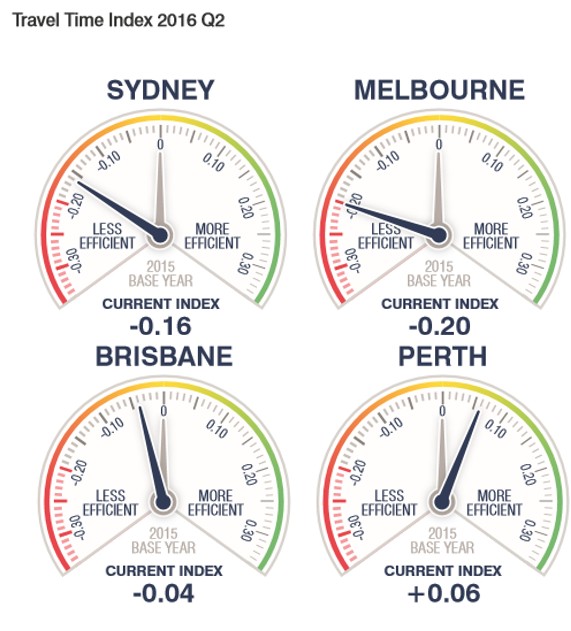
Infrastructure Partnerships Australia’s latest report found that road network “efficiency” has followed the level of population growth. Melbourne, the population growth leader, has suffered the greatest efficiency loss, followed by Sydney (see below graphics).
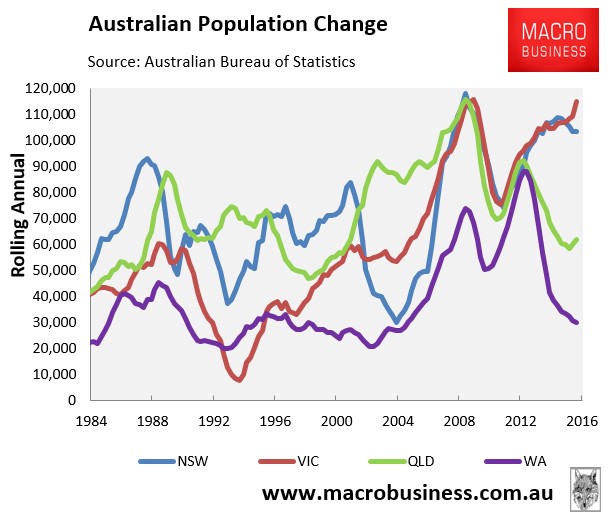
The Bureau of Infrastructure and Regional Economics also forecasts soaring costs of congestion, particularly in Sydney and Melbourne, over the next 15 years as their populations continue to boom:
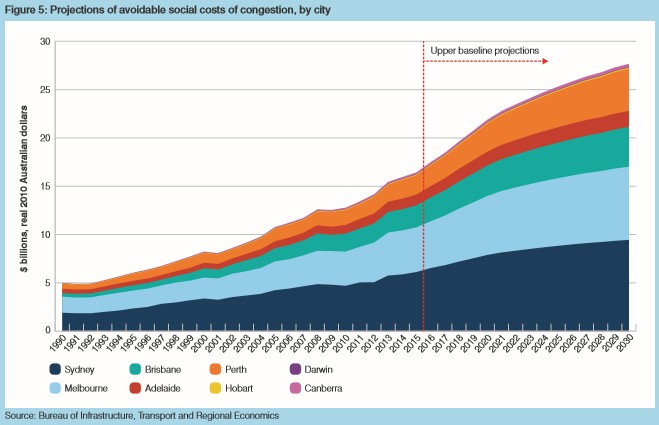
Blind Freddy can see the direct link between excessive population growth (immigration) and the strains on infrastructure, housing and living standards.
If all Australia is doing is growing for growth’s sake, pushing against infrastructure bottlenecks, diluting its fixed endowment of minerals resources, and reducing the living standards of the existing population, why persist with a mass immigration program?